

Why Groie, a B2B SaaS Product Marketing Studio, Works With Only 25 SaaS Companies a Year
Groie could probably work with more than 25 SaaS companies a year, but we choose not to. We don’t say this to sound “exclusive” or “snobbish”, and we definitely don’t enjoy telling companies no.
We do it because we’ve learned that there’s a point in any agency life, where taking on more clients starts affecting how deeply you can think about each one. And Groie was never built to be the kind of agency where a client becomes another account on someone’s dashboard. It’s always quality over quantity for us.
If we’re working with you, we want to know your product, your buyers, what sales is hearing, what isn’t converting, what your competitors are saying, what you’re launching next and where marketing is actually getting stuck. That takes time. More importantly, it takes attention. So we capped it at 25.
Because we’ve seen that somewhere between positioning workshops, sales calls, campaign reviews, product launches, SEO reports, Figma comments and the occasional “can we quickly redo the homepage?”, we learned something important: Good SaaS marketing gets worse when the people responsible for it are spread too thin. So we put a number on it.
And looking at it right now, that is the maximum number of companies we want Groie deeply involved with. And “involved” is the important word here. Because Groie was never built to become another agency sitting outside your business waiting for the next brief.
We built it to get inside the problem.
First, what exactly is Groie?
Groie is an Austin-based B2B SaaS product marketing studio founded by Aabha Tiwari and Anwesha Roy, bringing together 15+ years of experience across B2B marketing, positioning, growth and go-to-market (GTM). Today, we work with venture-backed SaaS businesses, from early-stage startups to Series A and beyond, alongside established enterprise brands across Atlanta, Boston, Washington DC, Virginia, Miami and Los Angeles, with our work extending to Australia, the Netherlands and London.
Our job sits somewhere between a product marketing team, a growth team and the people in the meeting who keep asking: But why would the buyer care? & How do we get them to care?
We work across positioning and messaging, GTM, product marketing, SEO and AEO, content, demand generation, paid acquisition, websites and sales enablement. It is a broad scope, but that is largely because the marketing problems we are brought in to solve rarely sit within a single channel.
A SaaS company rarely comes to us simply because it needs four blogs a month or another paid campaign. Usually, something larger isn't working the way it should.
- Traffic is growing, but conversion isn't
- Sales and marketing are describing the product differently
- The website has evolved into a list of features rather than a reason to buy
- A new product is ready to launch, but the GTM around it isn't
- Paid acquisition is bringing people in, but the journey after the click is weak
- Organic visibility is improving, but it isn't translating into meaningful pipeline
- Or sometimes, the product has simply matured faster than the marketing around it.
These problems cannot be solved by treating SEO, content, paid, product marketing and the website as separate work-streams. They are connected parts of the same marketing system. And that is usually where our work begins.
We don't start with “What do you need us to execute?”
One of the fastest ways for an agency to make money is to accept the brief.
- You want SEO? Sure
- LinkedIn? Sure
- New website? Sure
- Paid ads? Sure
- Eight blogs, twelve posts and a newsletter? Sure
The agency then brings a report to every meeting, filled with impressions, numbers and completed checklists, without anyone stopping to ask the more important question: Should all of this even exist?
Groie operates differently. Before execution, we want to understand the product, buyer, category, competitive landscape, current acquisition engine, sales process and what is actually stopping growth.
- Sometimes the answer is SEO
- Sometimes it is a new website
- Sometimes it is positioning
- And sometimes our answer is: Do not spend money on this yet.
That can make Groie slightly inconvenient to work with. We’re okay with that.
We would rather question the plan now than spend the next three months executing it, hit every deliverable on the checklist, and realise we were solving the wrong problem in the first place.
25 clients means we can actually know your company
Our fees are not based on how many deliverables we can fit into a month. A large part of what you are paying for is the quality of minds working on your account, how deeply they understand your business and how involved they remain in the decisions that follow.
Groie is still very founder-involved. Aabha and Anwesha are not names that appear on the pitch deck and disappear after the kickoff. We stay close to the strategy, positioning, campaigns, creative decisions and, quite often, the uncomfortable conversations around what isn't working.
That involvement has a limit. So does good expertise.
- There are only so many companies a senior product marketer can understand deeply
- There are only so many positioning problems you can properly think through at once
- And there is a point where adding another account doesn't increase capacity. It simply divides attention.
We don't want to cross that point. If Groie works with you, we want to know more than what is written in the brief.
Why did you build the product? Why are customers actually buying it? Where do sales lose deals? Which competitor keeps appearing? What objections come up on demos? Which features matter internally but mean very little to the buyer? What did you try six months ago that failed? What is changing in the product next quarter? Does sales describe the product the same way the CEO does? And why are those answers sometimes completely different?
That context changes the work. You cannot get it from a 45-minute monthly account-management call. They affect the positioning we recommend, the pages we build, the campaigns we run, the keywords we pursue and sometimes even the work we tell you not to do.
That is also why Groie isn't priced to be the cheapest marketing option in the room.
You're not paying us to produce the maximum number of assets for the lowest possible fee. You're paying for senior people to spend meaningful time understanding your business, making decisions with context and staying accountable for whether those decisions actually make sense.
For us, keeping that standard matters more than adding another logo to the client page. And 25 is where we've chosen to draw the line.
Because we have seen what happens when marketing finally becomes one system
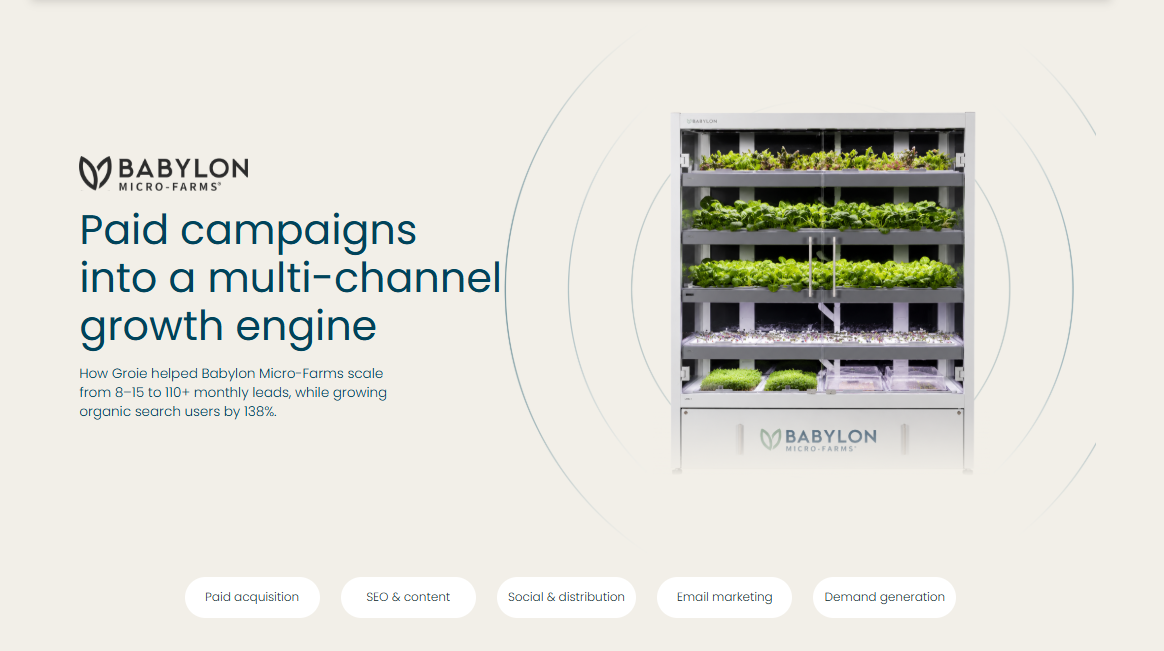
One of the best examples is Babylon Micro-Farms.
Babylon Micro-Farms is a Virginia-based indoor farming technology company bringing hydroponic growing systems into senior living communities, healthcare facilities, corporate spaces, universities, schools and other commercial environments.
When we started working together, there were marketing activities happening. Paid advertising was running, newsletters were going on time and the company had a good website with decent traffic. It had good brand visibility.
What it didn't have? A connected acquisition system. So we didn't simply add another channel. We started building the system around them.
- Paid acquisition
- SEO and AEO
- Content, website strategy and conversion
- Email nurture & social
- Sales enablement
- Campaigns for different ICPs
- Messaging around different use cases.
And a much clearer journey between someone discovering Babylon Micro-Farms and eventually becoming a lead.
The difference matters. After six months of working within their marketing system, Babylon Micro-Farms saw 88.1% growth in leads, followed by another 29.6% MoM increase in leads.
How did Groie do it? By connecting the different parts of marketing so they started working together, rather than operating as separate activities.
Sometimes the job is not generating demand. It is making a complicated product easier to buy.
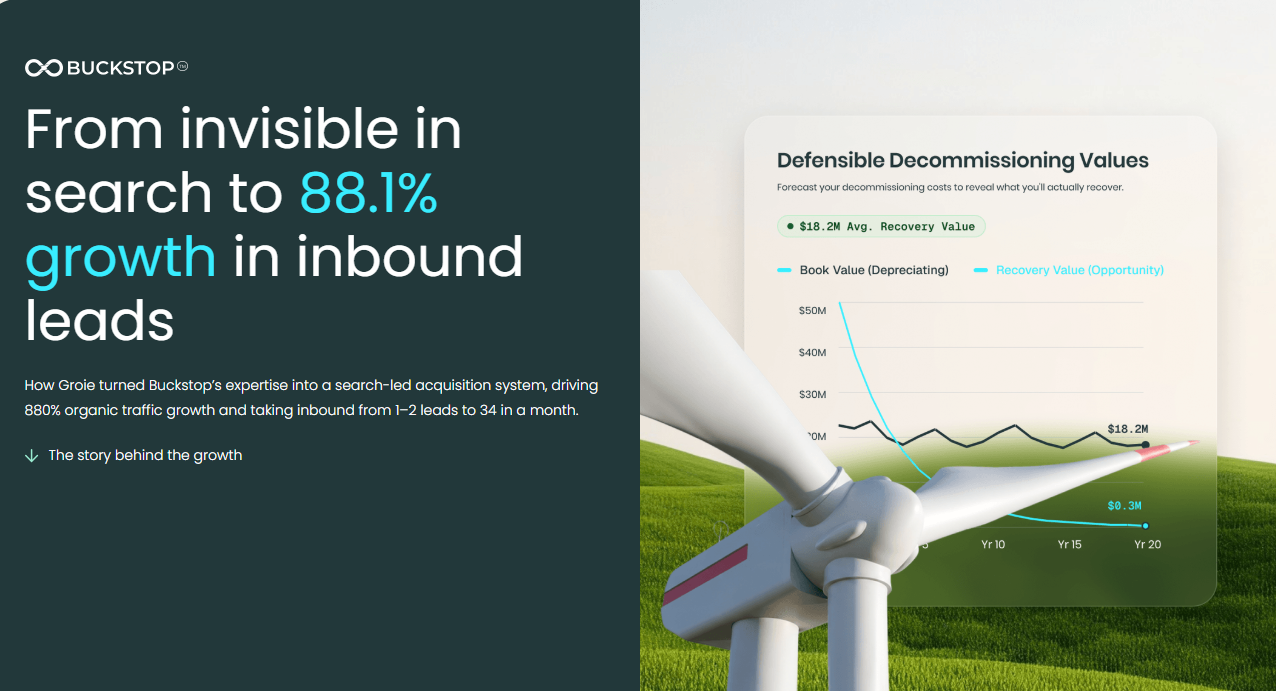
Take Buckstop.
Buckstop operates in renewable energy asset valuation, helping insurers, lenders, asset owners and other stakeholders understand residual value and asset economics.
That isn't exactly a product you explain with: “Save time. Grow faster. Unlock insights.” The buyer is sophisticated, technical subject matter, and the financial consequences of the information is real.
So the marketing has to earn attention differently. Our work has involved rebuilding how the product is positioned and presented across the website, creating solution and feature pages, developing SEO/AEO and thought-leadership around renewable energy asset valuation, supporting product launches and building campaigns around specific buyer problems.
The job isn't to make a complex product sound simple by removing all the complexity. But to make its value obvious without making it stupid or too complex for the ICP.
That distinction is a large part of product marketing that Groie does.
And sometimes the problem starts much earlier
We also work with SaaS companies where the biggest question isn't: How do we get more leads?
It is: What exactly should we be saying before we try to get them?
This is why positioning is such a large part of Groie's work. We have worked across pre-seed companies, growing SaaS businesses, YC-backed companies, Series A and later-stage organisations.
Their marketing budgets may be wildly different but the pattern is the same. Companies start adding channels before fixing the thing every channel depends on: Why should this buyer choose us? If that answer isn't clear, more distribution simply distributes unclear messaging faster.
So what happens when a SaaS company wants to work with Groie?

It would never be about convincing you to become a client or pushing a proposal across the table. The first conversation is usually much more diagnostic.
- How are you operating today, and who actually owns the marketing decisions?
- Are you PLG, sales-led, or an SLG but functioning like a PLG?
- Then, we see the website’s present content, category, current numbers and if you show up on search channels at all?
- What is translating into pipeline? Do you have organic growth support? How’s your organic or inbound growth?
- Where are customers coming from today? Which acquisition channels are working, which ones aren't, and which ones are you trying to scale?
- How mature is the company's marketing OS? Do positioning, product marketing, demand generation, sales and reporting actually work together?
We get into most of this on the very first call. And that conversation happens with one of Groie's founders, not a salesperson whose job is to get you to the proposal stage. Because we're qualifying the engagement just as much as you are.
We want to understand whether there is a problem we are genuinely equipped to solve, whether Groie is the right team to solve it, and whether the level of involvement the company needs matches the way we work. That's how we decide which companies eventually take one of Groie's 25 spots.
What makes us say yes?
We don't have a secret scoring sheet where you receive +4 points for ARR and lose two because your homepage says “revolutionize.” Although the second one is tempting.
Actually, we do not have a scoring sheet at all. (Should we have one?) It’s the conversation, the company’s genuine need to have its marketing problem solved, and the intent to let us help them.
Sometimes, during our scope walkthrough, we lay out the entire plan in detail, month by month, with each activity mapped out. They could take our plan and execute it on their own. But we know it’s the expertise that matters.
And honestly, when someone expresses during the conversation that they want the expertise Groie brings, that’s what compels us.
What makes us hesitate?
There are also engagements we know we're not particularly good for. If you need someone to quietly execute a predetermined checklist without questioning it, Groie will probably become annoying very quickly.
If marketing is expected to manufacture a pipeline while nobody wants to fix positioning, product communication, conversion or sales follow-up, we're probably not the right team. Aabha calls it, “Plan manufactured to fail, and Groie will not be part of this”
If the brief is essentially: “We need 100 qualified leads next month. Budget: $700.” We give the recommendations of other agencies that might be the right fit.
The limit forces us to ask a useful question before every engagement: Would we still want this company as one of our 25 if another opportunity arrived tomorrow? If the answer isn't yes, we shouldn't take the account.
Why not just become a 100-client agency?
Maybe one day Groie will become much bigger. The team certainly will. But client count isn't the number we're trying to maximize. Impact per account is.
Now, that impact could mean working across the entire marketing function or owning a specific part of marketing for an enterprise. The intent remains the same: whatever part Groie is working on should function better and contribute meaningfully to the business.
It also lets me stay close enough to the work to challenge things when I think we're solving the wrong problem.
That last part matters to me. We didn’t start Groie to eventually become completely removed from marketing. We started it to get more involved, because we genuinely like solving marketing problems.
Why does Groie function like that?
Because our founders saw how haywired the whole marketing functioning is, especially with SaaS, vendors, agencies and in-house teams.
Someone on contract doing SEO/AEO, a paid marketing agency (charging fees per led generated), a freelance designer, then another development and outbound agency, CRM consultant and six different slack channels and a POC from the company handling them all (and losing their minds).
And the founder in the meeting was still thinking, "Where are the leads, am I even making money?” The individual activities may all be fine.
The problem is that nobody owns how they work together. That is the gap Groie is trying to occupy.
Is Groie the right B2B SaaS product marketing studio for you?
Maybe. We deliberately don't want the answer to always be yes. But if you have a strong SaaS product and marketing feels fragmented, unclear, inconsistent or simply behind where the company has reached, that is usually where our best conversations begin.
- Maybe your product has grown faster than its positioning
- And your website no longer represents what you sell
- Traffic is good but pipeline is a problem
- You are going upmarket or entering a new market
- You do not have a marketing engine
- And you know for sure something is not working
That gets us excited to start a conversation.
Think your SaaS company should be one of them?
Apply to work with Groie. We'll look at your product, current marketing and growth problem before we talk about scope. If we think Groie can genuinely move it forward, we'll tell you how.
And if we don't? We'll tell you that too.

Author
Aabha Tiwari
Founder, Groie.
