
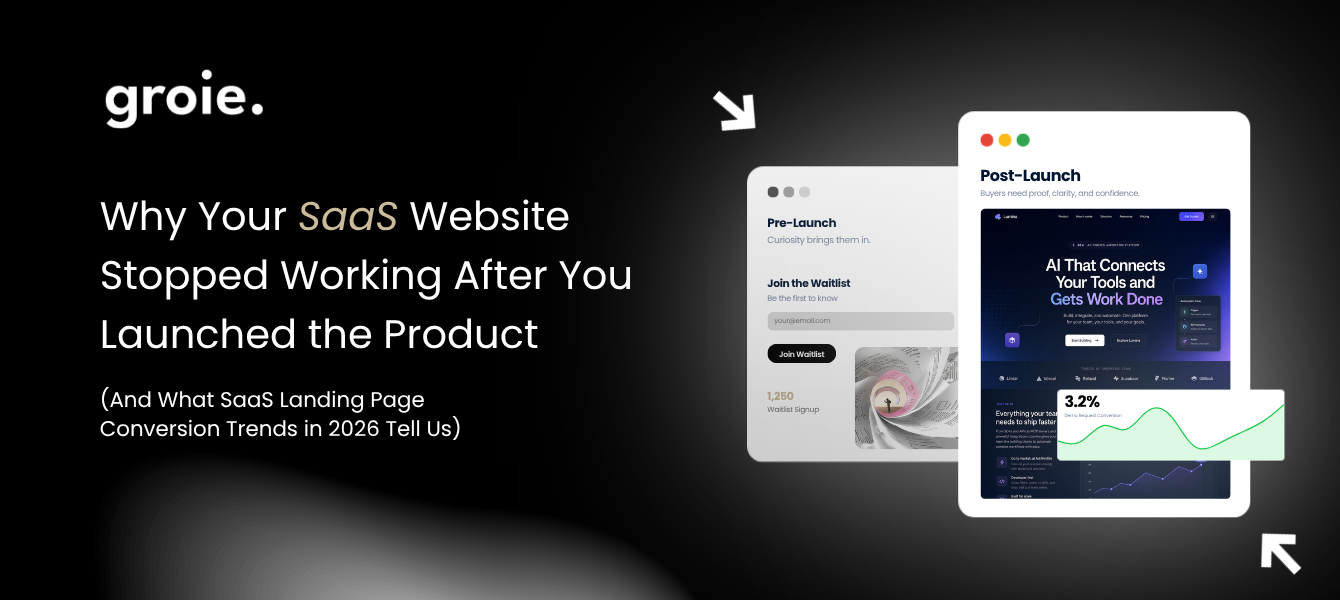
Why Your SaaS Website Stopped Working After You Launched the Product (And What SaaS Landing Page Conversion Trends in 2026 Tell Us)
You spent months watching the waitlist numbers climb. The landing page was pulling in signups from LinkedIn posts, Product Hunt teasers, and the occasional podcast mention, and demo requests were coming in fast enough that you started worrying about your ability to keep up. Then you launched. The product went live, you flipped the site over from waitlist mode to a full marketing presence, and within a few weeks the pipeline slowed to a trickle.
This pattern has become increasingly common as SaaS landing page conversion trends in 2026 continue to shift. Buyers now expect stronger proof, clearer positioning, and deeper product validation before they ever request a demo. The traffic often looks similar in analytics, and the bounce rate is close to what it was before, but the meaningful conversions quietly disappear.
This happens to a lot of founders in the 6 months following a general availability launch, and the reasons are almost always structural rather than tactical. The website that worked before launch was doing a fundamentally different job than the one you need now, and unless you rebuild around that shift, tweaking headlines and testing button colours will not move the numbers back.
What the pre-launch site was actually selling
Before launch, your site had one job: convert curiosity into a low-friction commitment. The people arriving on that page were early-stage buyers in the loosest sense of the word. They were interested in the category, curious about your specific take on it, and willing to hand over an email address in exchange for the promise of early access or a founder update. The site succeeded because it made a promise and asked for very little in return. Nobody was evaluating your product on that page they were deciding whether the story was interesting enough to keep tabs on. Then you launched, and the story became a product.
Suddenly the same site is being visited by a different kind of person. This visitor is not curious in the abstract sense. They are looking for something specific, they have a budget or an approval process behind them, and they are quietly comparing you against two or three alternatives they already have open in other tabs.
According to Gartner's research on the B2B buying journey, buyers now spend roughly 27% of their total purchase time doing independent online research more time than they spend meeting with any single vendor across the entire buying cycle. That research happens on your website, and if the site is still built to capture curiosity rather than answer buyer questions, the visitor leaves without ever appearing in your CRM.
What actually breaks
Three things tend to go wrong in the first few months after launch, and they compound on each other.
The first is that the messaging is still written for people who already believe the category matters. Pre-launch copy assumes shared context, which works when your audience is arriving from a founder essay or a carefully targeted LinkedIn post. Post-launch traffic comes from search, referrals, outbound campaigns, and comparison research. Those visitors need the site to explain what problem you solve before they'll care how you solve it.
Forrester and similar analyst research has consistently shown that B2B buyers form initial vendor impressions within seconds of landing on a website, and unclear positioning remains one of the fastest ways to get eliminated from consideration. The average B2B SaaS website converts somewhere between one and 3% of visitors into leads, and weak messaging is often the biggest reason why.
The challenge becomes even bigger for SaaS founders trying to balance product growth with fundraising. Many teams unintentionally optimise their websites for investor conversations instead of customer conversations. That fundraising goals misalignment creates messaging that sounds compelling in a pitch deck but leaves buyers wondering whether the product actually solves their problem.
The second failure is the absence of buyer-grade proof.
A waitlist page can get away with a founder photo and a bold claim. A live product cannot. Buyers evaluating SaaS tools want to see logos of companies like theirs, quantified outcomes from real customers, and enough specificity in case studies to believe the results are repeatable. Research from Trust Radius has found that buyers consult multiple independent information sources before making a software decision, with customer reviews and case studies consistently ranking among the most trusted.
One of the clearest positioning weak proof 2026 patterns we're seeing is that companies invest heavily in redesigning their websites while leaving the underlying evidence unchanged. Beautiful pages cannot compensate for missing customer proof.
The third failure is architectural.
The pre-launch site was a linear funnel that pushed everyone toward one action, usually an email capture. The post-launch site needs to serve multiple visitors simultaneously. A product manager evaluating fit, a technical lead validating integrations, a founder comparing pricing, and an existing customer looking for documentation are all landing on the same website with entirely different questions.
The information architecture that worked when everyone wanted the same thing simply collapses under the weight of that complexity.
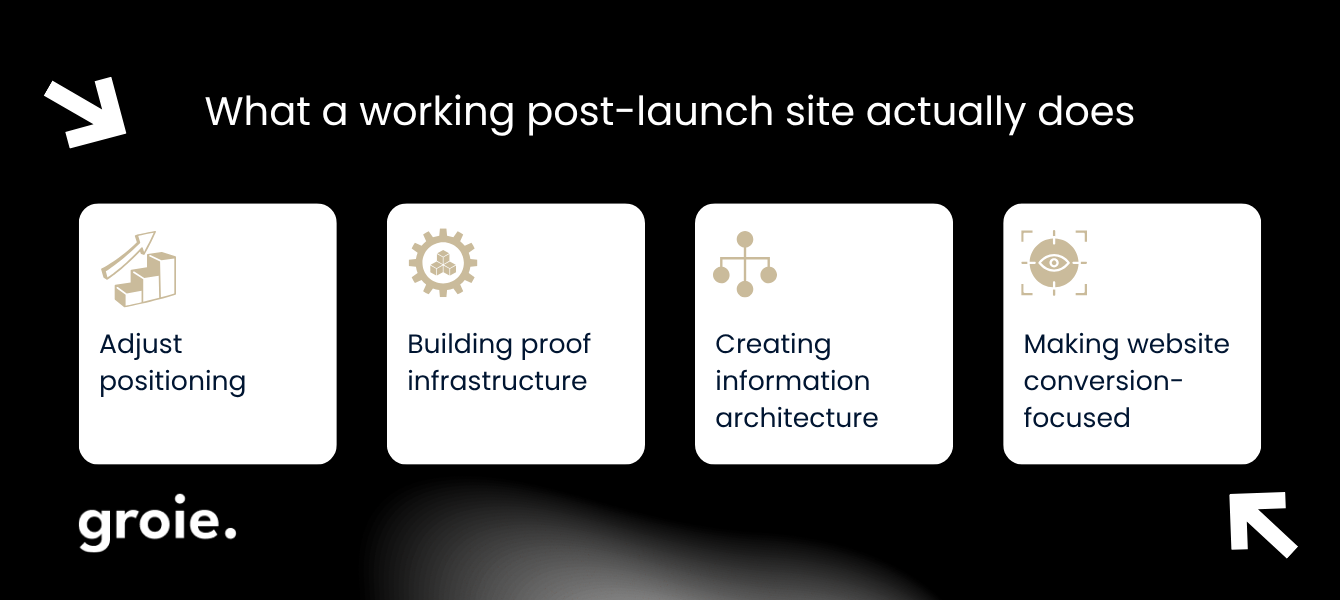
What a working post-launch site actually does
The rebuild is not primarily about design polish, and adding more pages will not fix it either. What matters is recognising that your website is now doing sales work for a buyer who will make most of their decision before you ever speak to them.
The first job is positioning that lands in the visitor's language rather than in yours. This is exactly where a SaaS positioning agency or a website and positioning agency for SaaS creates leverage. The problem usually isn't poor design. It's a disconnect between how founders describe their product and how buyers search for solutions.
That usually means replacing feature-led headlines with outcome-led messaging tied to a specific buyer, removing internal category jargon, and being unambiguous about who the product is for and who it isn't.
In our experience working with pre-seed and Series A SaaS founders at Groie, the companies that recover fastest after launch are the ones willing to narrow their audience on the website, even if the product itself can serve a broader market later.
The second job is building proof infrastructure.
This includes case studies with real numbers and named customers wherever possible, integration and security pages that answer procurement questions without requiring a sales call, and pricing pages that reduce uncertainty instead of creating it. Recent buyer research from Gartner Digital Markets and G2 consistently shows that visible pricing improves the quality of inbound demo requests because it filters out poor-fit visitors while signalling confidence to qualified buyers.
The 3rd job is creating information architecture that respects the fact that different visitors need different paths through the site. Good architecture gives product evaluators, technical validators, decision-makers, and existing customers clear journeys without turning the website into a maze. The best-performing teams treat these journeys as hypotheses that can be tested, not assumptions that never change.
Most importantly, your website should function as a conversion-focused website, not simply an attractive online brochure. Every page should reduce friction, answer objections, build confidence, and make the next step feel obvious.
It's equally important to set realistic SEO timelines. Stronger positioning and clearer messaging can improve conversions almost immediately for existing traffic, while organic search performance compounds over time. SEO and conversion optimisation work best together not as separate initiatives competing for attention.
Where Groie fits
The websites that stop working after launch are almost always victims of the same mistake: the founding team is so close to the product that they don't notice the audience has changed underneath them.
Fixing that requires stepping outside the founder narrative long enough to see the website the way a sceptical buyer does. Only then can you rebuild the messaging, proof, and structure around what that buyer actually needs to make a decision.
Groie is an agency for SaaS companies that helps founders rebuild websites around positioning, buyer psychology, and conversion rather than aesthetics alone. Through ROI-driven website design services for SaaS companies, we help early-stage teams align messaging, proof, and information architecture so their website starts generating qualified pipeline again instead of simply attracting traffic.
If your website is quieter than it was six months ago and you can't quite figure out why, chances are it isn't because your product got worse. Your buyers simply changed. Think your website might be sending the wrong message? Let's review it together. Book a free website strategy call with Groie and discover what's preventing your site from converting qualified buyers and what to fix first.
Frequently Asked Questions
Why does my SaaS website stop converting after product launch?
Most SaaS websites stop converting after launch because they continue speaking to early adopters instead of active buyers. The messaging, proof, and user journey that worked for waitlist signups rarely answer the questions prospects have when they're comparing vendors.
What causes landing page conversion drop in B2B SaaS post-launch?
The biggest reasons are unclear positioning, weak customer proof, poor information architecture, and messaging that focuses on product features instead of buyer outcomes. As traffic shifts from referrals to search and outbound, these weaknesses become much more visible.
Is it positioning, copy, or design when website conversions stall?
Positioning usually comes first. If visitors don't immediately understand who the product is for and why it's different, better copy or a cleaner design will only deliver marginal improvements. Design should reinforce positioning—not replace it.
How often should a SaaS website be updated after launch?
Most SaaS companies should review their messaging, proof, and conversion paths every quarter. Major updates are often necessary whenever the product evolves, a new customer segment is introduced, or the go-to-market strategy changes.
What are signs your SaaS website needs a positioning refresh instead of a redesign?
Common signs include steady traffic with declining demo requests, prospects repeatedly asking what your product actually does, high bounce rates on product pages, or sales teams spending most of their calls explaining information that should already be clear on the website.
How long does it take to fix a SaaS website that stopped converting?
A positioning-led website overhaul typically takes between four and eight weeks, depending on the size of the website and the availability of customer proof. Messaging improvements can increase conversions quickly, while SEO improvements generally take several months to compound.

Author
Aabha Tiwari
Founder, Groie.
