The Brand vs Performance Trade-Off: Where to Put Your First $50K in SaaS Marketing
There's a moment for every early-stage SaaS founder when the marketing budget goes from theoretical to allocated, and the first real question is where to spend the first $50K. The answer they hear back from most people is confident, usually branded to whoever is answering, and usually wrong.
The confidence comes from a framing problem. Applying a brand-versus-performance split or go-to market startegy vs marketing strategy split to the first $50K assumes a company at least two years further along than a pre-seed or Series A team actually is, and the numbers get worse the earlier you apply them.
Why the Brand-Versus-Performance Framing Fails Early
Both terms carry assumptions that only hold at scale. Brand marketing at a mature B2B SaaS company means out-of-home, sponsored podcasts, category studies, and the LinkedIn B2B Institute referencing your name in a report. Performance marketing at that scale means paid search, paid social, and outbound at volume, all with predictable payback windows and an optimisation team behind them.
Neither of those things exists yet at pre-seed. The brand you have is whatever your founder says on LinkedIn on a Wednesday afternoon. The performance you have is a hand-built LinkedIn campaign spending $2K a month on a message you rewrite every fortnight. Applying a big-company split to that context is like applying a Series C ops playbook to a five-person team.
What Actually Changed in 2026
The SaaS growth marketing trends of 2026 have made this worse. Paid channels are more expensive year over year, with LinkedIn CPMs up meaningfully since 2022 and Google search now competing with AI Overviews for the click before it happens. Organic content, the cheapest channel of the previous decade, has been re-priced by AI Overviews and the helpful content signal. Ahrefs put click-through loss on the top organic result at around 34.5% when an Overview is present, and the number has held.
For B2B specifically, the 95:5 rule from the Ehrenberg-Bass Institute and the LinkedIn B2B Institute has been telling the whole story for a decade. At any given moment, only about 5% of your total addressable market is actively in-buying-mode. The other 95% will be, eventually. Performance marketing captures the 5%. Brand builds recognition for when the 95% becomes the 5%. If you have no brand at all, your capture rate on that future 95% is close to zero when they show up, because they will not remember you exist.
Where the First $50K Actually Goes
For a pre-seed to pre-Series A B2B SaaS company, an honest split of a first $50K quarterly budget looks nothing like the ratios an agency will quote. Roughly 40% goes into positioning and messaging work. This is the layer both brand and performance are built on, and it decides whether the money spent on either category returns anything. A Wynter survey of B2B SaaS buyers found that 76% rated clarity of the offering as the single most important factor when evaluating a vendor's website. CB Insights has documented that 38% of failed SaaS startups cite customer misunderstanding of value as a primary cause. Both stats say the same thing in different words. The message has to work before the media does.
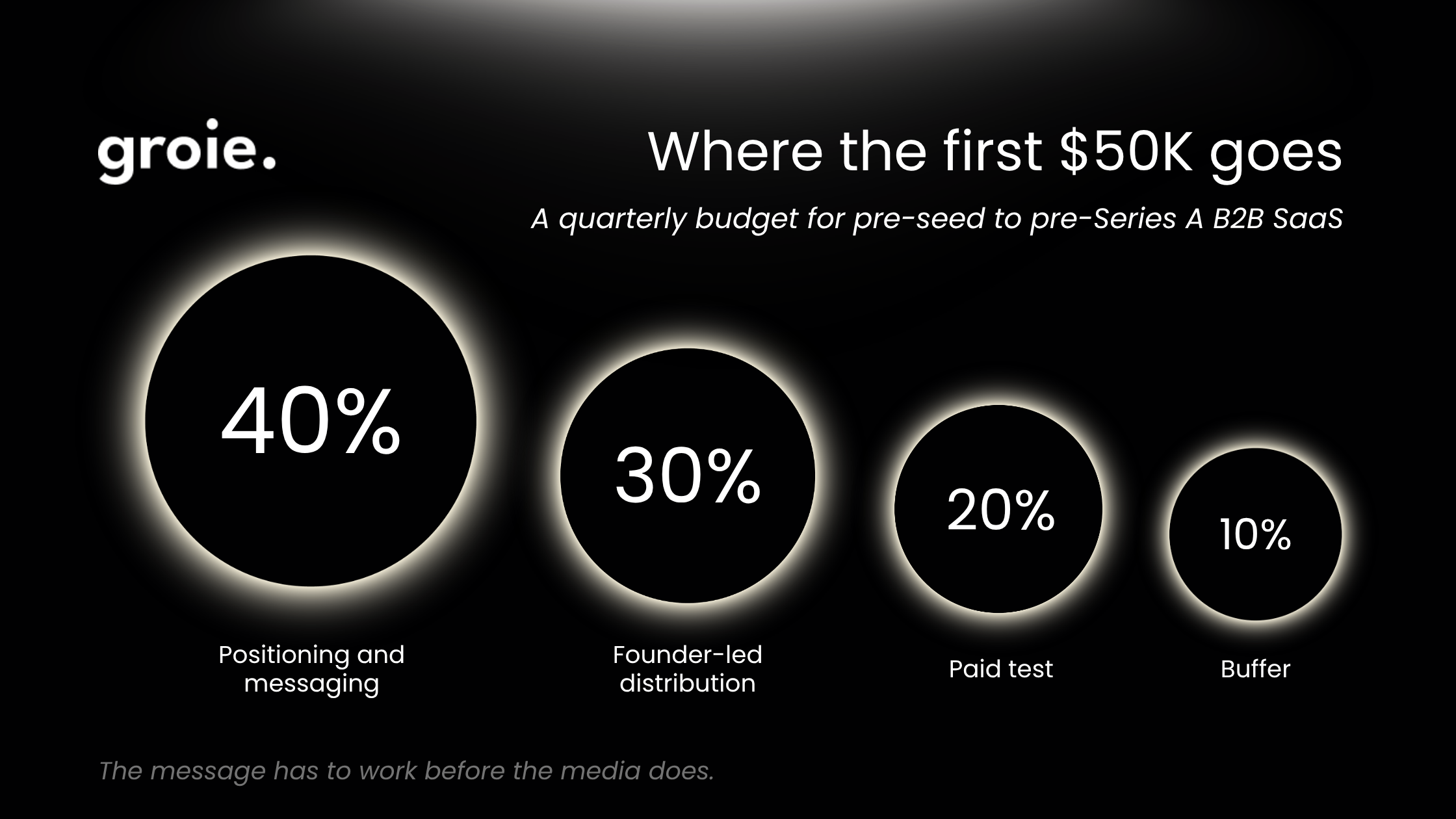
Roughly 30% goes into founder-led distribution and owned channels. Founder LinkedIn posts, a company podcast if the guest access is there, a newsletter with three-figure subscribers that becomes four-figure subscribers over a year. This is what actually functions as brand marketing at this stage.
Roughly 20% goes into a small, tightly instrumented paid test. LinkedIn ads to a narrow ICP, retargeting on Google, one channel at a time until it either produces qualified pipeline or gets shut off. This is your performance layer, kept small on purpose.
The final 10% is buffer. It gets spent on the thing you learn mid-quarter that changes the plan.
Marketing Strategy vs Go-to-Market Strategy
A quick clarification. Marketing strategy vs go-to-market strategy is a distinction most early-stage founders skip, and it matters when you are deciding what the first $50K funds.
Go-to-market strategy sits above marketing. It answers who you sell to, what problem you solve for them, and how you reach them at scale, and it covers sales motion, pricing, packaging, and channel selection. Marketing strategy is the execution layer inside GTM. It answers how the story gets told, what assets get built, and which channels get tested. When you frame it as go-to-market strategy vs marketing strategy, the ordering becomes obvious: one sets the direction, the other executes against it.
A SaaS GTM without a marketing strategy underneath it produces founder-shaped growth that stalls between $30K and $50K MRR. A marketing strategy without a SaaS GTM above it produces campaigns that generate leads sales cannot close. Both are common at pre-seed, and both are variations on the same underlying gap: no one owning the layer that decides what the message is and who it is for.
Groie is a SaaS B2B Marketing Agency for pre-seed to pre-Series A B2B founders. We sit at the intersection of positioning, ICP, and messaging, which is the 40% of the first $50K most founders under-fund. When that layer is clear, the remaining 60% pays back. When it is not, the performance spend and the brand spend both bleed, and no paid acquisition agency retainer will fix it.
If you're deciding where your first marketing dollars should go, book a strategy call with Groie. We'll help you prioritize the investments that build pipeline instead of burning budget.
FAQs
Should early-stage SaaS spend on brand or performance marketing first?
Neither in isolation. At pre-seed, the highest-return work is positioning and messaging, since both brand and performance amplify whatever message is already in place. Once the message is tight, splitting spend between founder-led distribution and small, contained paid tests tends to compound faster than pouring the same dollars into either category alone.
How should a SaaS founder split a $50K marketing budget?
For a pre-seed to Series A B2B SaaS company, the rough split is 40% on positioning and messaging, 30% on founder-led distribution and owned channels, 20% on a tightly instrumented paid test, and 10% as buffer. The exact ratios move with funnel maturity, but the ordering rarely changes.
What's the right brand-to-performance ratio for pre-seed to Series A SaaS?
At this stage, the brand-to-performance ratio is less useful than the message-to-media ratio. Roughly 60% of a first budget funds the message layer (positioning, narrative, founder distribution) and 40% funds media (paid tests, retargeting). The Binet-Field 60:40 principle still holds, only the labels shift for the earlier stage.
How long before performance marketing pays back for B2B SaaS?
For B2B SaaS, paid acquisition payback typically lands between 12 and 18 months at seed to Series A, longer for enterprise motions. Anything meaningfully faster usually means a self-serve motion or a viral loop underneath. Anything much longer than 18 months means the paid channel is subsidising a broken conversion path further down the funnel.
Can brand marketing show measurable ROI for a seed-stage startup?
Yes, though the metrics are different. At seed stage, brand ROI shows up in direct traffic growth, branded search volume, inbound demo requests without an attributable touchpoint, and sales cycles shortening because prospects arrive already familiar with the product. It does not show up as a click-through rate in an ad account.
What's the minimum monthly paid budget to test SaaS performance marketing?
For a serious test, plan on $5K to $8K per month per channel, for at least three months. Below that, statistical significance is hard to reach and the test tells you almost nothing. If a paid acquisition agency is running below this floor and promising results, they are usually selling reach reports rather than pipeline.

Author
Aabha Tiwari
Founder, Groie.



.png)