Why Inbound Stalls for Early-Stage SaaS (and what founders misdiagnose as bad SEO)
You open the analytics tab on a Tuesday morning, coffee still hot, and the traffic line looks the same as last month. Same as the month before. Sessions holding steady around a number you've quietly memorized, keyword rankings creeping up in ways that never seem to translate into anything that pays your engineers. The signup form sits there, patient as ever, waiting for the demo requests that were supposed to arrive once the blog got going and the site got faster and the meta descriptions got tightened. Somewhere between the fourth and fifth month of this, most early-stage founders start blaming SEO. Understanding why inbound stalls for early stage SaaS almost always begins by looking somewhere other than search.
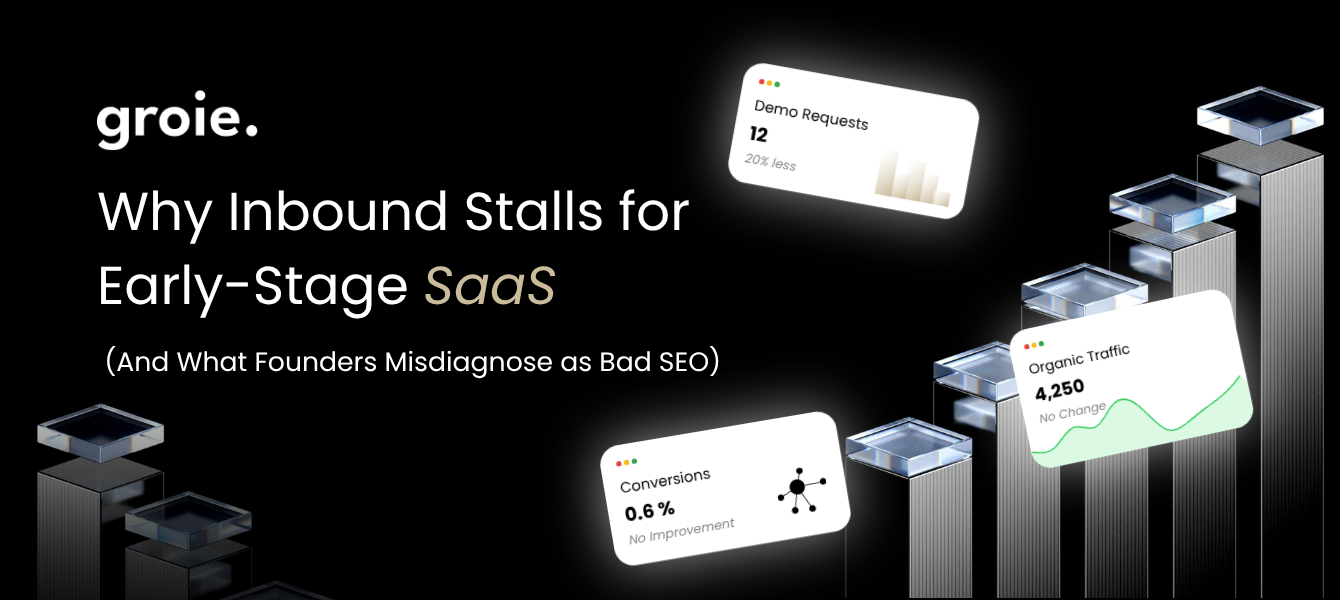
The inbound stall pattern: traffic flat, leads flatter, demos non-existent
The pattern shows up across dashboards in recognizable ways. Organic sessions plateau somewhere between two and eight thousand monthly visits, which feels like enough traffic to matter but never seems to convert into anything meaningful. Bounce rates on the blog look fine. Time on page looks fine. Rankings for a handful of terms climb into the top ten and stay there. And still, the leads don't follow. Demo requests trickle in at rates that were acceptable six months ago and are quietly concerning now. Product-qualified signups come from LinkedIn or from customers referring other customers, rarely from search.
This is the stall. It doesn't announce itself. It settles in quarter by quarter until you're sitting in a board meeting explaining why CAC on paid keeps climbing while inbound holds flat. Nothing looks broken. Everything looks disappointing. The instinct at this point is to fix whatever seems most fixable, which is where the misdiagnoses begin.
Misdiagnosis #1: 'Our SEO is bad' (when it's actually positioning)
The first instinct is to blame the SEO itself. Rankings feel like the most measurable part of the machine, so when leads dry up, rankings become the suspect. Founders will pull up Search Console, look at impressions and clicks, and start rewriting title tags or hiring another agency to run another technical audit. What they usually find, if they look closely enough, is that they're ranking for terms nobody in their ICP is actually searching. Or they're ranking for terms buyers search when they've already decided on a category the product doesn't compete in cleanly.
This is a positioning problem wearing an SEO costume. When the words on your homepage describe what the product does but don't clearly signal who it's for or what problem it solves better than the obvious workaround, keywords lose most of their converting power. Search brings the right people to a story that doesn't quite land. Traffic goes up. Nothing else moves. Early-stage SaaS SEO fails most often at this exact layer, before a single blog post is written, and no amount of technical optimization rescues messaging that hasn't been sharpened first.
Misdiagnosis #2: 'We need more content' (when intent isn't matched)
The second instinct is to publish more. If ten posts didn't work, twenty will. If twenty didn't work, forty. Content calendars balloon, freelancers get hired, and the blog fills up with articles that all sound reasonable in isolation and add up to nothing in aggregate. Traffic climbs a little. Leads stay flat.
The missing piece is intent matching. A comparison post targeting a search where the reader is deep in evaluation mode does entirely different work than a top-of-funnel explainer for someone who just learned the category exists. Most early-stage SaaS content sits in an uncomfortable middle where it's too educational for readers ready to buy and too promotional for readers still learning the space, which leaves it generic enough to rank for neither audience with any real conviction. Volume compounds the problem rather than solving it. The SaaS SEO content trends in 2026 are moving hard in the opposite direction, toward fewer posts that land precisely against a defined stage of intent and away from calendars stuffed with mid-funnel filler.
Misdiagnosis #3: 'Our website needs a redesign' (when funnel logic is missing)
When SEO and content have both been declared innocent, the next suspect is the website itself. The design feels dated. The hero copy needs work. Someone on the team noticed the pricing page hasn't been touched since launch. A redesign gets scoped. Six weeks turn into fourteen. The new site launches, looks beautiful, and converts about the same as the old one, which is a special kind of quiet disappointment.
Redesigns rarely fix inbound stalls because the stall isn't a visual problem. The site works fine as a surface. What's missing underneath is funnel logic. Where do visitors from a comparison keyword actually go? What does a reader coming from a top-of-funnel post see next? Which CTA fires on which page for which persona, and does the sequence build enough trust to justify the demo ask? Most early-stage SaaS websites are structured like brochures with a signup form bolted on, and a beautiful brochure still converts like a brochure. A rebuild without funnel architecture underneath it is expensive rearrangement of the same problem.
Misdiagnosis #4: 'We should switch to outbound' (premature)
By month twelve of flat numbers, outbound starts to look attractive. Cold email feels controllable. Cold outreach has a spreadsheet. SDR hires promise pipeline you can forecast in a way inbound never will. Founders start telling investors that inbound isn't the right channel for their stage and shift budget accordingly, sometimes cutting the content program entirely.
The move is often premature. Outbound works when you have a tight sense of who buys, why, and what triggers the buying moment. If inbound stalled because positioning was fuzzy, outbound will stall for the same reason with faster feedback loops and higher costs per touch. The teams that succeed with outbound at the early stage almost always had inbound working first at whatever small scale, because inbound forced them to articulate the buyer clearly enough to write cold email that lands in a real person's inbox and gets a reply. Switching channels doesn't repair the underlying diagnostic problem, it just moves the symptom to a different line item on the budget.
What's actually happening: the 3 inbound conditions early-stage SaaS skip
Underneath all four misdiagnoses is the same structural gap. Inbound as a channel requires three conditions to compound, and most early-stage SaaS teams tend to skip the first two entirely.
First, positioning the buyer recognizes as their own problem, expressed in language they'd actually use when describing that problem out loud. Second, an intent map that connects specific searches to specific stages of buyer readiness, with content built deliberately for each stage rather than for a monthly quota. Third, distribution that gets that content in front of the right readers early enough for search engines and human referrers to start trusting it as a source.
Most early-stage teams start at the third condition, publishing steadily and hoping search takes care of the rest. When it doesn't, they blame the channel. SEO for product-led growth SaaS in particular fails when teams treat organic traffic as a passive outcome instead of a compounding asset that needs early founder-led distribution to gain momentum. The channel doesn't compound on autopilot at the early stage. It compounds when the conditions underneath it are properly set up.
The real fix order: positioning → intent map → content → distribution
Positioning comes first because everything downstream inherits its clarity or its confusion. Get the ICP language right and every keyword becomes easier to choose, every post gets easier to write, every CTA finds its place more naturally. Skip it, and no amount of technical SEO recovers what was lost at the top of the funnel.
Intent mapping comes second. This means walking the buyer journey from unaware to evaluating to ready, mapping specific searches to each stage, and being honest about which stages the product actually competes in at this moment in its life. Most early-stage SaaS teams should own three to five terms at the evaluation stage with genuinely useful comparison and how-to content before publishing a single top-of-funnel piece.
Content comes third, built to the intent map rather than to the editorial calendar. Then distribution, which at the early stage means LinkedIn, community participation, founder-led writing in relevant publications, and targeted outreach to newsletters that reach the ICP. In that order, inbound compounds. In almost any other order, it stalls somewhere along the way.
When inbound truly isn't your channel (the 3 disqualifiers)
Sometimes the channel really is wrong. Three disqualifiers are worth taking seriously before writing another content brief. If your buyer doesn't search for solutions to the problem you solve, either because the category is too new to have search volume or because the buying process is entirely relationship-driven, inbound won't build a pipeline in any reasonable timeframe. If your ACV is high enough that six or seven decision-makers are involved and each requires a bespoke conversation, inbound can support outbound but rarely replaces it as the primary motion. And if the founding team has zero appetite for writing, teaching, or public thinking, inbound as a strategy will starve on execution regardless of how well the setup is done.
Outside those three cases, most early-stage SaaS should be able to build inbound into a working channel within twelve to eighteen months of committed effort. When it stalls before that, the channel usually gets blamed for a problem it can't solve on its own. The conditions weren't there, and no amount of publishing or optimization substitutes for putting them in place properly.
At Groie, we help pre-seed to pre-Series A SaaS founders work through this diagnostic sequence, running positioning audits and building intent maps before any keyword strategy gets written. That order tends to be what separates inbound programs that compound from the ones that plateau around month nine and quietly get abandoned. If your inbound growth has plateaued and you're not sure whether the problem is SEO, positioning, or your GTM strategy, book a strategy call with Groie or visit our Contact Us page. We'll help you identify what's actually limiting your pipeline before you invest in the wrong solution.
FAQs
1. Why does inbound marketing stall for early-stage SaaS startups?
Inbound stalls when one of three foundations is missing: positioning the buyer recognizes as their own problem, an intent map that connects search behavior to buyer stage, or distribution that gets early content in front of the right readers before search engines and humans decide to trust it. Most stalls trace back to fuzzy positioning that makes every downstream decision harder to execute well. When founders diagnose the channel as broken, the actual issue is usually in the setup underneath.
2. What do SaaS founders misdiagnose as bad SEO?
Positioning problems get misdiagnosed as SEO problems more often than any other issue in early-stage SaaS marketing. Flat rankings and disappointing conversion often trace back to messaging that doesn't match how the ICP describes their own problem, which makes even well-ranked pages fail to convert visitors into pipeline. Content volume, website design, and channel choice tend to get blamed next, when the root issue is nearly always upstream of any of them.
3. How long does SaaS SEO take to show results for an early-stage company?
For a well-set-up early-stage SaaS SEO program, meaningful lead flow usually appears somewhere between six and twelve months of consistent execution. Rankings for evaluation-stage terms move faster than top-of-funnel terms, so teams that start with comparison and how-to content aimed squarely at their ICP tend to see traction closer to the six-month mark. Anything materially faster than that generally comes from paid channels or founder-led distribution rather than from organic search working on its own.
4. What are the best marketing channels for early-stage SaaS startups in 2026?
The best marketing channels for early-stage SaaS startups in 2026 are the ones that compound with founder involvement: LinkedIn built around the founder's voice, community participation in the spaces where the ICP already gathers, targeted content aimed at evaluation-stage searches, and outbound built on the clarity that inbound work forces. Paid works as an amplifier once positioning is tight. Broader SaaS startup trends in 2026 are moving toward tighter, founder-led distribution and away from broad top-of-funnel spend, especially for teams with limited runway.
5. Is SEO worth it for pre-Series A SaaS?
SEO is worth it for pre-Series A SaaS when the buyer searches for the category and when the team can commit to the positioning and content work that inbound requires to compound. It's rarely worth it when the founder has no interest in writing or when the buying journey is entirely relationship-driven from first touch. When it does work, it produces one of the lowest-CAC channels available to an early-stage company and continues producing quietly for years after the initial investment settles.
6. What SaaS SEO strategies are outdated in 2026?
The SaaS SEO strategies most clearly outdated in 2026 include high-volume top-of-funnel content optimized purely for search, keyword stuffing, thin comparison pages produced at scale, and template-driven blog networks that ignore buyer intent. AI overviews have absorbed most of the informational query traffic these approaches used to capture. What still works in 2026 is depth: content built for specific buyer moments, original research, and pages that reflect real product experience and point of view. SaaS marketing trends in 2026 favor fewer, deeper assets over broad volume plays.
7. When should an early-stage SaaS company abandon inbound for outbound?
Rarely, and almost never before the positioning work has been done properly. Outbound as a full replacement for inbound usually inherits the same underlying diagnostic problems and burns through budget faster while doing so. The stronger case is treating outbound as a complement, brought online once positioning is tight and the ICP is defined precisely enough to write cold email that reads like it was written by a human who understands the reader. Abandoning inbound entirely makes sense mainly in the three disqualifier cases described earlier in this article.

Author
Anwesha Roy
After spending nearly a decade in B2B space, as a founding partner in Groie, we help early stage SaaS startups with their GTM. Groie is built keeping in mind, what SaaS founders need, and we do exactly that.



.png)