

The Dead Homepage Test: 7 Signs Your SaaS Site Is Losing Warm Traffic
SaaS homepage conversion optimization is the single highest-leverage marketing investment a Series A founder can make, and most teams ignore it until paid ads stop working. By then, warm traffic has been leaking for months. Warm traffic is the segment of visitors who already know who you are. They saw your founder's LinkedIn post, heard you on a podcast, got a referral from a customer, or searched your brand name directly. They arrived intent-loaded. They want to buy, or they want to decide whether to buy. If your homepage is losing them, the problem is the page, not the channel.
This is the diagnostic we run at Groie when a founder tells us paid ads, content, or founder-led distribution stopped working. Nine times out of ten the channel is fine. The homepage is the leak. What follows is the dead homepage test:
7 signs your SaaS homepage is quietly killing pipeline that already showed up ready to convert.
Sign 1: Visitors cannot tell what you do in five seconds
The five-second test is the highest-leverage homepage audit you can run. Show your homepage to ten people in your ICP for five seconds. Hide it. Ask them to write down what your product does and who it is for. If more than three out of ten get it wrong, your hero is doing creative work instead of explanatory work.
Linear, Vercel, and Notion get this right in seven words or fewer. Most early-stage SaaS sites get it wrong in forty.
Sign 2: The hero CTA is "Get Started" or "Learn More"
Generic CTAs treat every visitor as if they are the same. Warm traffic does not need persuading to "learn more." They need a specific next step. "Book a 20-minute walkthrough," "See pricing," "Watch the 90-second demo." Specificity raises SaaS website conversion rate measurably. Industry conversion benchmarks from Unbounce and HubSpot consistently show CTAs with specific outcomes converting 1.5x to 2x higher than generic verb-noun pairs in B2B categories.
Sign 3: Your positioning could fit any competitor
Replace your company name with your top three competitors on your hero copy. If the sentence still makes sense, the positioning is generic. This is one of the most violated SaaS homepage best practices we see across early-stage clients. "AI-powered platform for modern teams" describes four thousand products. It positions none of them.
The fix is rarely a rewrite of the same idea in cleverer words. It is going back to messaging fundamentals: who specifically is this for, what specifically do they get, why specifically you.
Sign 4: There is no social proof above the fold
Warm visitors arrived because someone they trust signaled that you exist. They are now looking for confirmation that other people they trust also use you. Logos of recognizable customers, a named customer count, a one-line quote from a buyer they would recognize. Not three paragraphs of testimonials below the third scroll. Not a "trusted by industry leaders" tagline with no logos. Specific proof. Above the fold.
Sign 5: Your homepage is not structured for AI search
In 2026, your homepage is being read by Perplexity, ChatGPT, Gemini, and Claude as much as it is being read by humans. If you do not have an AI-search-ready SaaS homepage, your warm traffic is increasingly arriving from places you cannot see in Google Analytics. Answer engine optimization for SaaS (AEO) and generative engine optimization for SaaS (GEO) are no longer separate disciplines from your homepage build. They are the homepage build.
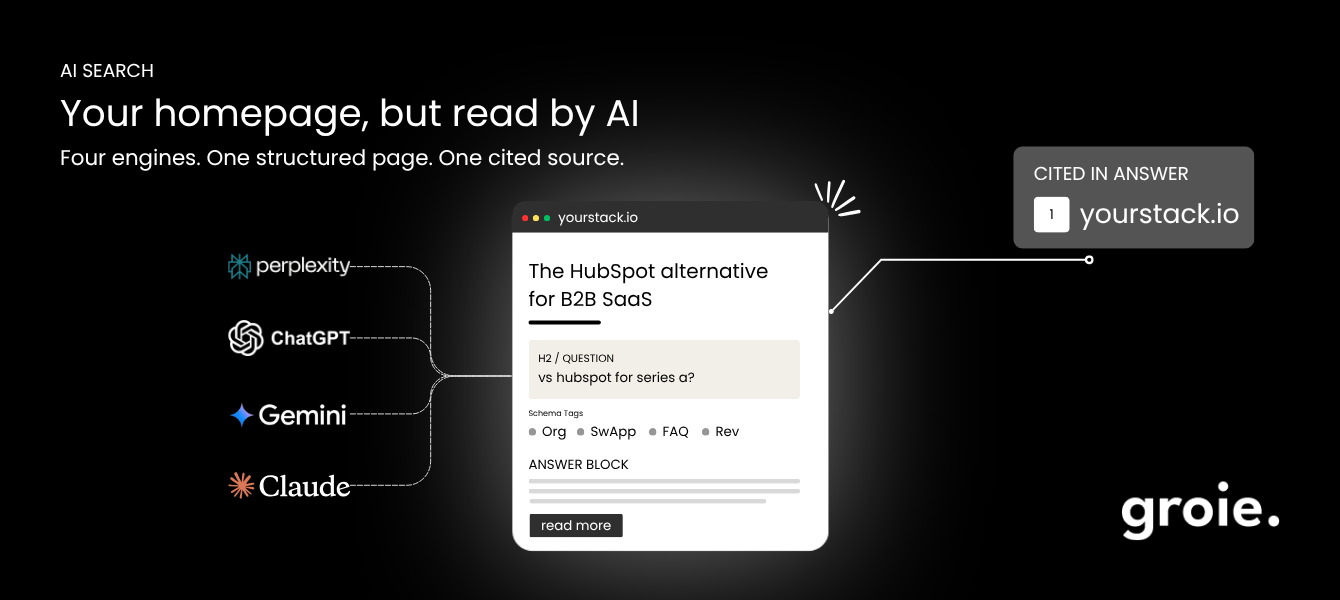
An AI-search-ready homepage has three things. Clear semantic structure with an H1 to H3 hierarchy that mirrors how buyers actually ask questions. Complete schema markup for Organization, Product or SoftwareApplication, FAQ, and Review. Short, direct paragraph answers to the questions your ICP asks AI engines. When a buyer asks ChatGPT "what is the best HubSpot alternative for B2B SaaS at Series A," your homepage needs to be a source the model finds, parses, and cites.
Sign 6: The page loads slower than 2.5 seconds
Largest Contentful Paint over 2.5 seconds is a documented conversion killer. Google's Core Web Vitals data shows pages loading under 2.5 seconds convert measurably better than those over four. Webflow sites with bloated video heroes and unoptimized CDN images routinely test at 4.5 to 6 seconds in the wild. Warm visitors will wait once. They will not wait twice.
Run your homepage through PageSpeed Insights. If LCP is over 2.5 seconds, your dead homepage test has a clear culprit before you change a single word.
Sign 7: No second-visit hook
B2B SaaS buyers visit a homepage two to three times on average before converting, according to Gartner B2B buyer journey research. If every visit shows the same hero, the same CTA, and the same three value props, you have nothing for the return visitor. Consider what changes between visit one and visit three: deeper proof (a recent case study), a more specific CTA (pricing instead of demo), a content asset (the playbook or benchmark report). A dead homepage looks identical to every visitor, every time.
SaaS homepage conversion optimization as a quarterly discipline
Most SaaS companies treat the homepage as a launch artifact. Built once, shipped, forgotten. The teams that compound traffic into pipeline treat it as a living system. Audit it quarterly against real conversion data, real session recordings, and a real five-second test with people in your ICP. Update it when your positioning sharpens, when a new ICP segment becomes a priority, or when a feature shift changes the value prop. SaaS homepage conversion optimization is not a one-time exercise. It is a quarterly discipline tied directly to revenue.
The Groie POV
We rebuild SaaS homepages across our pre-seed to Series A client base every month, and the pattern is consistent. Founders overspend on visual polish and underspend on messaging clarity. They optimise for compliments on demo day instead of conversions in production. They ship homepages that look like every other YC alum and wonder why warm traffic is not converting.
If 2 or more signs above describe your homepage right now, you are losing pipeline that has already shown up. The fix is not always a rebuild. Sometimes it is a hero rewrite, a CTA test, and a schema audit. The point is to run the test, find the leak, and patch it before your next campaign sends more warm traffic into the same broken page. Want a second opinion before you invest in a redesign? Book a strategy call with Groie to get a homepage conversion audit and uncover the gaps hurting pipeline growth.
Frequently asked questions
1. What are the warning signs that a SaaS homepage is losing warm traffic?
Unclear hero messaging, generic CTAs, copy-paste positioning, missing above-the-fold social proof, no AI-search structure, slow load times, and no second-visit hook. In analytics, watch for bounce rate above 60% on branded traffic, time on page under 25 seconds, and weak click-through from homepage to pricing or demo.
2. How is "warm traffic" different from "cold traffic," and why does it matter for SaaS homepages?
Cold traffic does not know you and arrives from paid ads or keyword searches. Warm traffic knows you and arrives from brand searches, referrals, founder posts, or community mentions. Warm traffic converts at three to five times the rate of cold when the homepage is doing its job. Flat warm conversion means the homepage is the bottleneck.
3. How do you optimize a SaaS homepage for AI answer engines (AEO/GEO) in 2026?
Three moves. Structure each section to answer a specific question your ICP asks AI engines, with clear H2 questions and short direct answers. Ship complete schema markup including Organization, Product, FAQ, and Review. Build cross-source presence on G2, Reddit, LinkedIn, and third-party content so AI engines find your homepage credible enough to cite.
4. What's the difference between traditional SEO and AEO/GEO for a SaaS homepage?
Traditional SEO optimizes for ranking on a search results page. AEO and GEO optimize for being cited inside an AI-generated answer. SEO rewards keywords and backlinks. AEO and GEO reward semantic clarity, schema markup, answer-style content, and brand mentions across trusted sources. The success metric is different: citation, not ranking.
5. How often should a SaaS company audit and update its homepage?
Audit quarterly. Cover the five-second clarity test, conversion data, session recordings, schema validity, and Core Web Vitals. Trigger a rebuild when positioning shifts, a new ICP segment becomes the priority, or conversion rate drops more than 20% on stable traffic.

Author
Anwesha Roy
After spending nearly a decade in B2B space, as a founding partner in Groie, we help early stage SaaS startups with their GTM. Groie is built keeping in mind, what SaaS founders need, and we do exactly that.
