
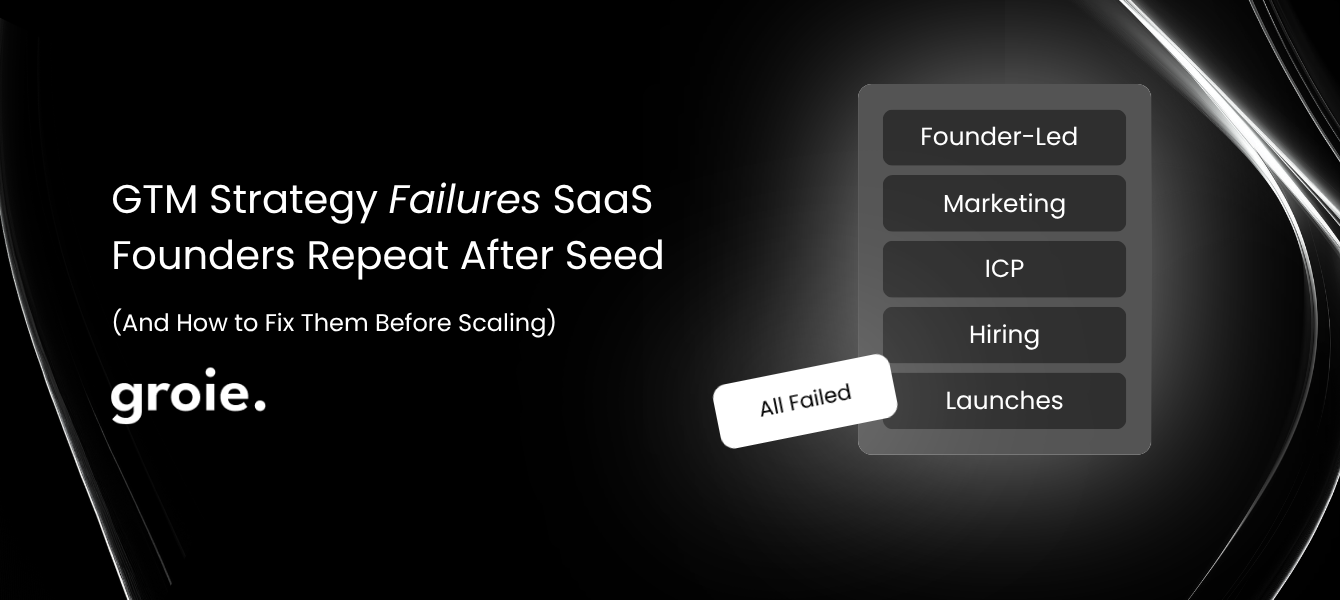
GTM Strategy Failures SaaS Founders Repeat After Seed (And How to Fix Them Before Scaling)
You raised your seed round. The deck told a clean story. The pipeline looked alive because you and your co-founder were closing every deal personally. Then you crossed $300k ARR, hired two AEs, doubled paid spend, and the numbers stopped behaving. New logos slowed. CAC crept up. Marketing started producing volume that sales refused to touch. Investors began asking the question every Series A board asks: "Is this thing actually repeatable?"
This is the post-seed GTM wall. It is one of the most predictable failure points in B2B SaaS, and it has very little to do with your product.
According to SaaS launch statistics compiled in early 2026, approximately 45% of SaaS startup failures occur between months 18 and 24 after launch, the exact window where most seed-stage companies attempt to scale. CB Insights data refreshed for 2026 still puts "no market need" as the number one cause of startup failure at 42%, which in practice usually means a go-to-market motion that was never really tested before being scaled.
The failures we see most often are not founder intelligence problems. They are pattern problems. The same five saas gtm failures show up across pre-seed to Series A SaaS companies, and they all get exposed at the same moment: when founder energy is no longer enough to carry the funnel.
The post-seed GTM trap: why what worked at $0 ARR breaks at $500k
The motion that got you your first 20 customers is almost never the motion that gets you to 200. At zero ARR, you have something invisible doing the heavy lifting: founder conviction, founder access, founder-tailored demos, and a willingness to bend the product to win a deal. That is a sales engine made of one person. It is not a GTM.
A real GTM motion is the set of repeatable answers to who you sell to, why they buy, what they believe before they buy, where they find you, who hands them off to whom inside your company, and what makes them expand. A founder-led motion answers all of that on instinct. A scaling company has to write it down.
This is where most post-seed GTM failures begin. The team treats the seed-stage motion as proof of repeatability, raises capital against that assumption, and then tries to clone the founder across new hires and paid channels. It almost never holds.
Failure #1: Mistaking founder-led sales for a repeatable GTM motion
Founder-led sales is a fantastic discovery instrument. It is a poor blueprint. When a founder closes a deal, the deal often closes despite the GTM, not because of it. Buyers are responding to vision, urgency, and the implicit promise of a custom-shaped product. None of that survives a handoff to a new AE reading from a deck.
The signal you are stuck in this trap: your win rate drops noticeably the moment a non-founder runs the sales cycle. The fix is not better sales training. The fix is decomposing how founder-led deals actually close, then encoding that into messaging, qualification criteria, objection handling, and a documented narrative the next rep can carry. This is where the line between go to market vs sales gets clarified. Sales executes the GTM. The GTM has to exist as a written, testable artifact before sales can scale against it.
Failure #2: Confusing marketing strategy with GTM strategy
This is the single most common mistake we see, and it is built into how most founders were taught to think about growth.
A marketing strategy answers: what do we say, where do we say it, what assets do we produce, and how do we drive demand. It is a subset.
A go-to-market strategy answers: who we sell to, what segment we win in first, what positioning makes that segment choose us, what the buying committee looks like, which channels match that buyer's behavior, how product, marketing, sales, and customer success coordinate around that buyer, and what economic model the whole thing produces.
The shorthand for the gtm vs marketing distinction is simple. Marketing is one motion inside the GTM. The GTM is the system that makes marketing useful.
The same logic applies when founders ask about product marketing vs go-to-market strategy. Product marketing owns positioning, messaging, launches, and sales enablement. It is one of the most critical functions inside a GTM, but it does not replace one. If your product marketing is strong and your GTM is undefined, you produce excellent collateral that converts at uneven rates because the underlying segmentation and motion were never decided.
When a founder tells us "our marketing is not working," the deeper problem most of the time is that there is no GTM strategy for the marketing to execute against.
Failure #3: Launching channels before nailing positioning and ICP narrowness
Post-seed founders feel pressure to "turn on growth." That usually means LinkedIn ads, Google ads, outbound sequences, and a content engine all spun up in the same quarter.
The problem is that channels amplify whatever positioning you have. If the positioning is broad, channels burn money efficiently. If the ICP is "mid-market SaaS companies," it is almost certainly too wide. Looking at saas go-to-market trends 2026, the companies actually compounding revenue have narrowed their ICP, not widened it. Just 28% of software and online service startups survive long enough to reach $100 million in revenue, and almost none of them got there by selling to everyone. They got there by dominating a narrow wedge first.
Before any channel decision, you need positioning that a buyer can repeat back to you in their own words after one conversation. If they cannot, no amount of paid media will fix the throughput.
Failure #4: Hiring a generalist marketer to fix a GTM problem
Around 12 to 18 months post-seed, the founder hires a "Head of Marketing" or a "Growth Lead." The expectation is that this person will diagnose the funnel, fix conversion, build the team, and unlock growth.
This hire fails more often than any other early SaaS hire. Not because the person is weak, but because the role is mis-scoped. A generalist marketer cannot fix a missing GTM. They can execute one. The diagnosis, the segmentation work, the positioning rewrites, the buyer research, the message-to-segment fit testing, all of that is product marketing and GTM strategy work, not generalist marketing work.
The pattern we watch break founders: hire a marketer, give them 90 days, expect pipeline. The marketer inherits a strategy gap, fills it with tactics, the tactics produce inconsistent results, and the founder concludes that "marketing does not work for our category." It is rarely true. The role was set up to fail.
Failure #5: Treating GTM as a launch event, not a system
The launch moment dominates founder mental space. The Product Hunt day, the press hit, the first webinar, the funding announcement. Founders pour everything into the spike, then watch the spike flatten and assume something is wrong with the channel.
A working GTM is not a launch. It is a system that produces a predictable rate of qualified pipeline every week, against a defined ICP, through channels matched to that ICP, with messaging that compounds rather than resets. Launches are inputs into the system. They are not the system itself.
This is also where founders confuse route to market vs go-to-market. Route to market is the distribution path: direct sales, channel partners, PLG, marketplace, reseller, and so on. Go-to-market is the full system around that route, including positioning, segmentation, narrative, and motion. You can change route to market without changing GTM. You cannot change GTM by only changing routes.
The fix: A 60-day GTM reset framework before you scale spend
Before you spend another dollar on channels or hire another marketer, the diagnostic work has to happen. The reset we run with post-seed founders fits into 60 days and looks roughly like this.
Weeks 1 to 2: Diagnosis. Pull every closed-won and closed-lost deal from the last 12 months. Interview five to ten of your best customers and ask why they bought, what they almost bought instead, and what nearly stopped them. Pull data on which deals closed fastest, which expanded, and which churned. The goal is to find the smallest defensible ICP that explains your wins.
Weeks 3 to 4: Positioning and segmentation. Rewrite positioning against the ICP from week 2, not the one in your deck. Pressure-test the new positioning against five prospects who do not know you. If they cannot describe what you do back to you in their own words within one call, the positioning is still wrong.
Weeks 5 to 6: Motion design. Decide the buying motion that matches your ICP and price point. Self-serve, sales-led, hybrid, or PLG with sales assist. Map the buyer journey from first touch to expansion. Identify the two or three channels where that buyer actually spends time, not the ones everyone else is using.
Weeks 7 to 8: Enablement and instrumentation. Build the messaging, narrative deck, website rewrite, sales collateral, and dashboards before you turn on spend. Set the success metrics for the next 90 days and write down what you will stop doing if results fall below the threshold.
This is the work Groie Launch Sprint was built to compress. It is a 60-day engagement priced at $9,000 that takes a post-seed founder from broken GTM to a documented, tested, channel-ready motion before any meaningful spend gets allocated. For teams that need ongoing GTM and marketing execution after the reset, Groie Core operates as a fractional product marketing and growth function at $4,000 per month. The companies that get to Series A with clean unit economics in 2026 are not the ones spending the most. They are the ones who fixed the GTM before they tried to scale it.
FAQs
1. What is the difference between GTM strategy and marketing strategy in SaaS?
A GTM strategy is the full system covering who you sell to, what positioning wins that segment, which channels match the buyer, how sales, marketing, and customer success coordinate, and what economic model the motion produces. A marketing strategy sits inside the GTM and covers messaging, content, demand generation, and channel execution. Marketing without a GTM produces output. A GTM tells marketing what output matters.
2. Why do SaaS founders repeat GTM mistakes after seed funding?
Because the seed-stage motion that closed the first 20 customers was carried by founder conviction, founder access, and custom-shaped deals. Founders read that traction as proof of repeatability, raise against that assumption, and then try to clone the motion across hires and paid channels. The motion was never repeatable to begin with. It was founder-shaped.
3. When should a Series A SaaS startup rebuild its go-to-market?
The moment any of three signals appear. Win rates drop when non-founders run sales cycles. CAC payback extends past 18 months without a clear explanation. New hires take more than 90 days to produce pipeline. Any one of those is a GTM signal, not a hiring or channel problem.
4. What does a working GTM look like for a post-seed SaaS company?
A defined ICP narrow enough to be repeated back by a stranger after one conversation. Positioning that survives outside a founder demo. A documented buyer journey with two or three matched channels. A handoff between marketing and sales that does not lose the narrative. Weekly pipeline that compounds rather than spikes and flattens.
5. Is route to market the same as go to market for SaaS?
No. Route to market is the distribution path: direct sales, partner channels, PLG, marketplace, or reseller. Go-to-market is the full system around that route, including positioning, segmentation, messaging, motion, and economics. Route to market is one decision inside a GTM. The two terms get used interchangeably in casual conversation, but the distinction matters when you are diagnosing why growth has stalled.
6. How long does it take to fix a broken SaaS GTM strategy?
For most post-seed teams, 60 days of focused diagnostic and reset work is enough to produce a documented, testable GTM ready for channel investment. Execution on that GTM, including pipeline build, message refinement, and channel expansion, is ongoing and typically takes another 90 to 180 days to show compounding results.

Author
Aabha Tiwari
Founder, Groie.
