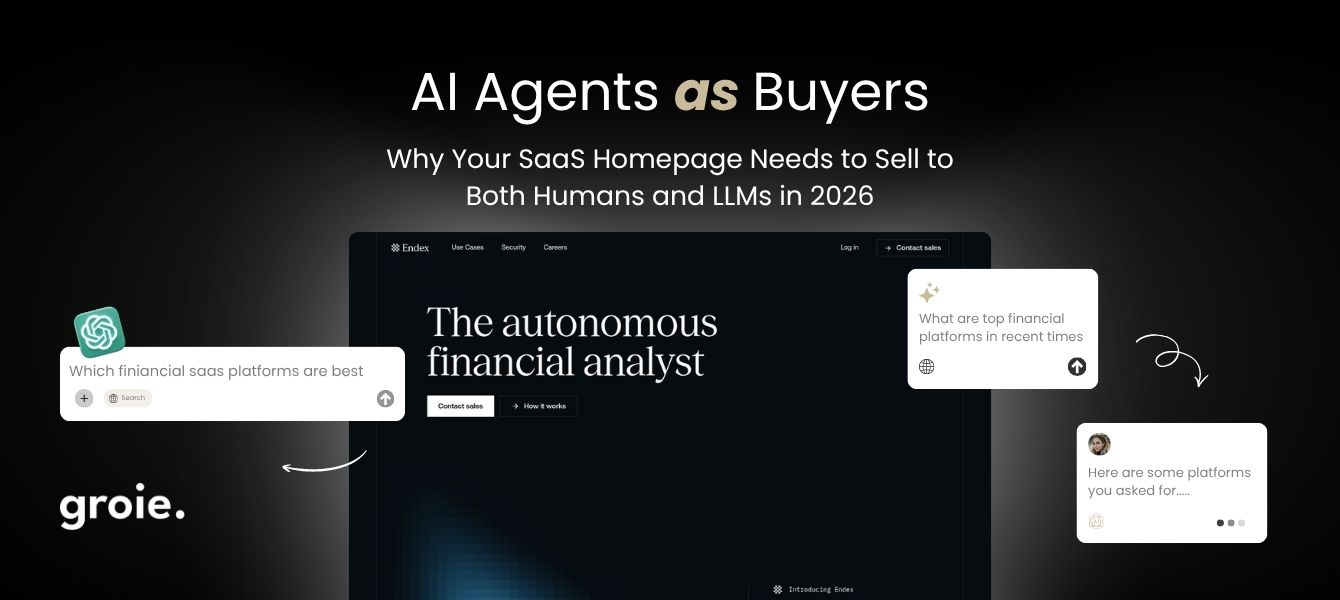
AI Agents as Buyers: Why Your SaaS Homepage Needs to Sell to Both Humans and LLMs in 2026
There's a specific moment when a SaaS founder realizes the game has changed. A prospect on a discovery call mentions they found the company through ChatGPT rather than Google or a LinkedIn ad. They had asked an AI which tool to consider for the use case, and the AI named the company alongside two competitors. The founder didn't submit anything, didn't rank for anything obvious, and just showed up in the answer.
That moment is happening more often, and by 2026 it has stopped being anecdotal. B2B SaaS buyer research has split in two. Half still runs through Google and vendor sites. The other half runs through Perplexity, Claude, ChatGPT, and Gemini, each of which is making buying recommendations on behalf of a prospect who may never visit a marketing site until the decision is 70% made.
The Buyer Research Shift Has Already Happened
Gartner forecast in 2024 that traditional search volume would drop 25% by 2026 as buyers migrated to AI chatbots. The forecast has held. ChatGPT crossed 300 million weekly active users in late 2024, Perplexity crossed 500 million monthly queries, and Claude, Gemini, and Copilot each added meaningful counts through 2025. Within B2B software the migration ran faster than the consumer average, and recent industry surveys show over 40% of B2B software buyers now begin research inside an AI tool rather than a search engine. Ahrefs put click-through loss on the top organic result at around 34.5% when an AI Overview is present.
Your SaaS homepage now has two audiences. The human buyer, still critical when they arrive. And the AI agent, often the deciding vote long before the human loads the page. Product discovery for B2B software increasingly happens inside AI tools before a buyer visits any vendor site at all.
AEO for SaaS, Defined Practically
So what is AEO for SaaS in practice? It is the discipline of structuring your product story, homepage, and supporting content so that AI answer engines can accurately extract, cite, and recommend you when a buyer asks a category question. In many ways, AEO is the new SEO, sitting alongside traditional SEO and covering what Google rankings alone no longer cover: how a language model composes its recommendation when the buyer never types a query into Google.
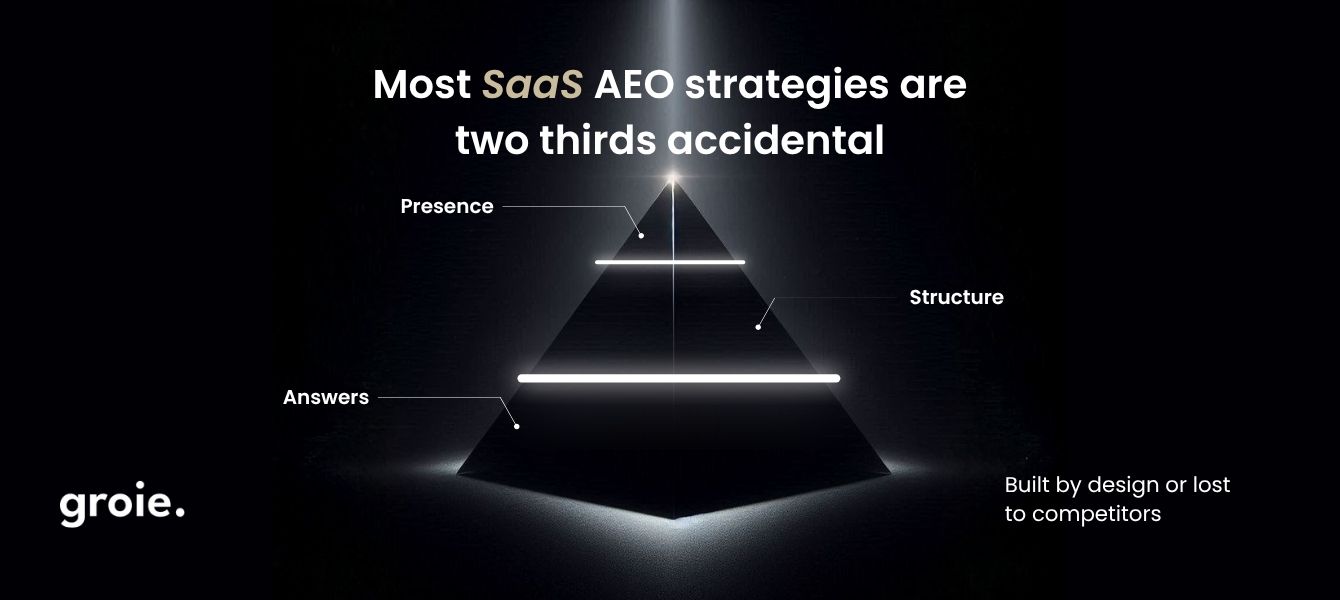
A serious B2B SaaS AEO strategy has three layers. Being present in the sources LLMs pull from. Structuring your site content so LLMs can extract it cleanly. Becoming the answer to the specific buyer questions your category is currently losing to competitors. Most SaaS companies have the first two by accident. Almost none have the third by design.
How AI Agents Choose Which SaaS to Recommend
The mechanics are less mysterious than they look. When a buyer asks Claude or ChatGPT which SaaS to consider, the model composes its answer from three sources: pre-training data, retrieval from a live search index, and any structured knowledge given through system prompts or connectors.
Retrieval is where most early-stage SaaS wins or loses in real time. Studies from Ahrefs, Semrush, and BrightEdge through 2024 and 2025 consistently found AI answers pull heavily from the top 10 organic Google results, with additional weight given to Reddit, YouTube, and platforms like G2 and Product Hunt. Rank on page one and you have a real chance of being cited. If you don't rank, you're functionally invisible to the AI. AEO does not replace SEO. It sits on top of it, and rewards content structured well enough for a language model to parse without ambiguity.
What a Homepage Optimized for Humans and LLMs Looks Like
Homepages that read well to both share a few structural traits. The hero makes an unambiguous category claim in the first sentence, because LLMs pull heavily from the H1 and opening paragraph when deciding what a page is about, and poetic taglines with no product noun force the model to guess. Value propositions are structured as three to five short blocks with a headline and a supporting sentence each, which maps cleanly to how LLMs extract product benefits. A clear who-it-is-for statement matters because LLMs recommending SaaS tools frequently include ICP context in their answers, and if that context is missing, the model infers it from third-party sources like G2.
Structured data matters more than most founders realize. Schema markup for SoftwareApplication, FAQPage, and Organization types materially increases the confidence with which LLMs extract information. Best AEO practices for SaaS discovery start with schema and work outward.
AEO Content Structure for B2B SaaS Platforms
Pillar pages still matter, and they should be built around clear H2 questions with direct answers underneath. LLMs are trained to extract question-answer pairs, and articles written around explicit buyer questions get cited at meaningfully higher rates than articles written around keyword targets.
Comparison content matters more than in traditional SEO too, because buyers ask AI agents for comparisons constantly. Without a page comparing yourself to your two closest competitors, the LLM uses the competitor's page as its source. FAQ blocks, tables, and lists extract cleanly. Prose paragraphs with buried claims do not. Effective AEO content structure for B2B SaaS platforms rewards documents that can be parsed line by line without requiring inference.
AEO vs GEO vs Traditional SaaS SEO
Traditional SEO optimizes for ranking on Google's organic results. AEO, or answer engine optimization, optimizes for being cited by AI answer engines including Google's AI Overviews, ChatGPT, Perplexity, and Claude. GEO, or generative engine optimization, is often used interchangeably with AEO, though some practitioners reserve it for optimization inside the generative response itself, including recommendation ranking within an AI answer. An early-stage SaaS company does not need three separate strategies. It needs one content strategy built for extraction and citation, the kind of work a b2b saas seo agency that also functions as a GEO agency for B2B SaaS companies would deliver, executed in a way that still ranks in traditional search.
Groie is a product marketing studio for pre-seed to pre-Series A B2B SaaS companies, and AEO is now a live part of what we work on with every founder. We tighten positioning until the category claim reads unambiguously, restructure homepages so both humans and language models can parse them, and build FAQ and comparison content designed to be pulled into AI answers rather than left in a blog archive. If prospects are already arriving through AI tools, the layer above the homepage has to earn a place in the answer as well as the ranking.
FAQs
What is AEO and why do SaaS companies need it in 2026?
AEO stands for answer engine optimization: structuring product content so AI answer engines like ChatGPT, Perplexity, Claude, and Google's AI Overviews can accurately cite and recommend it. SaaS companies need it because a growing share of buyer research now happens inside AI tools before any vendor site is loaded.
How do AI agents and LLMs choose which SaaS products to recommend?
LLMs blend three inputs: pre-training data, retrieval from a live search index, and any structured signals given at runtime. Retrieval leans heavily on top 10 Google organic results, Reddit, YouTube, and G2, which is why traditional SEO signals remain critical for AI visibility.
What does a homepage optimized for both humans and LLMs look like?
It leads with an unambiguous category claim in the H1, structures value propositions as short scannable blocks, states clearly who the product is for, and uses schema markup for SoftwareApplication, FAQPage, and Organization types so language models can extract information without ambiguity.
How do you structure SaaS content so ChatGPT, Perplexity, and Claude cite it?
Structure content around explicit buyer questions with clear H2 headings and direct answers underneath. Use FAQ blocks, tables, and comparison structures rather than dense prose. Keep claims attributable and phrased in language a model can extract without inference.
Should early-stage SaaS invest in AEO before traditional SEO?
Both, running in parallel. AEO for SaaS depends on the same content foundation SEO depends on, and a page cited by an AI answer engine is almost always one that also ranks in Google's top 10.
What's the difference between AEO, GEO, and traditional SaaS SEO?
Traditional SEO targets ranking in Google's organic results. AEO targets being cited by AI answer engines. GEO is often used interchangeably with AEO, though some practitioners reserve it for optimizing the recommendation itself inside the AI-generated answer.

Author
Aabha Tiwari
Founder, Groie.



.png)