Posted on:
21/10/26

What Groie Looks for Before Saying Yes to a B2B SaaS Marketing Engagement

We work with 25 companies a year. And no, that's not a marketing gimmick.

At Groie, we've had conversations with SaaS founders who have incredible products but aren't quite ready for marketing. We've met companies with healthy budgets but unrealistic expectations. We've also met founders running on tight budgets who knew their customers better than companies ten times their size. And we've learned something over the years: A good product doesn't automatically make a good marketing engagement. Neither does a big budget.

As a B2B SaaS product marketing studio, we've worked with 75+ companies, from early-stage startups and YC-backed businesses to established SaaS companies and enterprises. Some engagements have been straightforward. Others have required us to rethink the positioning, rebuild the website, untangle the GTM strategy, and occasionally question whether the company was solving the right marketing problem in the first place. Those experiences have shaped how we choose the companies we work with today.

Groie now operates as a membership-based product marketing studio, with a deliberately limited roster of 25 companies per year.

‍

This could be an interesting read for you: Why Groie, a B2B SaaS Product Marketing Studio, Works With Only 25 SaaS Companies a Year

‍

So, what exactly happens before we say yes?

1. We Want to Understand the Product Before We Discuss Marketing

You'd be surprised how many marketing conversations begin with a list of deliverables: "We need 12 LinkedIn posts, four blogs, Google Ads, and maybe a landing page."

Okay.

  • But what are we selling?
  • Who's buying it?
  • Why would they choose it?
  • What happens after someone books a demo?

We don't expect founders to have perfect answers. In fact, helping companies figure out their positioning, messaging, and go-to-market strategy is a large part of what we do. But we need to understand the product and the business behind it. Before accepting a B2B SaaS marketing engagement, we look at:

  • The product: What does it actually do, and what problem does it solve?
  • The buyer: Who uses it, who pays for it, and who influences the purchase?
  • The market: What alternatives are buyers considering today?
  • The differentiation: Is there a credible reason someone would choose this product?
  • The business stage: Are we building awareness, creating demand, entering a new market, or improving an existing funnel?

A company doesn't need to have everything figured out to work with us. But there needs to be enough substance for us to build something meaningful. Marketing can make a strong product easier to understand, discover, and buy. It cannot manufacture a reason to buy one.

2. We're Interested in the Actual Business Problem, Not Just the Marketing Wishlist

A company might approach us asking for SEO because its competitors are ranking on Google. Another might want paid advertising because its board expects more leads. Someone else might want a website redesign because the current website looks dated.

All perfectly reasonable requests. But here's where we tend to ask more questions. Why SEO? Is organic search where your buyers actually research solutions? Why paid ads? Do we know which audience converts? Why a new website? Is the current one failing to communicate the product, or is the problem further down the funnel?

  • We've seen SaaS companies invest in traffic when their real problem was positioning.
  • We've seen companies invest in branding when they needed a clearer sales narrative.
  • And we've seen teams produce content consistently without knowing which business outcome that content was supposed to influence.

This is why our discovery conversations don't start and end with deliverables. We want to know what isn't working, what's already been attempted, and what the business needs marketing to accomplish. Sometimes the answer is exactly what the founder came asking for.

Sometimes it isn't. A good SaaS marketing partner should be able to challenge the brief, not just quote for it.
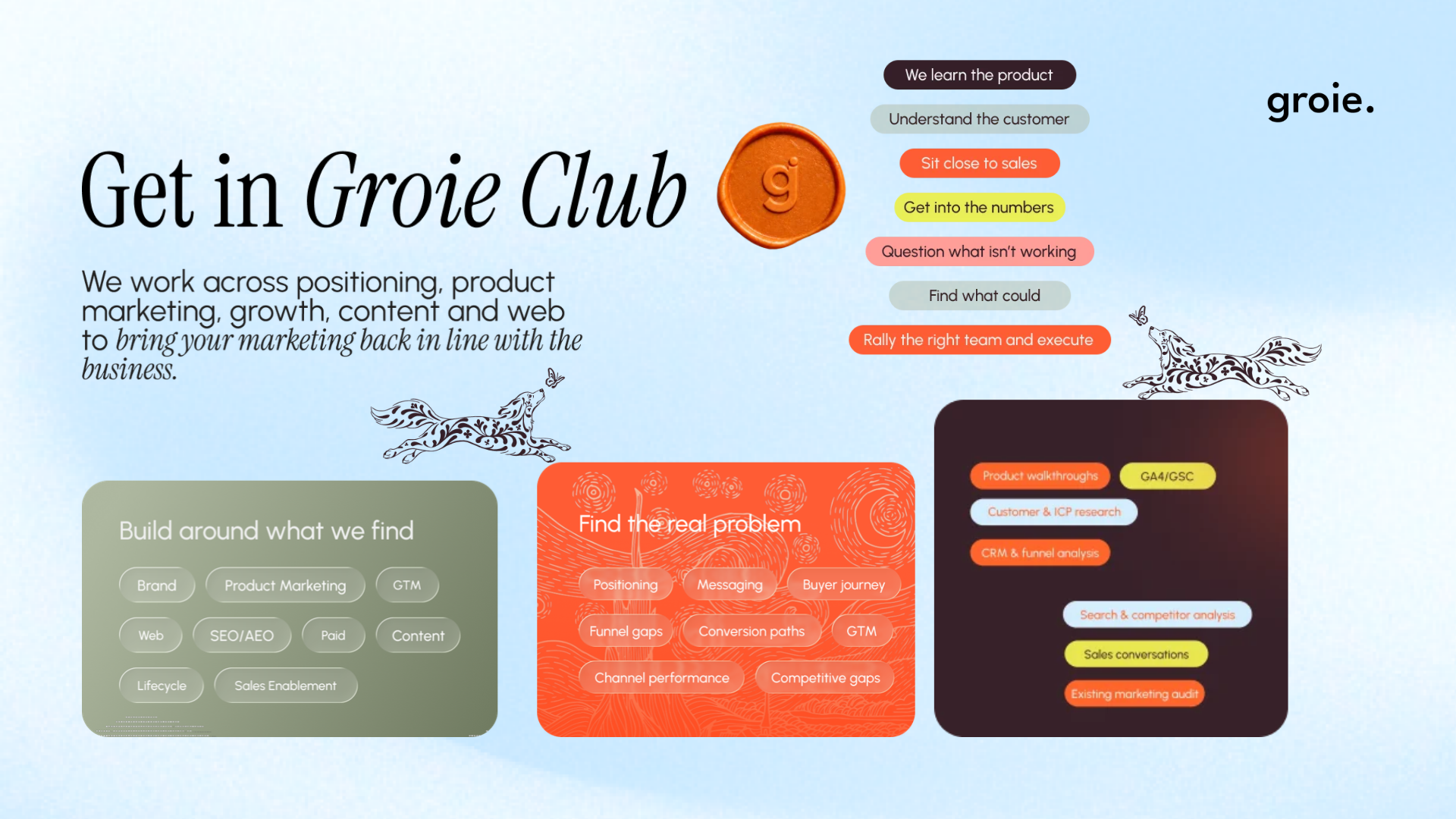
What it takes to become one of Groie's 25 marketing partners.

3. We Look at Whether the Expectations Match the Starting Point

Here's a conversation we've had in different forms: "We're launching next month. Can you get us 100 qualified demos?" Maybe. But from which audience? With what existing demand? What conversion history? What budget? And what does a qualified demo mean for this business? We understand urgency. SaaS founders operate with runway constraints, investor expectations, hiring pressures, and growth targets. But there's a difference between ambitious goals and expectations disconnected from the current business.

If a company has no established positioning, little search visibility, no functioning nurture system, and a website that doesn't explain the product, expecting a predictable pipeline in 30 days is a difficult starting point. We evaluate what already exists and what needs to be built.

For example:

  • An early-stage SaaS company might need positioning, an ICP framework, foundational website pages, and an initial GTM strategy.
  • A Series A company might need stronger demand generation, channel experimentation, and conversion improvements.
  • An established SaaS business might need to improve acquisition efficiency, enter new markets, or strengthen its product marketing function.

Each requires a different approach, investment, and timeline. We don't reject ambitious targets. We do push back when the proposed timeline ignores the work required to reach them. And we'd rather have that conversation before signing an agreement.

4. We Look for Founders and Teams Who Will Actually Work With Us

This is probably one of the most underrated factors in a successful agency-client relationship. Outsourcing marketing doesn't mean outsourcing every business decision.

We can research the market, develop positioning, create campaigns, build websites, improve search visibility, and manage execution. But we still need access to the people who understand the product.

  • We need sales insights
  • Customer objections
  • Product updates
  • Competitive intelligence
  • Feedback on what resonates with buyers.

And occasionally, we need someone to make a decision. We've seen how quickly marketing moves when founders and internal stakeholders are involved. We've also seen how easily work gets delayed when feedback takes weeks, priorities change without context, or nobody owns approvals. That doesn't mean founders need to attend every meeting or review every social post.

Quite the opposite. Our goal is to take marketing execution off their plates while keeping them involved in the decisions that matter. The best marketing engagements aren't the ones where the client disappears. They're the ones where both teams know exactly what they own.

5. We Evaluate Whether Groie Is Actually the Right Team

Not every company needs a product marketing studio. Some need a full-time marketing leader. Some need a specialist for a very specific technical problem. Others need a short consulting engagement rather than an embedded marketing team. And that's fine.

Groie is built for B2B SaaS companies that need product marketing thinking combined with hands-on execution. Our work spans positioning and messaging, GTM strategy, website design and development, SEO and AI search visibility, content, paid acquisition, social, CRM, and sales enablement. But that doesn't mean every client needs every service. We look at where we can make the strongest contribution and whether our team has the right experience for the problem.

For example, if a company already has a strong internal demand generation function but needs help with product positioning and a new market launch, the engagement should reflect that. If a company needs an outsourced SaaS marketing team to build and manage several functions together, that's a different engagement altogether. And if the problem sits outside our expertise, we'd rather acknowledge it than sell something we shouldn't be selling.

6. We Want to Know Whether the Company Is Ready to Invest in Marketing Properly

Let's talk about budgets. A company doesn't need an enterprise marketing budget to work with Groie. We work with early-stage SaaS companies, too. Honestly that’s our expertise.

But there needs to be alignment between the investment, the scope, and the expected outcomes. If a business wants a complete GTM function, including positioning, website optimization, SEO, paid acquisition, content, and CRM management, that requires meaningful resources. The same applies to execution timelines. Good research takes time. A positioning exercise requires conversations. A website needs thoughtful architecture. SEO requires sustained work. Paid campaigns need testing and optimization.

We don't believe in selling a long list of services at a price that makes delivering them properly impossible.

That's why Groie has two membership models
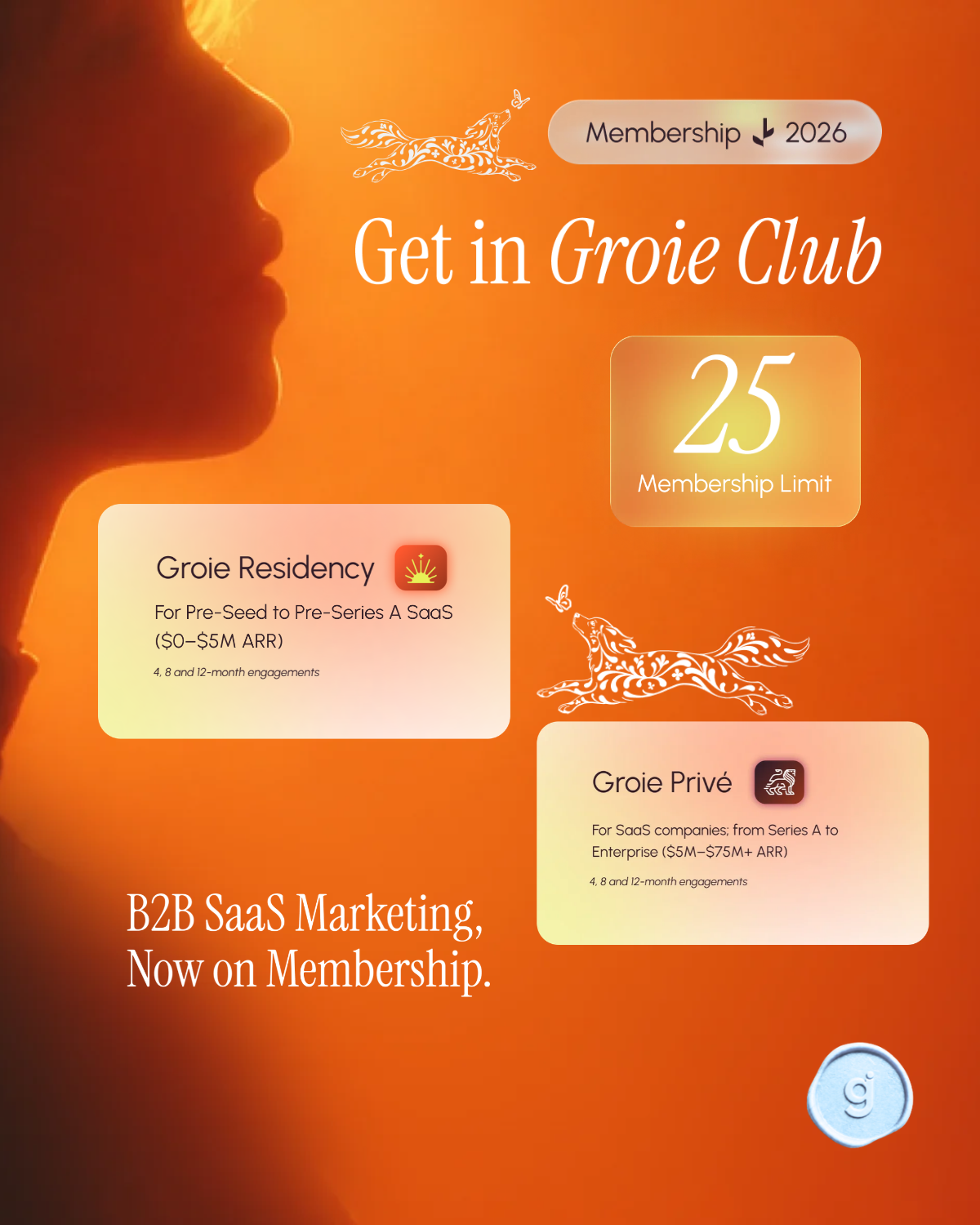
Groie membership for early stage SaaS & Series A+ 

‍

Groie Residency: Built primarily for pre-seed to pre-Series A SaaS companies looking for an embedded marketing team, with engagements starting at $4,500 per month.

Groie Privé: Designed for Series A through enterprise companies that need more specialized, complex, or cross-functional marketing support, starting from $12,000/monthly, with custom engagement scopes.

The membership model allows us to structure the work around the company's needs rather than forcing every client into an identical package. The question isn't simply whether a company can afford marketing. It's whether we can agree on a realistic investment and build an engagement that makes business sense for both sides.

7. We Pay Attention to How the Discovery Conversation Goes

Not every evaluation criterion fits neatly into a spreadsheet. Some of the most important signals appear during the first few conversations.

  • Does the founder understand the difference between marketing activity and business outcomes?
  • Are they open to being challenged?
  • Can the team explain what has and hasn't worked? Do they treat marketing as a business function or simply a collection of tasks to delegate?

We don't need everyone to agree with our recommendations immediately. Healthy disagreements are useful. But we do need mutual respect, transparency, and enough trust to make decisions together. We're going to ask uncomfortable questions about positioning, conversion, budget allocation, and priorities. Sometimes we'll recommend stopping an activity the company has been investing in for months. Sometimes we'll disagree with the founder's preferred messaging. And sometimes the right answer will be to delay a campaign until the fundamentals are ready. If a company wants a team that will simply execute instructions without questioning them, Groie may not be the right partner.

We want to be accountable for the thinking behind the work, not just the work itself.

8. We Ask Ourselves One Final Question: Can We Do This Engagement Justice?

This is where the 25-company limit comes in. Groie isn't built around acquiring as many accounts as possible and then distributing them across an ever-expanding delivery team. We're intentionally keeping our roster small.

Every membership requires strategic attention, execution capacity, cross-functional coordination, and founder involvement at important stages. And those resources are finite. Before accepting a new member, we consider whether we have the right people available, whether the engagement fits our capabilities, and whether we can maintain the standard of work we expect from ourselves.

  • Sometimes that means declining an otherwise attractive opportunity.
  • Sometimes it means asking a company to come back later.
  • And sometimes it means accepting a smaller company over a larger one because the business problem, expectations, and working relationship are a stronger fit.

The 25-company limit isn't a statement about how many companies deserve good marketing. It's a decision about how many we believe we can serve well within our operating model.

So, What Makes Us Say No?

There isn't a secret scoring system where a company loses points for having an imperfect website or an unclear ICP. We actually enjoy solving those problems. But there are a few situations where we're unlikely to move forward:

  1. When marketing is expected to compensate for a product that hasn't established a credible customer problem.
  2. When targets, timelines, and budgets are fundamentally misaligned, with no willingness to revisit them.
  3. When the company wants execution but isn't willing to share the context needed to make it effective.
  4. When the engagement requires expertise or resources we aren't equipped to provide.
  5. When we don't have the capacity to give the business the attention it deserves.

And occasionally, we say no because the company simply doesn't need us yet. That might not be the most aggressive way to grow a marketing studio. But we'd rather lose a deal during discovery than enter an engagement neither side should have signed.

What Happens When We Say Yes?

A yes from Groie means we see a business problem worth solving, believe our team can contribute meaningfully, and have a shared understanding of what the engagement should accomplish. From there, we align on the scope, priorities, responsibilities, timelines, and the metrics that matter.

Not every membership starts with the same playbook. Some begin with positioning and messaging. Others start with a website overhaul, an SEO and AEO strategy, a product launch, or a broader demand generation program. The starting point depends on the business. The principle stays the same: marketing should be connected to the product, the buyer, and the commercial objectives of the company.

A Final Word From Groie

We've built Groie around a simple belief: the companies we work with should get more than an agency that completes tasks. They should get a team that understands what they're building, questions what needs questioning, and takes ownership of the marketing work it commits to. That's also why we don't think every SaaS company should hire us. Some aren't ready. Some need something different. Some are better served by building internally.

And some are exactly the kind of companies we'd love to have in the club. We're not trying to work with every SaaS company. We're trying to do our best work with the 25 that join us. If you're building a B2B SaaS company and think Groie could be the right marketing partner, we'd be happy to learn more about what you're working on.

Explore Groie Memberships

Applications are reviewed based on business fit, engagement requirements, and available capacity.

‍

Groie Founder Aabha Tiwari

Author

Aabha Tiwari

Founder, Groie.

What Groie Looks for Before Saying Yes to a B2B SaaS Marketing Engagement

October 21, 2026
13 mins read
  • Groie Founder Aabha Tiwari
    Aabha Tiwari
    Founder
How Groie Selects B2B SaaS Marketing Partners
Founder Thoughts
Groie POV
GTM
Marketing insights
Groie membership
About Groie

We work with 25 companies a year. And no, that's not a marketing gimmick.

At Groie, we've had conversations with SaaS founders who have incredible products but aren't quite ready for marketing. We've met companies with healthy budgets but unrealistic expectations. We've also met founders running on tight budgets who knew their customers better than companies ten times their size. And we've learned something over the years: A good product doesn't automatically make a good marketing engagement. Neither does a big budget.

As a B2B SaaS product marketing studio, we've worked with 75+ companies, from early-stage startups and YC-backed businesses to established SaaS companies and enterprises. Some engagements have been straightforward. Others have required us to rethink the positioning, rebuild the website, untangle the GTM strategy, and occasionally question whether the company was solving the right marketing problem in the first place. Those experiences have shaped how we choose the companies we work with today.

Groie now operates as a membership-based product marketing studio, with a deliberately limited roster of 25 companies per year.

‍

This could be an interesting read for you: Why Groie, a B2B SaaS Product Marketing Studio, Works With Only 25 SaaS Companies a Year

‍

So, what exactly happens before we say yes?

1. We Want to Understand the Product Before We Discuss Marketing

You'd be surprised how many marketing conversations begin with a list of deliverables: "We need 12 LinkedIn posts, four blogs, Google Ads, and maybe a landing page."

Okay.

  • But what are we selling?
  • Who's buying it?
  • Why would they choose it?
  • What happens after someone books a demo?

We don't expect founders to have perfect answers. In fact, helping companies figure out their positioning, messaging, and go-to-market strategy is a large part of what we do. But we need to understand the product and the business behind it. Before accepting a B2B SaaS marketing engagement, we look at:

  • The product: What does it actually do, and what problem does it solve?
  • The buyer: Who uses it, who pays for it, and who influences the purchase?
  • The market: What alternatives are buyers considering today?
  • The differentiation: Is there a credible reason someone would choose this product?
  • The business stage: Are we building awareness, creating demand, entering a new market, or improving an existing funnel?

A company doesn't need to have everything figured out to work with us. But there needs to be enough substance for us to build something meaningful. Marketing can make a strong product easier to understand, discover, and buy. It cannot manufacture a reason to buy one.

2. We're Interested in the Actual Business Problem, Not Just the Marketing Wishlist

A company might approach us asking for SEO because its competitors are ranking on Google. Another might want paid advertising because its board expects more leads. Someone else might want a website redesign because the current website looks dated.

All perfectly reasonable requests. But here's where we tend to ask more questions. Why SEO? Is organic search where your buyers actually research solutions? Why paid ads? Do we know which audience converts? Why a new website? Is the current one failing to communicate the product, or is the problem further down the funnel?

  • We've seen SaaS companies invest in traffic when their real problem was positioning.
  • We've seen companies invest in branding when they needed a clearer sales narrative.
  • And we've seen teams produce content consistently without knowing which business outcome that content was supposed to influence.

This is why our discovery conversations don't start and end with deliverables. We want to know what isn't working, what's already been attempted, and what the business needs marketing to accomplish. Sometimes the answer is exactly what the founder came asking for.

Sometimes it isn't. A good SaaS marketing partner should be able to challenge the brief, not just quote for it.

What it takes to become one of Groie's 25 marketing partners.

3. We Look at Whether the Expectations Match the Starting Point

Here's a conversation we've had in different forms: "We're launching next month. Can you get us 100 qualified demos?" Maybe. But from which audience? With what existing demand? What conversion history? What budget? And what does a qualified demo mean for this business? We understand urgency. SaaS founders operate with runway constraints, investor expectations, hiring pressures, and growth targets. But there's a difference between ambitious goals and expectations disconnected from the current business.

If a company has no established positioning, little search visibility, no functioning nurture system, and a website that doesn't explain the product, expecting a predictable pipeline in 30 days is a difficult starting point. We evaluate what already exists and what needs to be built.

For example:

  • An early-stage SaaS company might need positioning, an ICP framework, foundational website pages, and an initial GTM strategy.
  • A Series A company might need stronger demand generation, channel experimentation, and conversion improvements.
  • An established SaaS business might need to improve acquisition efficiency, enter new markets, or strengthen its product marketing function.

Each requires a different approach, investment, and timeline. We don't reject ambitious targets. We do push back when the proposed timeline ignores the work required to reach them. And we'd rather have that conversation before signing an agreement.

4. We Look for Founders and Teams Who Will Actually Work With Us

This is probably one of the most underrated factors in a successful agency-client relationship. Outsourcing marketing doesn't mean outsourcing every business decision.

We can research the market, develop positioning, create campaigns, build websites, improve search visibility, and manage execution. But we still need access to the people who understand the product.

  • We need sales insights
  • Customer objections
  • Product updates
  • Competitive intelligence
  • Feedback on what resonates with buyers.

And occasionally, we need someone to make a decision. We've seen how quickly marketing moves when founders and internal stakeholders are involved. We've also seen how easily work gets delayed when feedback takes weeks, priorities change without context, or nobody owns approvals. That doesn't mean founders need to attend every meeting or review every social post.

Quite the opposite. Our goal is to take marketing execution off their plates while keeping them involved in the decisions that matter. The best marketing engagements aren't the ones where the client disappears. They're the ones where both teams know exactly what they own.

5. We Evaluate Whether Groie Is Actually the Right Team

Not every company needs a product marketing studio. Some need a full-time marketing leader. Some need a specialist for a very specific technical problem. Others need a short consulting engagement rather than an embedded marketing team. And that's fine.

Groie is built for B2B SaaS companies that need product marketing thinking combined with hands-on execution. Our work spans positioning and messaging, GTM strategy, website design and development, SEO and AI search visibility, content, paid acquisition, social, CRM, and sales enablement. But that doesn't mean every client needs every service. We look at where we can make the strongest contribution and whether our team has the right experience for the problem.

For example, if a company already has a strong internal demand generation function but needs help with product positioning and a new market launch, the engagement should reflect that. If a company needs an outsourced SaaS marketing team to build and manage several functions together, that's a different engagement altogether. And if the problem sits outside our expertise, we'd rather acknowledge it than sell something we shouldn't be selling.

6. We Want to Know Whether the Company Is Ready to Invest in Marketing Properly

Let's talk about budgets. A company doesn't need an enterprise marketing budget to work with Groie. We work with early-stage SaaS companies, too. Honestly that’s our expertise.

But there needs to be alignment between the investment, the scope, and the expected outcomes. If a business wants a complete GTM function, including positioning, website optimization, SEO, paid acquisition, content, and CRM management, that requires meaningful resources. The same applies to execution timelines. Good research takes time. A positioning exercise requires conversations. A website needs thoughtful architecture. SEO requires sustained work. Paid campaigns need testing and optimization.

We don't believe in selling a long list of services at a price that makes delivering them properly impossible.

That's why Groie has two membership models

Groie membership for early stage SaaS & Series A+ 

‍

Groie Residency: Built primarily for pre-seed to pre-Series A SaaS companies looking for an embedded marketing team, with engagements starting at $4,500 per month.

Groie Privé: Designed for Series A through enterprise companies that need more specialized, complex, or cross-functional marketing support, starting from $12,000/monthly, with custom engagement scopes.

The membership model allows us to structure the work around the company's needs rather than forcing every client into an identical package. The question isn't simply whether a company can afford marketing. It's whether we can agree on a realistic investment and build an engagement that makes business sense for both sides.

7. We Pay Attention to How the Discovery Conversation Goes

Not every evaluation criterion fits neatly into a spreadsheet. Some of the most important signals appear during the first few conversations.

  • Does the founder understand the difference between marketing activity and business outcomes?
  • Are they open to being challenged?
  • Can the team explain what has and hasn't worked? Do they treat marketing as a business function or simply a collection of tasks to delegate?

We don't need everyone to agree with our recommendations immediately. Healthy disagreements are useful. But we do need mutual respect, transparency, and enough trust to make decisions together. We're going to ask uncomfortable questions about positioning, conversion, budget allocation, and priorities. Sometimes we'll recommend stopping an activity the company has been investing in for months. Sometimes we'll disagree with the founder's preferred messaging. And sometimes the right answer will be to delay a campaign until the fundamentals are ready. If a company wants a team that will simply execute instructions without questioning them, Groie may not be the right partner.

We want to be accountable for the thinking behind the work, not just the work itself.

8. We Ask Ourselves One Final Question: Can We Do This Engagement Justice?

This is where the 25-company limit comes in. Groie isn't built around acquiring as many accounts as possible and then distributing them across an ever-expanding delivery team. We're intentionally keeping our roster small.

Every membership requires strategic attention, execution capacity, cross-functional coordination, and founder involvement at important stages. And those resources are finite. Before accepting a new member, we consider whether we have the right people available, whether the engagement fits our capabilities, and whether we can maintain the standard of work we expect from ourselves.

  • Sometimes that means declining an otherwise attractive opportunity.
  • Sometimes it means asking a company to come back later.
  • And sometimes it means accepting a smaller company over a larger one because the business problem, expectations, and working relationship are a stronger fit.

The 25-company limit isn't a statement about how many companies deserve good marketing. It's a decision about how many we believe we can serve well within our operating model.

So, What Makes Us Say No?

There isn't a secret scoring system where a company loses points for having an imperfect website or an unclear ICP. We actually enjoy solving those problems. But there are a few situations where we're unlikely to move forward:

  1. When marketing is expected to compensate for a product that hasn't established a credible customer problem.
  2. When targets, timelines, and budgets are fundamentally misaligned, with no willingness to revisit them.
  3. When the company wants execution but isn't willing to share the context needed to make it effective.
  4. When the engagement requires expertise or resources we aren't equipped to provide.
  5. When we don't have the capacity to give the business the attention it deserves.

And occasionally, we say no because the company simply doesn't need us yet. That might not be the most aggressive way to grow a marketing studio. But we'd rather lose a deal during discovery than enter an engagement neither side should have signed.

What Happens When We Say Yes?

A yes from Groie means we see a business problem worth solving, believe our team can contribute meaningfully, and have a shared understanding of what the engagement should accomplish. From there, we align on the scope, priorities, responsibilities, timelines, and the metrics that matter.

Not every membership starts with the same playbook. Some begin with positioning and messaging. Others start with a website overhaul, an SEO and AEO strategy, a product launch, or a broader demand generation program. The starting point depends on the business. The principle stays the same: marketing should be connected to the product, the buyer, and the commercial objectives of the company.

A Final Word From Groie

We've built Groie around a simple belief: the companies we work with should get more than an agency that completes tasks. They should get a team that understands what they're building, questions what needs questioning, and takes ownership of the marketing work it commits to. That's also why we don't think every SaaS company should hire us. Some aren't ready. Some need something different. Some are better served by building internally.

And some are exactly the kind of companies we'd love to have in the club. We're not trying to work with every SaaS company. We're trying to do our best work with the 25 that join us. If you're building a B2B SaaS company and think Groie could be the right marketing partner, we'd be happy to learn more about what you're working on.

Explore Groie Memberships

Applications are reviewed based on business fit, engagement requirements, and available capacity.

‍

Think your SaaS company should be one of them?

Apply to work with Groie. We'll look at your product, current marketing and growth problem before we talk about scope. If we think Groie can genuinely move it forward, we'll tell you how.

Book a studio call

Related Thoughts

Oct 20th, 2026

Your SaaS Positioning Worked at Seed. It Might Not Work at Series A

Learn why SaaS positioning that worked at Seed may fail at Series A, signs your messaging needs work, and how to align positioning with sales and GTM.
Read More
Oct 13th, 2026

When Should a B2B SaaS Company Hire a Product Marketing Agency?

Learn when to hire a B2B SaaS product marketing agency. Groie connects positioning, GTM strategy, and hands-on execution to help SaaS companies scale.
Read More