Your SaaS Positioning Worked at Seed. It Might Not Work at Series A
Your SaaS product has evolved. You've added features, entered new markets, hired a sales team, and possibly raised another round of funding. But there's one thing that might still be stuck at Seed: your positioning.
And it's surprisingly easy to miss. At Seed, your positioning might have been built around one problem, one buyer, and a handful of features. The founder handled most sales conversations, prospects understood the vision, and the website only needed to communicate enough to get someone interested. Now you're selling to larger teams, dealing with multiple decision-makers, facing established competitors, and expecting marketing to contribute to a predictable pipeline. The product has changed. The buying process has changed. Your positioning should at least be questioned.
But this isn't exclusively a Seed-to-Series A problem. Whether you're preparing for your first SaaS product launch, entering a new market, introducing a feature, or building your next marketing campaign, positioning determines how buyers understand what you're selling. The question isn't whether your positioning sounds good. It's whether it still helps you sell.
What is SaaS positioning, and why does it matter?
SaaS positioning is the strategic process of defining who your product is for, what problem it solves, how it differs from competing alternatives, and why your target customers should choose it.
Positioning and messaging are closely related, but they aren't interchangeable.
- Positioning determines where your product fits in the market and why it matters to a specific buyer.
- Messaging translates that positioning into language your buyers understand.
- Branding shapes how that product and company are recognized and remembered.
- Go-to-market (GTM) determines how you reach, engage, convert, and retain those buyers.
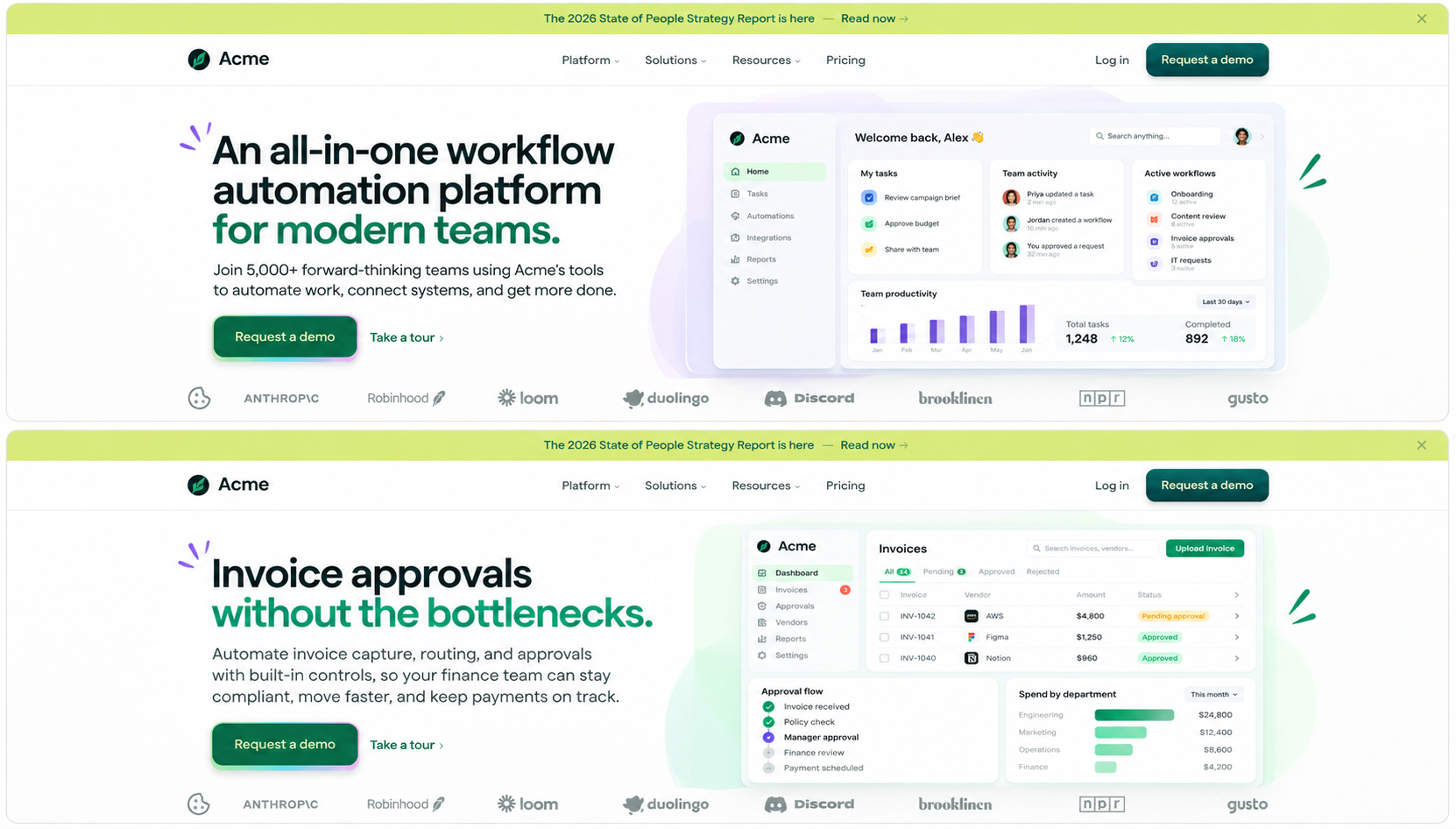
Think about a fictional SaaS company selling workflow automation software. Its original messaging says: "An all-in-one workflow automation platform for modern teams." It sounds acceptable, but it doesn't establish a specific reason to buy. After working with customers, the company discovers that its strongest adoption comes from finance operations teams struggling with manual invoice approvals. A more focused positioning direction might be: "Invoice approval automation for finance teams that need tighter controls without slowing down payments."
Now there's a defined buyer, a recognizable problem, and a reason to investigate the product. The second statement isn't necessarily the final homepage headline. It's a clearer strategic direction that can inform the website, sales pitch, campaigns, and product demonstrations. That's the difference between writing something that sounds marketable and establishing a position that buyers can understand.
Why positioning that worked at Seed may not work at Series A
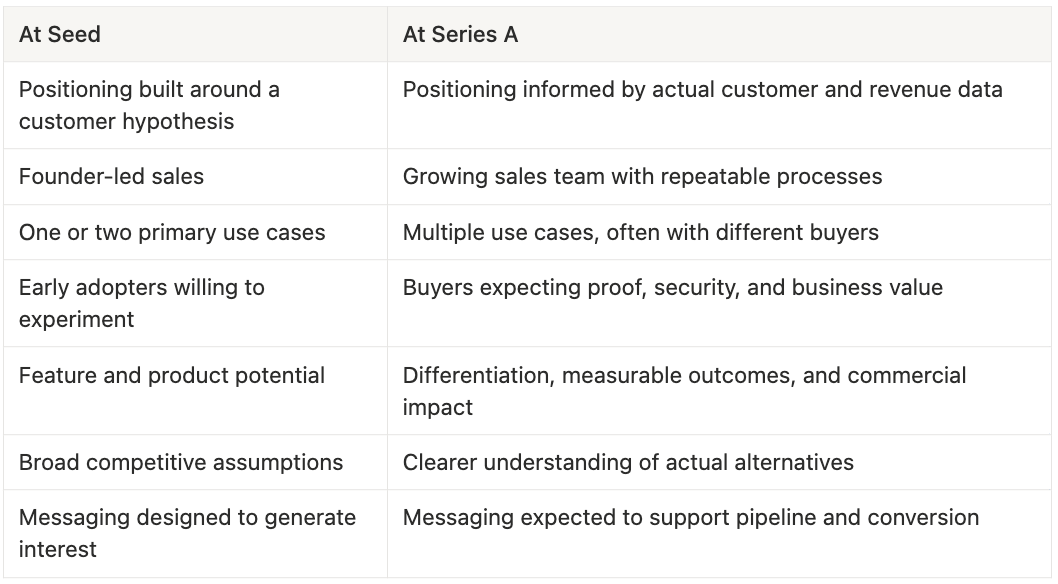
Seed-stage SaaS companies often build their initial positioning around a hypothesis. They have a particular customer in mind, a problem worth solving, and an early product designed to address it. That's completely reasonable. The challenge begins when companies treat their first positioning decision as permanent. By Series A, the company should have more evidence about who buys, who stays, which use cases create value, and what actually differentiates the product.
Here's what changes.
Let's take an example: Consider a project management SaaS that started by helping small agencies manage tasks.
At Seed, "Simple project management for growing teams" might have been enough to attract early users. Two years later, the company discovers its most valuable customers are professional services firms using the product to manage client delivery, utilization, and project profitability. Continuing to position it as another simple task management tool could make it harder to communicate the value those customers actually pay for. The company doesn't necessarily need a rebrand.
It needs to evaluate whether the original market category, ICP, and value proposition still reflect its strongest commercial opportunity. A funding round alone doesn't mean you need new positioning. A meaningful change in your buyers, product value, or competitive environment might.
Liked this read? We've got another one for you: When Should a B2B SaaS Company Hire a Product Marketing Agency?
8 signs your SaaS positioning isn't working
Poor positioning doesn't always announce itself through a dramatic drop in leads. Sometimes it shows up in everyday sales and marketing problems that teams mistakenly try to solve with more content, bigger campaigns, or another website redesign.
1. Your sales team spends too much time explaining what the product does
A prospect joins a discovery call after reading your website, but the first 15 minutes are spent explaining the basics. Some explanation is normal, especially for complex products. But if qualified prospects consistently misunderstand the product category, use case, or value, your messaging might be attracting interest without establishing understanding.
What to examine: Review sales call recordings and identify the questions prospects repeatedly ask before they understand the product.
2. Your website attracts traffic, but the right buyers aren't converting
Traffic growth is encouraging, but it doesn't automatically mean your positioning is effective. If visitors arrive through relevant commercial searches yet rarely request demos, the issue could involve your value proposition, offer, proof, page experience, or audience fit.
What to examine: Compare conversion rates across branded, non-branded, industry-specific, and use-case landing pages before concluding that positioning is the problem.
3. Prospects keep comparing you with the wrong competitors
If buyers repeatedly categorize your product as something it isn't, you're potentially losing control of the competitive conversation.
For example, a revenue intelligence platform might be evaluated as a basic reporting dashboard, even though its primary value comes from improving forecast decisions.
What to examine: Ask sales which products, spreadsheets, internal workflows, or existing processes prospects compare you against.
4. Every sales pitch sounds different
One account executive sells productivity. Another sells cost savings. Marketing promotes AI. The founder talks about business transformation. Different buyer personas may need different messages, but those messages should come from the same underlying positioning.
What to examine: Ask the founder, sales, product, and marketing teams to independently explain the product's primary value and differentiation. Compare their answers.
5. Your biggest differentiator is a feature your competitors also have
"AI-powered," "easy to use," "seamless integrations," and "real-time analytics" are useful capabilities, but they rarely establish differentiation on their own.
The relevant question is what those capabilities enable for a specific buyer that the alternatives don't deliver as effectively.
What to examine: Identify the capabilities customers mention when explaining why they selected or renewed your product.
6. You keep changing campaign messaging without improving results
Your team has tested different headlines, ad creatives, CTAs, and landing pages. Yet qualified conversion remains disappointing. Sometimes the problem isn't the copy. It's the underlying assumption about who needs the product and why.
What to examine: Validate the ICP, buying trigger, competitive alternative, and offer before running another round of copy tests.
7. You're winning customers outside your original ICP
Your original target was startups, but mid-market companies are becoming your most valuable customers. Or your product was built for marketing teams, but operations leaders are driving most purchases. This doesn't automatically mean your original positioning is wrong. It does mean you have evidence worth investigating.
What to examine: Compare win rates, retention, ACV, sales cycle length, and product adoption across customer segments.
8. Your sales team relies heavily on discounts to close deals
Pricing pressure has many causes, including budgets, procurement, competition, and product fit. But if prospects struggle to understand why your product deserves its price, unclear differentiation could be contributing.
What to examine: Analyze pricing objections alongside lost-deal reasons and competitive win/loss data.
Bad positioning doesn't just affect marketing. It affects sales.
This is where SaaS companies often underestimate the problem. Positioning is frequently assigned to marketing, but sales experiences its consequences directly.
A sales representative can deliver an excellent demo, answer technical questions, and build a strong relationship with the prospect. But if the buyer still doesn't understand why the product is meaningfully better than the alternatives, closing becomes harder.
Poor positioning can create several commercial problems:
- Longer sales cycles: Buyers need additional conversations to understand the product's relevance.
- More competitive pressure: Without meaningful differentiation, prospects compare products primarily on features and pricing.
- Lower demo-to-opportunity conversion: Interested prospects may discover the product isn't what they expected.
- Inconsistent qualification: Sales and marketing disagree on which accounts are worth pursuing.
- Weaker business cases: Champions struggle to explain the purchase to finance, procurement, or leadership.
- Greater reliance on founder-led selling: The founder remains the only person who can convincingly communicate the product's value.
Not every sales problem is a positioning problem. Product gaps, pricing, execution, and market demand also matter. But positioning should be investigated when the same misunderstandings appear across different salespeople, campaigns, and customer segments.
As positioning expert April Dunford has discussed, positioning needs to translate into the sales pitch, not remain confined to the marketing team.
Updating your website isn't the same as implementing your positioning
Let's say you've completed a positioning exercise. You've identified your ICP, clarified your differentiation, finalized the messaging framework, and approved the new homepage.
Great. But what happens next?
If the sales deck still uses the old value proposition, paid campaigns target the old audience, and product demos continue emphasizing features unrelated to the new positioning, you've only updated one part of the buyer experience. Positioning is a company-wide decision. Implementation is what makes it useful.
Here's where your positioning needs to show up.
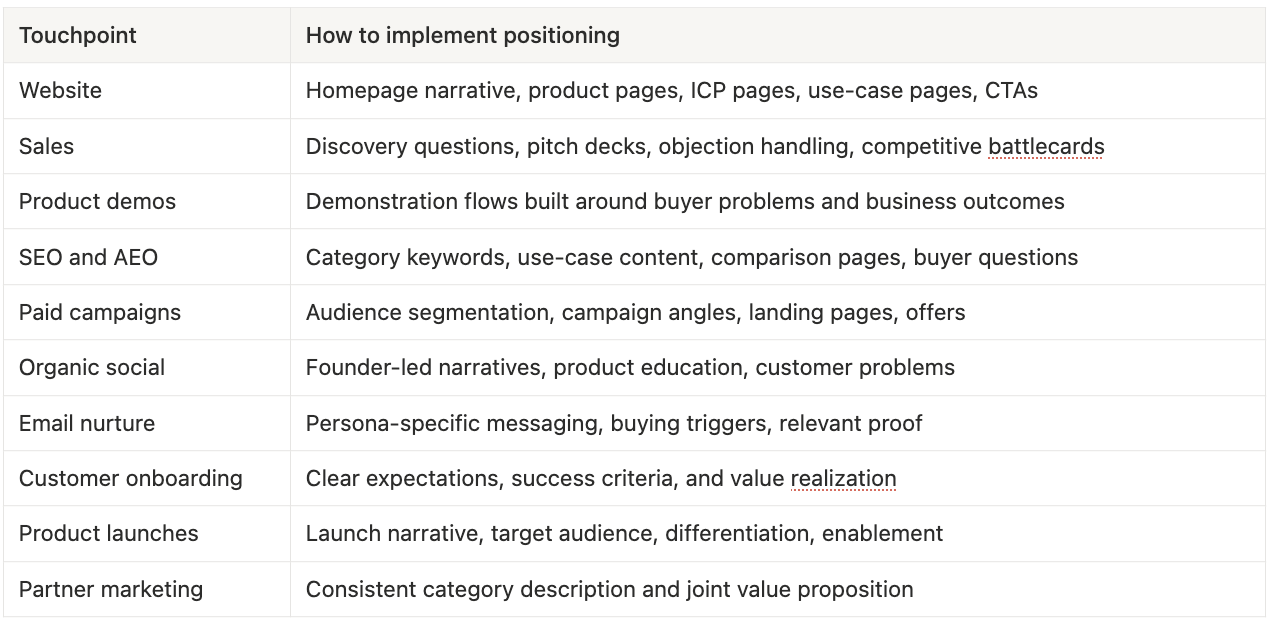
You don't need to rewrite every asset simultaneously. Prioritize the touchpoints that have the greatest influence on qualified pipeline, active opportunities, and customer expectations. For most B2B SaaS companies, that means starting with the homepage, primary product pages, sales narrative, and highest-intent campaigns. Then extend the positioning into supporting channels.
What should early-stage SaaS companies prioritize in positioning?
For pre-seed and Seed-stage companies, positioning should help test a focused market hypothesis without pretending every answer is already known. At this stage, the biggest mistake is trying to appeal to everyone. A product built for everyone rarely communicates a compelling reason for any particular buyer to choose it.
Early-stage SaaS positioning should focus on five questions:
- Who experiences the problem most urgently? Define a specific initial customer segment rather than an enormous addressable market.
- What are customers doing today? Understand whether they use spreadsheets, internal processes, existing software, or nothing at all.
- What makes the problem worth solving now? Identify urgency, frequency, financial impact, or operational consequences.
- Why is your approach worth considering? Explain the meaningful difference without relying entirely on unproven promises.
- What evidence can validate the positioning? Use interviews, pilots, early adoption, activation, and sales conversations.
At this stage, your positioning should be specific enough to test and flexible enough to improve. You don't need to invent a new category or build a complicated messaging architecture before speaking to customers. You need a credible explanation of the problem, buyer, alternative, and value.
What should Series A SaaS companies prioritize in positioning?
At Series A, positioning should become more evidence-led and repeatable. You may have customer segments with different buying behaviors, a growing product portfolio, and a sales team that needs to communicate value without relying on the founder.
The priorities change.
1. Reassess your highest-value ICP. Study which segments have stronger retention, expansion potential, win rates, and sustainable acquisition economics.
2. Identify where you consistently win. Look beyond feature comparisons. Understand which business problems, competitive situations, and buying triggers favor your product.
3. Clarify the category you want buyers to associate with your product. Make sure the category helps prospects understand the offering and compare it appropriately.
4. Develop a repeatable sales narrative. Give sales a consistent commercial story that can be adapted to different stakeholders without changing the core positioning.
5. Connect differentiation to evidence. Use customer outcomes, case studies, implementation data, and product capabilities to substantiate important claims.
6. Align positioning across the GTM organization. Marketing, sales, product, customer success, and leadership should understand the same strategic decisions.
A Series A company doesn't necessarily need more sophisticated language than a Seed company.
It needs stronger evidence, clearer commercial priorities, and better execution.
SaaS positioning should be one of the simplest decisions to communicate
Here's something we believe at Groie: Positioning is serious strategic work. Explaining the outcome shouldn't be complicated.
- A strong positioning exercise requires customer understanding, competitive research, commercial judgment, and sometimes uncomfortable decisions about which audiences not to pursue. But the output should make marketing and sales easier to execute.
- If your positioning framework takes an hour to explain internally, imagine how difficult it will be for a prospect to understand in a 30-second website visit.
- And if you're working with a marketing agency/head of marketing, you should question whether multiple sessions discussing basic messaging decisions are producing meaningful progress.
- Workshops have their place, particularly when teams disagree on the ICP, differentiation, or market category. Complex organizations may genuinely need more stakeholder involvement. But meetings should resolve decisions, not repeatedly revisit the same questions.
A positioning engagement should leave your team with clear answers:
- Who are we selling to?
- What problem are we solving?
- What alternatives are we competing against?
- Why should customers choose us?
- What proof supports our claims?
- How will this translate into marketing and sales?
The objective here is that your team should have a usable commercial direction and not producing the longest positioning document.
How Groie approaches positioning across its memberships
At Groie, positioning and messaging are part of the product marketing work we bring into our two membership engagements: Groie Residency and Groie Privé. The approach is grounded in the company's stage, product maturity, and commercial priorities.
Groie Residency: Positioning for pre-seed to pre-Series A SaaS
For early-stage SaaS companies, we focus on making the initial GTM direction clearer and more actionable. Our positioning work is designed around:
- Understanding the founder's product vision and initial market assumptions.
- Reviewing the ICP, customer problems, and competitive alternatives.
- Identifying the product's most relevant differentiators and value propositions.
- Developing the core messaging and product narrative.
- Translating those decisions into website content, launch messaging, campaigns, and sales materials.
We use focused positioning discussions and working sessions to reach decisions, then connect those decisions to execution. Because an early-stage founder shouldn't have to spend weeks discussing how to describe a product while the launch and GTM work waits.
Groie Privé: Positioning for Series A to Enterprise SaaS
For more established SaaS companies, positioning often involves additional layers. The company may serve several customer segments, have multiple products, or need to align different sales teams around a consistent market narrative. Our positioning work can involve:
- Reassessing ICPs using existing customer, sales, and marketing insights.
- Evaluating market category, competitive differentiation, and portfolio messaging.
- Building messaging hierarchies for different products, solutions, and buyers.
- Aligning product marketing with sales enablement and demand generation.
- Applying the positioning across campaigns, websites, launches, and other GTM touchpoints.
The objective is the same across both memberships: establish clear positioning and make sure it reaches the market. We don't believe positioning should become a separate strategy exercise disconnected from the marketing team responsible for executing it. Your positioning should help your team make decisions, not create another calendar full of meetings.
Did you know Groie only works with 25 companies a year? Yep, there's a reason for that. Here's the story.
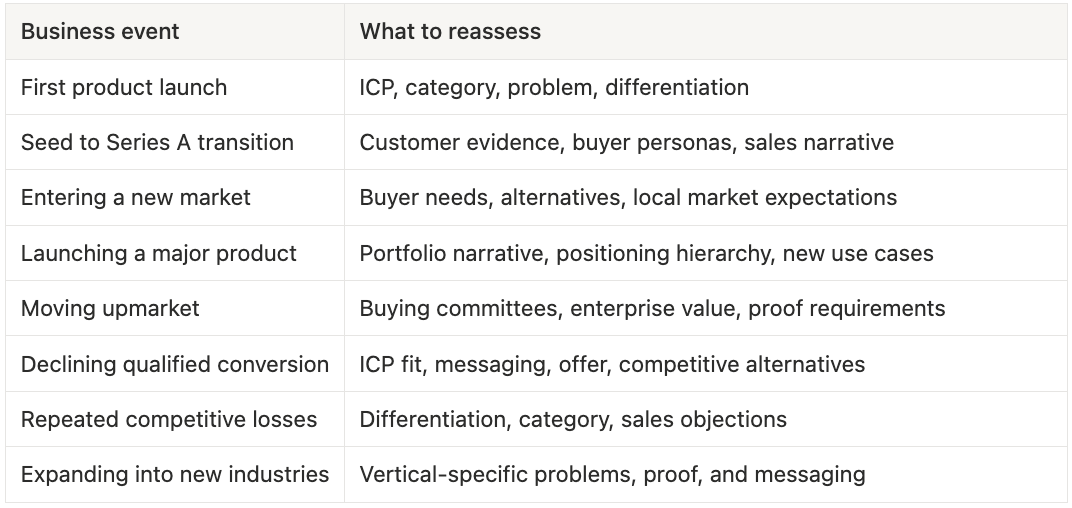
When should a SaaS company revisit its positioning?
Not every new feature, campaign, or funding announcement requires a positioning overhaul. However, there are moments when reviewing your positioning makes commercial sense.
Final thoughts: Your SaaS positioning should grow with your product
The positioning that helped you win your first 10 customers might not be the positioning that helps you win your next hundred. The 1.0 version isn’t wrong, but now your company has learned more about the market. Your buyers may have changed. Your product may solve bigger problems. Your competitive landscape may look different. And your sales process may require a level of clarity that wasn't necessary when the founder handled every conversation.
The important thing is recognizing when your original assumptions no longer reflect the business you're building. And once you've established the right positioning, don't stop at the website. Bring it into your sales conversations, product demos, campaigns, customer onboarding, and every other place where buyers form an opinion about your product. Because positioning isn't just about how you describe your SaaS. It's about helping the right customers understand why they should buy it.
At Groie, we work with SaaS companies across growth stages through Groie Residency and Groie Privé, bringing product marketing, positioning, and GTM execution together. If your product has grown beyond its original story, perhaps it's time your positioning caught up.
Frequently asked questions
What is SaaS positioning?
SaaS positioning defines how a software product should be understood by its target customers relative to competing alternatives. It identifies the ideal customer, primary problem, differentiated value, and market context that inform messaging, sales, and marketing.
What is the difference between SaaS positioning and messaging?
Positioning determines the strategic market position of a product, including its target audience, differentiation, and competitive alternatives. Messaging communicates that positioning through website copy, campaigns, sales pitches, and other customer-facing content.
When should a SaaS startup change its positioning?
A SaaS startup should reassess positioning when customer evidence, buyer segments, product value, competitive alternatives, or GTM strategy materially change. Funding milestones such as Series A can prompt a review, but don't automatically require repositioning.
How does poor positioning affect SaaS sales?
Poor positioning can make it harder for prospects to understand a product's value, distinguish it from competitors, or justify its price. It may contribute to longer sales cycles, inconsistent sales pitches, weaker qualification, and lower conversion rates.
How should SaaS positioning change from Seed to Series A?
At Seed, positioning typically focuses on validating a specific buyer, problem, and differentiated value. At Series A, positioning should incorporate customer evidence, competitive win/loss insights, stronger commercial proof, and a repeatable sales narrative.
Is updating website messaging enough to reposition a SaaS product?
No. A positioning change should be reflected across relevant buyer touchpoints, including the website, sales decks, product demos, paid campaigns, content, email nurture, and customer onboarding. Website updates alone don't establish consistent market positioning.

Author
Groie Team
The Groie Team is a collective of B2B SaaS product marketers, growth strategists, SEO/AEO specialists, designers, and content experts who work with startups and established SaaS companies across industries. Drawing from hands-on experience with 75+ companies, the team shares practical insights on product marketing, positioning, go-to-market strategies, demand generation, and everything that goes into building and scaling a SaaS business.


