
Why Series B SaaS Companies Outgrow Their First Marketing Agency
The marketing partner that helped you find traction may not be equipped to help you scale revenue, enter new markets, and build predictable pipeline. Your first marketing agency probably did exactly what you hired it to do. It helped launch your website, build your content engine, establish your brand, run campaigns, and create some early traction. Maybe it even helped you get to your Series B.
But something changes as your SaaS company grows. You have more customers, more product capabilities, a larger sales team, higher revenue expectations, and investors asking increasingly difficult questions about customer acquisition costs, pipeline contribution, and marketing efficiency.
Your agency, meanwhile, is still discussing blog calendars, ad impressions, social media engagement, and the number of campaigns delivered last month. The problem isn't necessarily that your agency has stopped performing.
It's that your business has moved into a different stage of growth, and your marketing requirements have changed with it. For Series B SaaS companies, choosing the right B2B SaaS marketing agency is no longer simply about finding a team that can execute marketing activities. It's about finding a partner capable of connecting product marketing, demand generation, customer acquisition, and revenue growth.
Here's why many growth-stage SaaS companies outgrow their first agency, what changes after Series B, and how to evaluate the marketing partner you need next.
What Changes in Marketing After Series B?
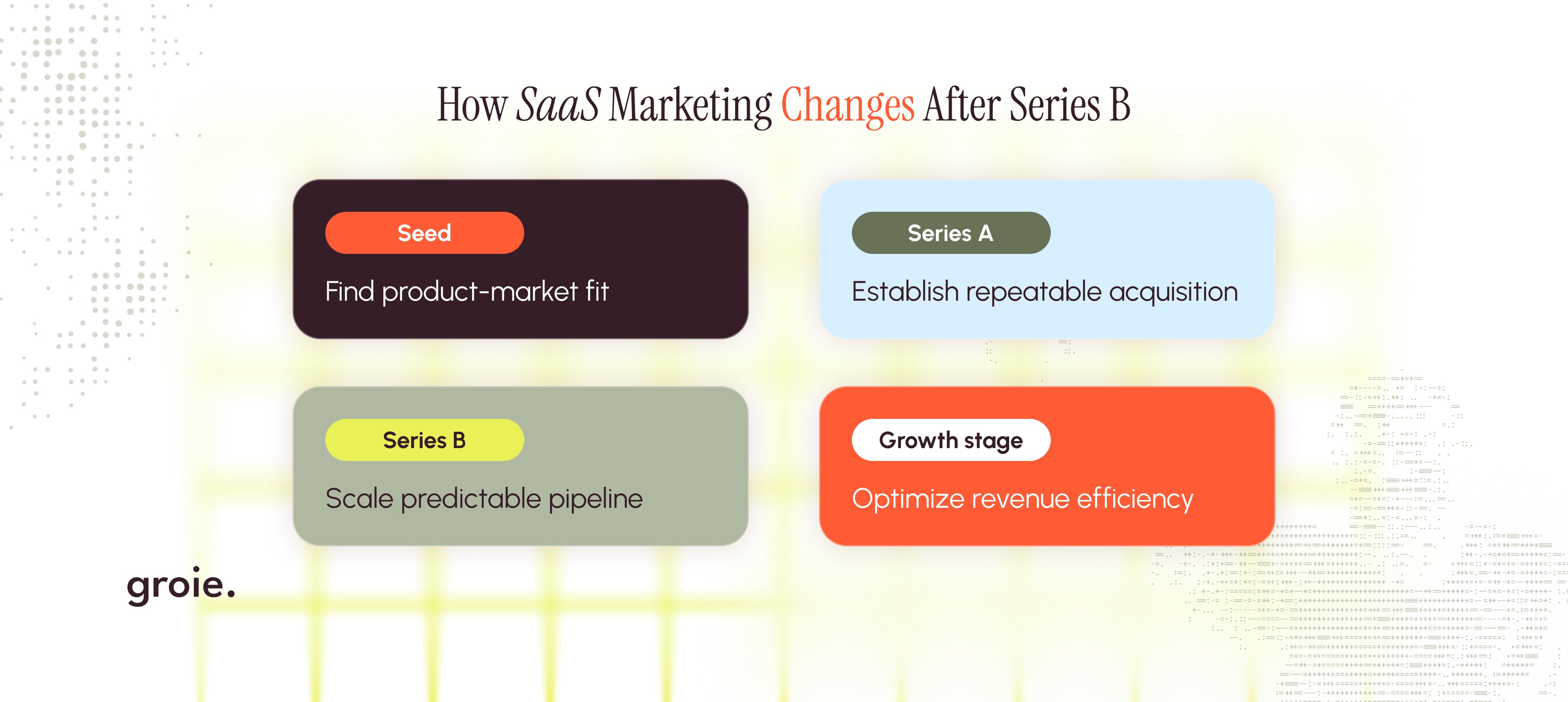
Before Series B, marketing is often focused on establishing traction. The company needs to validate its positioning, attract early customers, develop an acquisition strategy, and determine which channels deserve further investment. A smaller marketing agency can be an excellent fit at this stage. It can help founders move quickly without committing to a large in-house marketing department.
After Series B, the expectations become more demanding. The business may now need to support several customer segments, multiple products, a growing sales organization, and expansion into new markets. Marketing must become more predictable, measurable, and closely connected to revenue.
This shift changes what a Series B SaaS marketing agency needs to deliver. The question is no longer whether your agency can produce marketing assets. It's whether those assets are part of a system that helps your business acquire customers more efficiently.
7 Signs Your Series B SaaS Company Has Outgrown Its Marketing Agency

1. Your agency executes campaigns but doesn't challenge your strategy
You tell your agency to produce four blogs, launch a LinkedIn campaign, redesign a landing page, or build a webinar funnel. They do it.
Everything arrives on time. The work looks professional. The monthly report lists all the completed deliverables. But nobody asks whether the campaign targets the right buyer, whether the landing page addresses the actual objection, or whether the channel deserves continued investment.
This becomes a serious limitation at Series B. Your marketing partner should understand your product, ICP, competitive environment, sales cycle, and growth priorities well enough to challenge a request when it doesn't make commercial sense.
For example, if your sales team is struggling to convert enterprise opportunities, producing another ten awareness articles might not be the highest-impact use of your budget. You may need stronger competitive positioning, better proof points, industry-specific landing pages, or sales enablement.
What you need instead: A strategic SaaS marketing partner that evaluates business priorities before assigning deliverables.
2. You're getting marketing reports, but not answers about pipeline
Your SEO agency reports increasing impressions. Your paid marketing agency reports a lower cost per click. Your content team reports more published articles. Your social media agency reports engagement growth.
All of these metrics can be useful, but none independently explains whether marketing is helping the company acquire more customers. At Series B, leadership needs to understand how marketing investments influence revenue.
That means examining questions such as:
- Which campaigns are generating sales-qualified opportunities?
- Which channels contribute to pipeline?
- What percentage of marketing-generated leads convert into opportunities?
- How do acquisition costs vary across channels and customer segments?
- Where are prospects dropping out of the funnel?
- Which content and campaigns help accelerate existing opportunities?
Not every marketing activity should be judged by immediate revenue. Brand development, category education, and organic acquisition often require longer measurement periods. But your agency should be able to explain the commercial purpose of its work and how performance will be evaluated.
What you need instead: A B2B SaaS growth marketing agency that connects channel performance with CRM data, funnel conversion, sales feedback, and pipeline outcomes.
3. Your marketing channels operate independently
Your SEO team is targeting one audience. Your paid campaigns are targeting another. Your product marketing team is developing a new positioning framework. Your sales team is using messaging from six months ago.
Meanwhile, your website tells a slightly different story.This fragmentation becomes expensive as your company grows.Consider a Series B SaaS company entering the enterprise market.
Its product marketing team identifies a new enterprise ICP, but the content agency continues publishing articles for small businesses. Paid campaigns drive traffic to generic landing pages, while the sales team pitches a more sophisticated enterprise value proposition.
Every team is working. The overall strategy isn't aligned. An effective Series B marketing strategy needs coordination across channels. Product marketing should inform demand generation. Sales feedback should influence positioning. Content should support buyer education and commercial conversion. Website experiences should reflect the audiences targeted by campaigns.
What you need instead: An integrated B2B SaaS marketing team working from one strategy, with shared context and commercial priorities.
4. Your agency understands marketing, but not your product
This is one of the biggest challenges for technical B2B SaaS companies. Your agency may understand SEO, advertising, content production, and campaign management. But does it understand your product's architecture, use cases, integrations, buying committees, implementation considerations, and competitive differentiation?
Can the team explain why an enterprise customer should choose your product over an established competitor? Can it distinguish between the requirements of a technical evaluator, an economic buyer, and an end user? As SaaS companies move toward Series B, product complexity often increases. New features, integrations, customer segments, and product lines create additional messaging challenges.
Generic marketing execution becomes less effective when the underlying product story requires deeper understanding. This is why product marketing becomes central to growth-stage marketing. Your partner needs to translate product capabilities into commercially relevant messaging, develop differentiated narratives, and support go-to-market execution.
What you need instead: A SaaS product marketing agency that understands the product before building the campaigns.
5. You're spending more on acquisition without improving efficiency
Increasing marketing budgets can temporarily disguise an inefficient acquisition strategy. If paid acquisition costs are rising, the immediate response might be to increase spending, launch more campaigns, or experiment with another channel. But the underlying problem could be somewhere else.
Perhaps your landing pages aren't converting. Your positioning attracts the wrong audience. Your campaigns are targeting low-intent buyers. Your nurture sequence isn't helping prospects progress. Or your sales team isn't receiving the information it needs to convert opportunities.
At Series B, simply increasing acquisition volume isn't enough.Marketing teams need to understand how channel performance, customer acquisition costs, funnel conversion, and sales efficiency interact. A capable SaaS demand generation agency should identify where the acquisition system is underperforming before recommending additional spending.
What you need instead: A marketing partner that can improve conversion and acquisition efficiency across the funnel, not just manage individual campaigns.
6. Every new marketing requirement means hiring another specialist
Your original agency handles SEO and content. Then you need account-based marketing, so you hire an ABM consultant. You need HubSpot workflows, so you bring in a CRM specialist. Your website needs conversion optimization, so you engage a CRO agency. Then come product launches, paid media, sales enablement, and executive thought leadership. Soon, your marketing leader is coordinating multiple external partners, each with different reporting formats, timelines, and priorities.
Specialist agencies can deliver excellent results, and there are situations where they remain the right choice. But the coordination costs increase when no single partner owns the relationship between strategy and execution. Your internal team ends up spending substantial time briefing vendors, reconciling recommendations, and ensuring that everyone is working toward the same commercial objectives.
What you need instead: A cross-functional SaaS marketing partner capable of handling interconnected marketing priorities, while working alongside your existing internal specialists.
7. Your agency hasn't evolved with your business
The agency you hired at $1 million ARR may have been perfect for the company you were building then. But your requirements at $10 million ARR can look very different. You may now need to enter new geographic markets, compete against larger companies, reposition a growing product portfolio, support enterprise sales, or build more sophisticated account-based campaigns.
Your agency should evolve its strategy, team composition, and capabilities as your company changes. If you're still receiving essentially the same monthly deliverables you received two years ago, it's worth questioning whether the engagement has kept pace with the business. The most useful question isn't whether your agency is doing good work. It's whether that work is solving the problems your company has today.
What Should a Series B SaaS Marketing Agency Actually Deliver?
A growth-stage SaaS marketing partner should bring capabilities that extend beyond individual channels. That doesn't mean every company needs every service simultaneously. It means the partner should be able to identify the highest-impact priorities and connect execution across the relevant functions.
Strategic product marketing and GTM
As products and customer segments expand, positioning needs to remain differentiated and commercially relevant. This may involve ICP refinement, market segmentation, competitive positioning, product launches, pricing and packaging messaging, and enterprise go-to-market strategy.
Demand generation and pipeline development
A Series B demand generation strategy should combine acquisition, conversion, and nurture rather than treating lead generation as a standalone activity. Depending on the business, this could include paid acquisition, organic search, account-based marketing, email campaigns, webinars, and industry-specific programs.
SEO, AEO, and category visibility
Growth-stage SaaS companies need a strong B2B SaaS SEO strategy to capture existing demand while establishing authority around the problems their products solve. That requires a coordinated approach to technical SEO, commercially relevant content, website architecture, and answer engine optimization.
Website conversion optimization
A website supporting multiple ICPs and products needs clear buyer journeys, differentiated messaging, and conversion paths. The objective is to help prospective buyers evaluate the product and move toward a commercial conversation.
Lifecycle marketing and RevOps alignment
Acquiring a lead is only part of the process. CRM workflows, segmentation, nurture programs, lead management, and reporting need to support the relationship between marketing and sales.
Sales enablement
Marketing should help sales teams explain product value, handle competitive objections, and communicate effectively with different stakeholders. That includes battlecards, industry-specific collateral, product narratives, account-based content, and sales presentations. The most effective partner isn't necessarily the one offering the longest service list. It's the one that understands which capabilities your business needs, how they connect, and what should be prioritized.
Should You Replace Your Existing Agency or Expand Your In-House Team?
Not every Series B SaaS company needs to replace its marketing agency. Sometimes the right decision is to retain a strong specialist partner while building internal capabilities around it. In other cases, the business needs a more integrated external team. Here are three common approaches.
For many Series B companies, a hybrid model makes sense. The internal marketing leader owns business priorities, budget, stakeholder alignment, and long-term direction. An external strategic partner brings specialized capabilities, execution capacity, and additional perspectives without requiring the company to hire every role immediately. The important factor is ownership. Someone needs to connect the work across functions and ensure that marketing activity supports the business strategy.
How to Evaluate Your Next B2B SaaS Marketing Agency
Before hiring a new marketing partner, ask questions that reveal how the agency thinks, not simply what it produces.
1. How will you understand our product and buyers?
Look for a discovery process involving product understanding, ICP research, sales conversations, competitive analysis, and existing performance data.
2. How do you decide which marketing activities to prioritize?
A credible partner should explain how it evaluates business objectives, channel opportunities, funnel gaps, and available resources.
3. How do you connect marketing performance with pipeline?
Ask how the agency works with CRM data, attribution, conversion metrics, and sales feedback.
4. Who will actually work on our account?
Understand the difference between the senior team involved in the pitch and the people responsible for strategy and execution.
5. Can you support more than one marketing function?
Determine whether the agency can connect product marketing, content, demand generation, website optimization, and lifecycle marketing.
6. How do you handle strategies that aren't working?
A strong partner should be comfortable identifying underperformance, changing priorities, and explaining decisions with evidence.
7. What will success look like after six months?
The answer should reflect your company's starting point and commercial priorities, not a generic promise of more traffic or leads.
These questions help distinguish an execution vendor from a strategic marketing partner.
Groie Privé: Built for SaaS Companies That Have Outgrown Conventional Agency Models
At Groie, we work with B2B SaaS companies that need marketing to operate as a coordinated growth function. Our approach starts with understanding the product, the buyers, the competitive landscape, and the commercial problems marketing needs to solve. We don't begin an engagement by assigning a predetermined content calendar or recommending every available marketing channel.
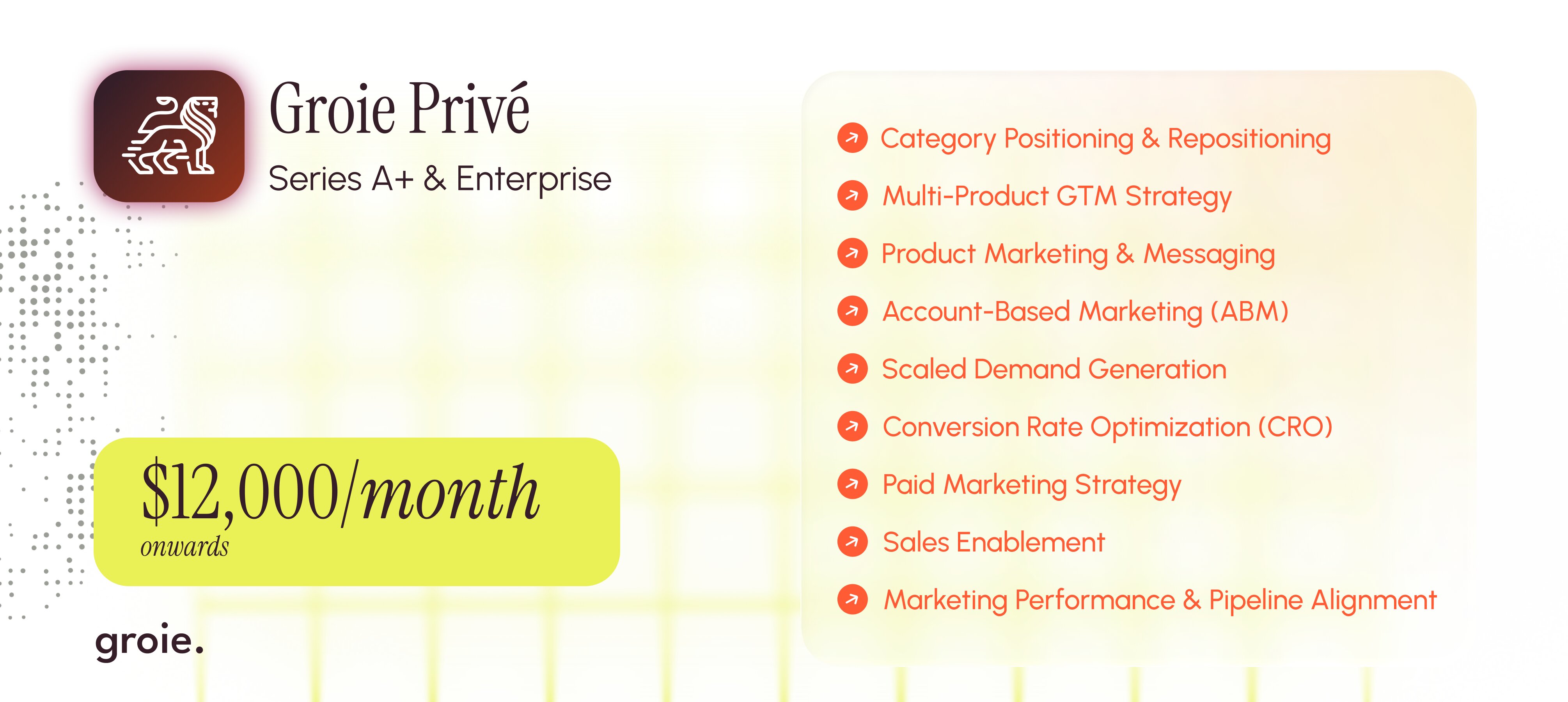
We first evaluate what's working, what's underperforming, and where the business has the strongest opportunities for improvement. That's the thinking behind Groie Privé, our marketing membership for Series A, Series B, and enterprise SaaS companies.
One strategy. Multiple marketing disciplines.
Groie Privé brings together product marketing, growth strategy, demand generation, content, website optimization, and sales enablement within a coordinated engagement.
Depending on your company's priorities, our work can include:
- Category positioning and multi-product messaging
- Enterprise go-to-market strategy
- Account-based marketing and demand generation
- SEO, AEO, and content-led acquisition
- Paid marketing strategy and execution
- Website conversion optimization
- CRM, lifecycle marketing, and nurture
- Sales enablement and competitive messaging
- Marketing analytics and performance optimization
Our product marketers, designers, content specialists, developers, and growth marketers work from a shared understanding of the business. That means your positioning strategy isn't disconnected from your paid campaigns. Your SEO content isn't disconnected from your sales narrative. And your website isn't treated as an independent design project.
Senior involvement doesn't end after the pitch
Groie operates with a deliberately limited client portfolio. Our founders remain involved in engagements because we believe strategic decisions should stay close to the people responsible for execution. We also believe agencies should be willing to challenge clients.
If a campaign doesn't make commercial sense, we'll say so. If a website problem needs fixing before additional acquisition spending, we'll recommend addressing it first. The objective isn't to maximize the number of deliverables. It's to make the marketing function more effective.
We measure what matters to the business
For growth-stage SaaS companies, that means looking beyond surface-level channel reporting. We focus on indicators such as relevant traffic, conversion rates, qualified inquiries, pipeline contribution, acquisition efficiency, and campaign performance. Not every result happens immediately, and not every channel has the same measurement window.
But the work should have a clear purpose, an agreed measurement framework, and accountability for execution. Groie Privé starts at $12,000 per month, with 8 and 12-month engagement options. Scope is determined by the company's priorities and agreed engagement.
The Next Stage of SaaS Growth Requires a Different Kind of Marketing Partnership
Outgrowing your first marketing agency doesn't mean the original partnership was a mistake. The agency may have played an important role in helping your company establish its market presence and reach its current stage. But Series B introduces a different set of expectations.
Marketing must support a more complex product, a larger sales organization, multiple buyer segments, and increasingly demanding revenue goals. If your current agency can evolve to meet those requirements, the relationship may still have considerable value. If it can't, continuing with the same operating model can create friction between marketing activity and business growth.
The next agency you hire should understand more than marketing channels. It should understand how your product is bought, how your market is changing, and how marketing contributes to the company's next stage of growth. Your SaaS company has grown. Your marketing operating model should grow with it. If you're evaluating your next B2B SaaS marketing partner, we'd like to understand what you're building and where marketing needs to perform better.
Frequently Asked Questions
When should a Series B SaaS company switch marketing agencies?
A Series B SaaS company should consider switching agencies when its existing partner can no longer support changing business requirements. Common indicators include disconnected marketing channels, limited product understanding, weak pipeline reporting, insufficient strategic involvement, and an inability to support new markets or customer segments. Before switching, evaluate whether the current agency can adapt its capabilities and operating model.
What should a Series B SaaS marketing agency specialize in?
A Series B SaaS marketing agency should understand B2B buying cycles, product marketing, demand generation, account-based marketing, SEO, website conversion optimization, and marketing-to-sales alignment. The right combination depends on the company's growth priorities, product complexity, and internal capabilities.
How much does a Series B SaaS marketing agency cost?
Pricing varies depending on the scope, expertise, senior involvement, and execution requirements. Specialist agencies may charge for individual services, while integrated marketing partners typically use broader retainers. Groie Privé starts at $12,000 per month and offers coordinated marketing capabilities for growth-stage SaaS companies.
Should Series B SaaS companies hire an in-house marketing team or an agency?
Many Series B SaaS companies benefit from a hybrid model combining internal marketing leadership with external specialists. An internal leader can own business priorities and stakeholder alignment, while an agency provides execution capacity and expertise across specific functions. The best structure depends on budget, existing capabilities, and the predictability of marketing requirements.
What is the difference between a SaaS marketing agency and a SaaS growth marketing agency?
A SaaS marketing agency may provide services such as content, SEO, advertising, and website development. A SaaS growth marketing agency typically places greater emphasis on acquisition, conversion, experimentation, and measurable business outcomes. However, the distinction depends on the actual capabilities and operating model of the agency, not simply its positioning.
What marketing KPIs should Series B SaaS companies track?
Series B SaaS companies should track metrics that connect marketing performance to commercial outcomes. These may include marketing-sourced and marketing-influenced pipeline, lead-to-opportunity conversion, customer acquisition cost, CAC payback period, website conversion rates, sales-qualified opportunities, and channel efficiency. Metrics should reflect the company's sales cycle and revenue model.
How can a marketing agency help a SaaS company scale after Series B funding?
A marketing agency can help by strengthening positioning, identifying acquisition opportunities, improving conversion, supporting expansion into new markets, developing account-based programs, and aligning demand generation with sales. The objective is to build repeatable marketing capabilities that support the company's revenue goals.
What makes Groie Privé different from a traditional B2B SaaS marketing agency?
Groie Privé is an embedded marketing membership that brings together product marketing, demand generation, content, website optimization, and other growth capabilities under a coordinated strategy. Groie maintains a limited client portfolio, keeps its founders involved in engagements, and emphasizes measurable commercial performance rather than deliverable volume alone.

Author
Anwesha Roy
After spending nearly a decade in B2B space, as a founding partner in Groie, we help early stage SaaS startups with their GTM. Groie is built keeping in mind, what SaaS founders need, and we do exactly that.


