
How Groie Helped Buckstop, a Renewable Energy Valuation Company, Increase Organic Traffic by 880%
An inside look at the B2B SaaS SEO strategy that turned a complex renewable energy product into a measurable inbound growth engine. Getting organic traffic is difficult enough for a B2B SaaS company. Getting the right people to discover a highly technical product, understand its value, and eventually become inbound leads is an entirely different challenge.
For companies operating in specialized industries, the traditional SEO playbook often falls short. Search volumes are smaller, buying committees are more complex, and potential customers rarely search for products using the same terminology that companies use to describe them.
This was the challenge facing Buckstop, a renewable energy asset intelligence company operating in a specialized market where asset valuation, insurance, financing, and end-of-life recovery intersect. Buckstop had the technical expertise, a differentiated product, and a growing market opportunity. What it needed was a marketing foundation capable of translating that expertise into organic visibility and qualified demand.
Groie stepped in to rebuild that foundation. The results demonstrate what a structured B2B SaaS SEO strategy can accomplish when positioning, website experience, content, and demand generation work together.
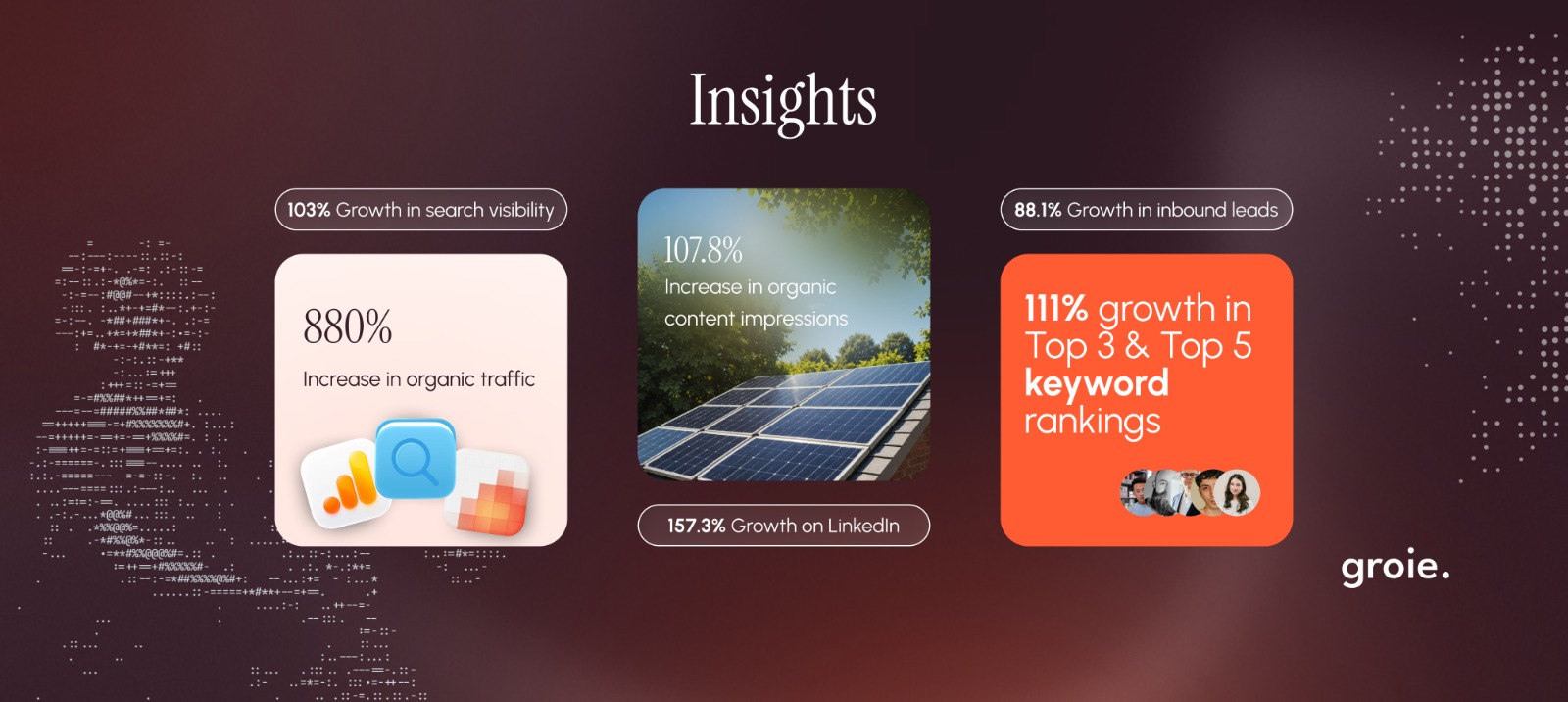
- 880% increase in organic traffic
- 111% growth in Top 3 and Top 5 keyword rankings
- 88.1% growth in inbound leads
- 34 inbound leads generated in a single month, up from approximately 1–2 per month
- First inbound lead generated within 32 days
This B2B SaaS SEO case study explains what Groie changed, why those changes mattered, and how other niche B2B technology companies can apply similar principles to their organic growth strategies.
About Buckstop: A Complex Product in a Specialized Market
Buckstop is a Washington, DC-based renewable energy asset intelligence company that helps organizations understand the value and risk of renewable energy assets. Its platform combines asset-level data, valuation methodologies, and market intelligence to support decisions involving renewable energy asset valuation, financing, insurance, appraisal, recovery, and decommissioning.
Buckstop serves several distinct buyer groups, including:
- Asset owners and independent power producers: Organizations managing renewable energy portfolios and making decisions about financing, repowering, asset recovery, and end-of-life planning.
- Lenders and capital providers: Financial institutions evaluating renewable energy assets as collateral and assessing portfolio exposure.
- Insurers and brokers: Professionals who need defensible asset valuations to support underwriting and risk decisions.
- Resellers and recyclers: Organizations evaluating equipment recovery, resale, and material value.
Each audience approaches renewable energy valuation from a different perspective. A lender researching solar project valuation may be concerned about collateral exposure. An insurer may need to understand asset value for underwriting. An asset owner may be evaluating residual value before repowering or decommissioning.
The underlying technology may be the same, but the buying motivations, search behavior, and information requirements differ considerably. That distinction became central to Groie's strategy.
The Challenge: Strong Technical Expertise, Limited Organic Discoverability
Buckstop's challenge wasn't a lack of product differentiation. It was the absence of a marketing system that could communicate that differentiation consistently and capture relevant demand. Before Groie's engagement, several connected issues needed attention.
1. Positioning didn't fully communicate the product's value
Buckstop operated in a market where concepts such as residual value, asset recovery, appraisal methodologies, and lifecycle intelligence could be difficult to explain.
The company needed messaging that communicated its capabilities without requiring every prospective customer to understand the underlying technical methodology first. It also needed to connect those capabilities to specific business outcomes for different buyer groups.
2. The website needed clearer buyer journeys
A renewable energy lender and an insurance underwriter shouldn't have to follow the same path to understand how Buckstop can help them. The existing website needed a more deliberate information architecture, clearer solution narratives, and conversion paths aligned with different audiences. Without those elements, attracting additional visitors wouldn't necessarily translate into more meaningful commercial conversations.
3. Technical expertise wasn't consistently translating into search visibility
Buckstop had substantial domain expertise, but that knowledge needed to become discoverable through organic search. Relevant buyers were researching renewable energy asset valuation, solar project valuation, appraisals, insurance, decommissioning, and asset recovery. Groie needed to connect those searches to Buckstop's capabilities through a structured SaaS keyword research and content strategy.
4. Inbound acquisition needed to become repeatable
Buckstop was generating approximately one to two inbound leads per month. The goal wasn't simply to publish more content or increase impressions. It was to create a repeatable acquisition system that could attract relevant visitors, educate potential buyers, and convert interest into conversations. This required more than conventional organic search optimization. It required coordinated work across product marketing, website strategy, SEO, content, and demand generation.
The Strategy: How Groie Built Buckstop's Organic Growth Engine
Groie's approach followed a deliberate sequence. Rather than starting with a blog calendar or an arbitrary keyword target, we first addressed the foundations that would determine whether additional search visibility could translate into commercial value.
Phase 1: Rebuild the SaaS Positioning and Messaging Strategy
The first step was understanding what Buckstop sold, who bought it, and why those buyers would choose Buckstop over existing alternatives. Groie conducted positioning and messaging workshops with the Buckstop team, reviewed previous messaging, listened to sales calls, and analyzed the company's products, use cases, and buyer requirements. This work helped us identify how different audiences understood the problem Buckstop was solving.
For example, renewable energy asset valuation could mean different things depending on the buyer:
- A lender may need current asset values to support credit and collateral decisions.
- An insurer may need defensible valuation information for underwriting.
- An asset owner may need to evaluate the financial implications of repowering or decommissioning.
- A recycler may need to understand recoverable equipment and material value.
Instead of forcing these audiences into one generic product narrative, Groie developed a messaging architecture that connected Buckstop's capabilities to specific buyer needs.
Why this matters for B2B SaaS SEO
Search visibility can introduce a company to prospective customers, but positioning determines whether those visitors understand why the product is relevant. A strong SaaS positioning and messaging strategy improves the relationship between search intent, landing-page content, product differentiation, and conversion.
For technical SaaS companies, this is particularly important because buyers often search for solutions to business problems rather than proprietary product categories.
Phase 2: Rebuild the Website Around Search Intent and Conversion
Once the positioning was established, Groie rebuilt Buckstop's website architecture, user experience, copy, and conversion paths. The objective was to make the website work as an acquisition channel rather than a static company presentation.
The revamped website introduced clearer audience journeys and dedicated content for Buckstop's solutions, capabilities, and methodology. This allowed prospective buyers to understand the product through the lens of their own requirements.
For instance, someone researching renewable energy asset valuation could discover Buckstop through educational content and then navigate toward the most relevant product capability or service. The website was designed to support a progression from discovery to understanding to commercial action.
How SaaS website conversion optimization supported SEO
Organic traffic growth only becomes commercially meaningful when visitors can identify the next step. Groie's website work connected search-driven discovery with clearer navigation, relevant messaging, and conversion opportunities.
That meant the SEO strategy and website conversion optimization strategy weren't competing priorities. They were designed together. This is an important distinction for early-stage SaaS companies evaluating a B2B SaaS SEO agency.
A technically optimized website can attract visitors while still failing to generate demand if the product story, audience relevance, and conversion experience remain unclear.
Phase 3: Build a B2B SaaS SEO and Content Strategy Around Buyer Questions
With the website foundation in place, Groie developed an SEO and content strategy based on the topics Buckstop's buyers were already researching. Instead of relying exclusively on broad, high-volume keywords, we focused on the intersection of search intent, technical relevance, and commercial opportunity.
The strategy covered subjects such as:
- Renewable energy asset valuation
- Solar project valuation
- Renewable energy insurance and underwriting
- Asset appraisal methodologies
- Decommissioning planning
- Residual value and asset recovery
These subjects connected Buckstop's expertise to the questions prospective buyers needed answered before evaluating a solution.
SaaS keyword research based on commercial relevance
For niche B2B technology companies, keyword volume alone is a poor indicator of business value. A highly specific search may attract fewer visitors than a broad industry term, but those visitors may be substantially more relevant to the product.
Groie's approach prioritized understanding the buyer's problem, the terminology they used, and how the search related to Buckstop's capabilities. The content strategy then connected those search opportunities to relevant website pages and buyer journeys.
Technical SEO for SaaS
Technical SEO formed part of the inbound engine alongside content and conversion paths. A scalable organic search strategy needs a website that search engines can discover, crawl, and understand, with content organized around clear topics and user intent.
For Buckstop, technical SEO was integrated with the broader website and content strategy rather than handled as a disconnected exercise.
Turning technical knowledge into useful content
Buckstop's competitive advantage included its expertise in renewable energy valuation and asset intelligence. Groie's role was to translate that expertise into content that answered buyer questions without stripping away the technical depth that made it valuable.
This is where a SaaS content strategy differs from publishing generic industry articles. The content must demonstrate genuine expertise, explain complex concepts clearly, and help prospective customers understand when a product or service is relevant to their business.
Phase 4: Connect Organic Discovery With Distribution and Nurture
SEO was an important acquisition channel, but it wasn't the entire growth strategy. Renewable energy financing, insurance, and asset management involve complex decisions and multiple stakeholders. Prospective customers may need several interactions before they're ready to speak with a provider.
Groie built additional distribution and nurture capabilities around Buckstop's inbound foundation.
These included:
- Email nurture campaigns
- Cold database outreach
- Webinars
- Organic social media
- Founder-led content
- Video marketing
- Newsletters
Each channel created another opportunity to educate prospective buyers and bring relevant audiences back into Buckstop's marketing funnel. For example, a technical article could introduce a topic through search, while a webinar or email campaign could provide additional context for buyers evaluating the same problem.
The purpose was to make Buckstop's expertise accessible across more than one touchpoint. The result was a connected marketing system where positioning informed the website, the website supported SEO, and distribution helped extend the reach of the company's expertise.
The Results: 880% Organic Traffic Growth and 34 Monthly Inbound Leads
The strongest evidence of a successful B2B SaaS organic growth strategy is measurable improvement in both discoverability and demand.
Buckstop's engagement with Groie delivered growth across multiple indicators.
These results demonstrate improvements at different stages of the acquisition process.
Organic traffic increased by 880%
Buckstop became substantially more discoverable through organic search. The growth reflected the value of combining stronger positioning, a clearer website structure, relevant content, and technical SEO within a coordinated strategy. For a company operating in a specialized B2B market, this kind of increase is especially meaningful because the addressable search audience is relatively focused.
Top keyword rankings grew by 111%
Buckstop also recorded 111% growth in its Top 3 and Top 5 keyword rankings. Higher visibility in these search positions increases the opportunity for prospective customers to encounter a company's content when researching relevant problems. For niche SaaS companies, building visibility across commercially relevant topics can be more valuable than pursuing unrelated high-volume searches.
Inbound leads increased to 34 in a single month
The most important outcome wasn't the traffic increase alone. Buckstop moved from approximately one to two inbound leads per month to 34 in a single month, with its first inbound lead arriving within 32 days of Groie beginning work on the inbound engine. The case study also recorded 88.1% growth in inbound leads.
These are reported performance indicators from the engagement, not a claim that SEO alone generated every lead. Buckstop's inbound growth was supported by the combined marketing system, including website improvements, organic search, content, and additional demand-generation activities.
That distinction matters.Organic traffic is an acquisition metric. Inbound demand is a business outcome. A B2B SaaS SEO strategy should be evaluated on both.
What Buckstop's CEO Said About Working With Groie
Alexander Olesen, CEO of Buckstop, highlighted Groie's technical understanding, data-driven approach, speed, and ability to build a marketing system that the company could continue scaling. His feedback emphasized an important difference between producing individual marketing assets and building an integrated marketing capability.
For Buckstop, the engagement extended beyond SEO deliverables to positioning, website development, content, and demand generation. The partnership also continued beyond the initial engagement.
Buckstop renewed with Groie, with the next phase focused on expanding content distribution, reaching additional qualified audiences, developing more channels for MQL and SQL generation, and introducing paid marketing as another acquisition layer.
Read the complete Buckstop case study and client feedback.
What This B2B SaaS SEO Case Study Teaches Early-Stage Companies
Buckstop's growth offers several lessons for founders and marketing leaders evaluating SEO services for growing B2B SaaS companies.
1. Don't start SEO before understanding your buyers
Keyword research should follow a clear understanding of the product, ideal customer profiles, buyer problems, and sales process. Without that foundation, companies risk attracting visitors who have little reason to evaluate their product.
2. SEO and product marketing should work together
A B2B SaaS SEO strategy becomes stronger when it is informed by positioning, competitive differentiation, and customer use cases. SEO determines how prospective buyers discover a company. Product marketing helps ensure they understand what makes its solution relevant.
3. Search volume isn't the same as commercial opportunity
Niche B2B companies often operate in markets with relatively small keyword volumes. That doesn't make organic search less valuable. It means keyword selection must account for buyer relevance, intent, and the potential business value of the audience.
4. Website conversion matters as much as acquisition
Increasing traffic to a website with unclear messaging or poor buyer journeys can limit the commercial return from SEO. Organic growth and SaaS website conversion optimization need to be planned together.
5. SEO should support a broader demand-generation system
A buyer who discovers a company through organic search may not be ready to purchase immediately. Email nurture, founder-led content, webinars, and other channels can help maintain engagement throughout the buying process. The objective isn't to make every channel operate independently. It's to create a connected system that supports the customer journey.
Why Groie Residency Is Built for This Kind of Growth
Buckstop's experience illustrates why we believe early-stage SaaS companies need more than a collection of disconnected marketing services. A founder might hire one agency for SEO, another for website development, a freelancer for content, and a separate consultant for positioning.
But these activities influence one another. If the positioning changes, the website needs to reflect it. If keyword research reveals a new buyer problem, the content and landing-page strategy need to respond. If traffic grows without conversions, the acquisition and website experience need to be evaluated together. That's the thinking behind Groie Residency.
Groie Residency is our embedded B2B SaaS marketing membership for companies that need a structured marketing function without building every capability in-house. Rather than selling SEO as an isolated deliverable, Residency brings together the expertise required to build and improve a company's acquisition system.
What Groie Residency can cover
Depending on the company's priorities and agreed scope, the membership can bring together:
Product marketing and positioning: ICP research, competitive analysis, messaging architecture, product narratives, and go-to-market strategy.
SEO, AEO, and content: Technical SEO, SaaS keyword research, organic content strategy, answer engine optimization, and content distribution.
Website and conversion optimization: Website messaging, information architecture, landing pages, conversion journeys, and CRO.
Demand generation: Campaign strategy, organic acquisition, paid marketing, and multi-channel demand generation.
CRM and lifecycle marketing: Lead nurture, email campaigns, funnel optimization, and marketing automation.
Sales enablement: Commercial messaging and content that helps sales teams communicate product value.
The scope is built around the company's growth priorities rather than a fixed list of unrelated monthly activities.
Who is Groie Residency for?
Residency is designed for pre-seed to pre-Series A SaaS companies that have a product to take to market and need a stronger marketing foundation.
It is particularly relevant for companies that:
- Have a technically complex product but struggle to explain its commercial value.
- Need a repeatable organic acquisition strategy.
- Have a website that isn't generating enough relevant inquiries.
- Want product marketing, SEO, content, and demand generation to work together.
- Need experienced marketing execution without hiring a complete in-house team.
- Want to measure progress through meaningful acquisition and conversion metrics.
Groie Residency starts at $4,500 per month, with 4, 8, and 12-month engagement options. Like any sustainable B2B SaaS organic growth strategy, the work is designed to compound. We don't promise an 880% increase for every client or guarantee immediate lead generation. We build the foundation, execute against commercial priorities, measure performance, and improve the system over time.
Looking for a B2B SaaS SEO Agency That Understands More Than Rankings?
Buckstop's 880% organic traffic growth is an example of what becomes possible when technical expertise, product positioning, website strategy, and SEO are connected. The more important outcome was building a marketing system that could generate inbound demand and support the company's next stage of growth.
If you're evaluating a B2B SaaS SEO agency, the question shouldn't only be how many articles it can publish or which keywords it can rank. It should be whether that partner understands your product, your buyers, and how organic acquisition fits into your commercial goals. That's the work Groie Residency is designed to do. Explore Groie Residency Or read the complete Buckstop case study to see the engagement in more detail.
Whether you're looking to improve organic visibility, generate qualified inbound leads, or build a stronger go-to-market strategy, let's discuss what your business needs to grow. Contact Groie to discuss your growth goals and explore how we can help.
Frequently Asked Questions
How did Groie help Buckstop increase organic traffic by 880%?
Groie developed an integrated B2B SaaS SEO strategy that combined positioning and messaging, website restructuring, technical SEO, buyer-focused content, and conversion optimization. The strategy aligned Buckstop's renewable energy valuation expertise with the information its target buyers were searching for, contributing to an 880% increase in organic traffic.
What SEO strategies helped Buckstop generate more inbound leads?
Groie focused on commercially relevant search topics, technical SEO, website architecture, and content addressing renewable energy valuation, insurance, appraisal, decommissioning, and asset recovery. These initiatives worked alongside website conversion improvements and broader demand-generation activities. Buckstop's inbound leads increased from approximately one to two per month to 34 in a single month.
How can B2B SaaS companies turn organic traffic into qualified inbound leads?
B2B SaaS companies can improve SEO-driven lead generation by aligning keywords with buyer intent, creating useful content, developing audience-specific landing pages, communicating product value clearly, and offering relevant conversion opportunities. Lead nurture and CRM workflows can help move prospects through longer buying cycles. Traffic growth alone doesn't guarantee qualified leads.
Why is industry-specific keyword research important for niche B2B SaaS companies?
Industry-specific SaaS keyword research helps companies prioritize search terms that reflect actual customer problems and commercial intent. For niche markets, a lower-volume keyword related to a specific buying requirement can be more valuable than a broad industry term that attracts visitors outside the target audience.
How does website positioning and messaging influence organic lead generation?
Positioning and messaging help visitors understand what a product does, who it serves, and why it's relevant to their needs. When landing-page messaging aligns with search intent, visitors can more easily evaluate the solution and identify the next step. Strong positioning supports both organic search optimization and website conversion.
How can technical B2B companies turn complex product expertise into SEO-driven content?
Technical B2B companies should start with recurring customer questions, sales conversations, industry challenges, and product use cases. Subject-matter expertise can then be translated into educational articles, solution pages, technical explainers, and decision-support content. The goal is to preserve technical credibility while making the information accessible and discoverable.
How long does SEO take to generate results for early-stage B2B SaaS companies?
SEO timelines depend on website maturity, competition, technical health, existing search visibility, and content quality. Buckstop generated its first inbound lead within 32 days of Groie beginning work on its inbound engine, but that isn't a standard SEO timeline or a guaranteed outcome. Sustainable organic growth generally requires ongoing optimization and measurement over several months.
Is AEO for SaaS different from traditional SEO?
Yes, although they share important foundations. Traditional SEO focuses on visibility in search results, while answer engine optimization (AEO) also considers how content can be discovered, interpreted, and referenced by AI-powered search and answer systems. For SaaS companies, both benefit from clear product explanations, authoritative content, structured information, and strong technical foundations. Buckstop's documented results relate to organic SEO and inbound growth, not a separately measured AEO uplift.
What should early-stage SaaS companies look for in an SEO agency?
Look for a partner that understands B2B buying behavior, SaaS positioning, technical SEO, content strategy, website conversion, and commercial measurement. The agency should be able to explain how its work connects to relevant traffic, inbound inquiries, and pipeline rather than reporting keyword rankings and impressions alone.
What B2B SaaS SEO services are included in Groie Residency?
Groie Residency can include SEO strategy, technical SEO, keyword research, content strategy, AEO, website conversion optimization, positioning, demand generation, and CRM nurture, depending on the agreed engagement scope. The membership starts at $4,500 per month and is designed to help early-stage SaaS companies build a coordinated marketing function.

Author
Aabha Tiwari
Founder, Groie.


