What Groie Would Do: You just raised $3M seed and want to do marketing
You closed a $3M seed round, good. Now, please don't spend $100K on marketing before figuring out what needs to be marketed, to whom, and why.
Let’s address the elephant in the room: Your investors want growth and you’re going to hire engineers first. That’s correct. Your product roadmap has become significantly more ambitious. And somewhere between the board meetings and hiring plans, someone asks: "So, what's our marketing strategy?"
You have a few options.
Hire a Head of Marketing or bring in an agency and your investors from second month start pushing you for traction (leads) and you trickle the pressure down with Google Ads, and maybe hire a freelancer (someone you know, or a personal branding ad agency) to do founder-led brand marketing on LinkedIn. Then to show some movement you’d redesign the website, and think of ‘why my competitors are everywhere’ and you’d try to speak to “industry leaders”, and get yourself in “CMO group chat”.
Sounds familiar, right? No…not even remotely?! Come on…
Not gonna lie, all are (technically) reasonable ideas but none of them is a marketing strategy on its own.
At Groie, we've worked with 75+ SaaS companies across different funding stages, from early-stage startups to established businesses. And if a B2B SaaS founder came to us tomorrow, fresh off a $3M seed round, here's how we'd approach their marketing.
First things first, it’s not going to be a generic 30-60-90-day checklist. The actual questions we'd ask, the decisions we'd make, the things we'd prioritize, and the things we'd deliberately leave alone.
For this exercise, let's assume you're a B2B SaaS company with a working product, some paying customers, early signs of product-market fit, and a founder who's handled most of the sales conversations so far.
Here's what we'd do.
First, We'd Ask You Not to Hire Five Marketers Yet.
A $3M seed round doesn't mean you suddenly need a five-person marketing department. And it definitely doesn't mean you need a content writer, SEO specialist, paid ads manager, social media manager, and designer all working independently.
At this stage, your biggest marketing problem probably isn't a shortage of people producing assets. It's that the knowledge required to market your product is still sitting inside your founder's head.
They know why the first ten customers bought. They know which competitors keep coming up during demos. They know which objections kill deals and which product features get buyers excited.
But that information hasn't necessarily been translated into positioning, messaging, a repeatable acquisition strategy, or a sales narrative.
Hiring people to execute before extracting that knowledge creates an expensive coordination problem.
Our first priority would be to turn founder knowledge into a marketing system that other people can actually operate.
And that starts with discovery.
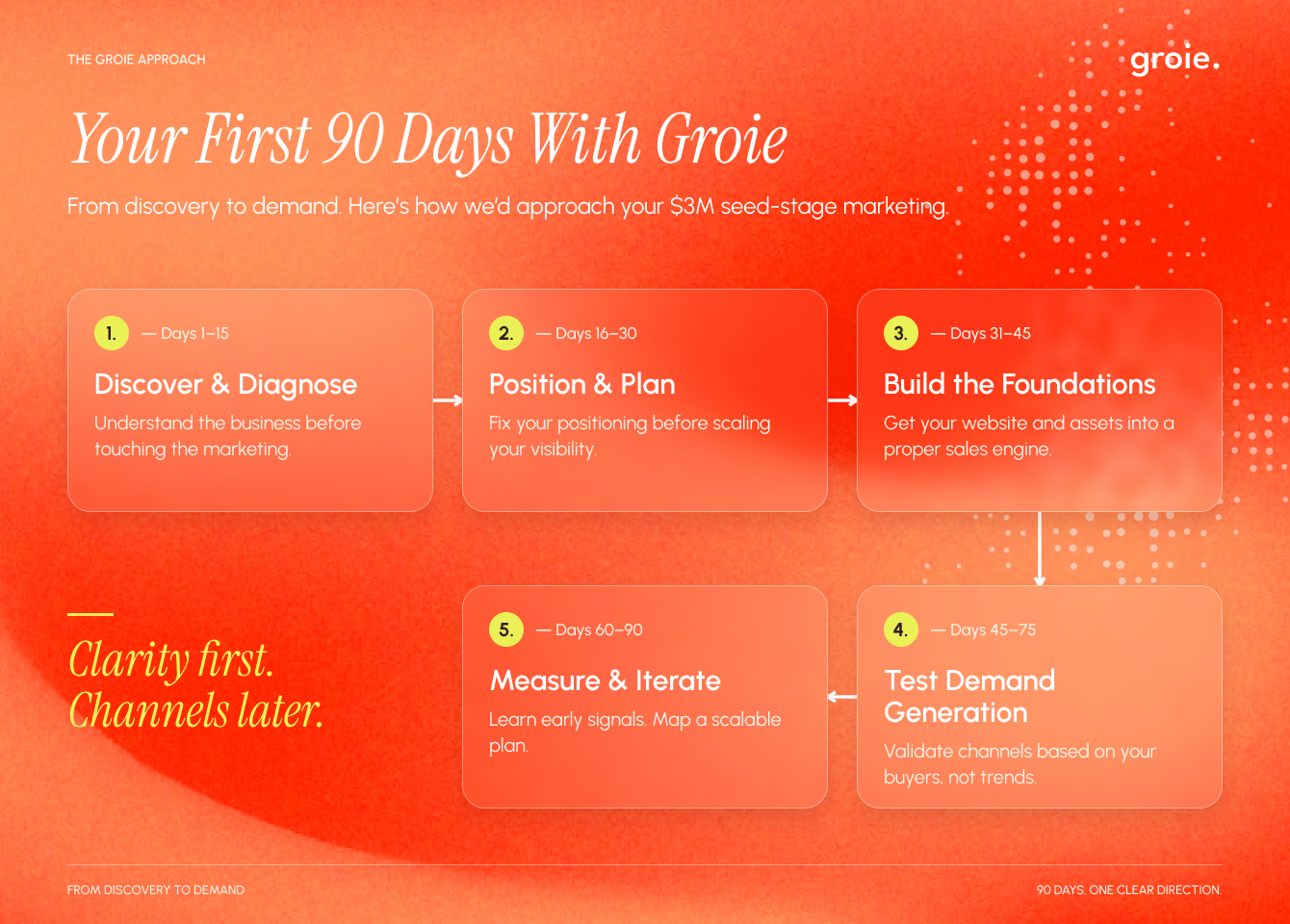
Days 1–15: We'd Audit the Business Before Touching the Marketing
The first two weeks wouldn't be spent designing LinkedIn carousels or publishing blogs. We'd get into the business. We know as a founder you’d get impatient, and keep on pinging “hey, so what are we doing this week?”, but have some patience.
1. We'd sit with the founders and understand the product.
It’s not going to be like those 30-minute demos. We'd want to understand the product architecture, use cases, current capabilities, roadmap, onboarding experience, pricing, and the specific problem the product solves better than the alternatives.
We'd ask questions like:
- What problem originally led you to build this product?
- Who were your first ten paying customers?
- What made them buy?
- Which features get demonstrated most frequently?
- Which features actually influence the purchase decision?
- What do customers misunderstand before seeing the product?
- What can your competitors do that you can't, and vice versa?
One of our favorite questions would be: "If I took away your product name and logo, could a buyer distinguish your website from your three closest competitors?"
If the answer is no, that's a positioning problem we need to solve before spending heavily on acquisition.
2. We'd get into your CRM and sales conversations.
This is where the interesting information usually lives.
- We'd request access to your CRM, historical pipeline, closed-won and closed-lost opportunities, lead sources, demo recordings, and sales notes.
- Then we'd look for patterns. Imagine your CRM has 40 closed-won deals. You initially thought your ICP was mid-market operations teams across several industries. But 26 of those customers are in two industries. Most of the larger contracts came through referrals. And the shortest sales cycles involve companies using a specific competing solution.
- That changes the marketing conversation. Instead of targeting every operations team, we now have a hypothesis about where demand might be easier to capture.
- We'd validate it against deal size, retention, product usage, and market potential before narrowing the ICP.
Your best-performing customer segment should influence your marketing strategy more than the market category you wrote into your pitch deck.
3. We'd audit every existing marketing and conversion asset.
Even if you haven't invested much in marketing, there's usually something to work with.
We'd examine:
And we'd establish a baseline before making changes.
- If your website gets 2,000 monthly visits and generates 12 demos, we need to understand whether the issue is traffic quality, website conversion, or something else.
- If your CRM shows 50 marketing-qualified leads but sales accepts only six, increasing MQL volume probably isn't the first priority.
- If your product page gets traffic but visitors rarely reach the demo CTA, we'd investigate the messaging, page structure, and buyer journey.
We wouldn't automatically prescribe SEO, paid ads, or a website redesign. We'd diagnose where the business is losing opportunities before deciding where to invest.
What you'd have by Day 15
A documented marketing baseline, initial ICP hypotheses, positioning gaps, a conversion and tracking audit, competitive observations, and a prioritized list of problems worth solving.
It’s not going to be like those 70-slide PPT audits that nobody opens again. A working diagnosis that tells us what to do next.
Days 16–30: We'd Fix Your Positioning Before Scaling Your Visibility
Let's say your homepage currently says: "An all-in-one AI-powered platform transforming business workflows." Congratulations. You sound like several thousand other SaaS companies.
Your product might be excellent. But the messaging isn't helping buyers understand why they should care. We'd spend the next phase answering four questions.
Who exactly is this for? Not "SMBs and enterprises."
- We'd identify the industries, company sizes, buyer roles, triggers, existing workflows, and problems associated with your strongest opportunities
- We'd distinguish between the person using the product, the person championing it, and the person approving the purchase.
What problem are they trying to solve? Buyers rarely wake up wanting another SaaS subscription. They want to reduce manual work, avoid risk, improve revenue, control costs, or solve a frustrating operational problem. We'd map the business problem to the product's actual capabilities.
Why should they choose you? We'd examine competitive alternatives, including spreadsheets, manual processes, internal tools, and established vendors. Your biggest competitor might not be another startup. It might be the process your buyer is already comfortable using.
Why should they act now? We'd identify the events that create buying urgency. A compliance deadline, new funding round, growing team, system migration, maybe a failed audit or an expansion into another market. These triggers can be more useful for acquisition than broad industry targeting.
We'd turn this into a messaging system.
This is also where we'd establish a clear SaaS positioning strategy for seed-stage companies, so the product's differentiation, target buyers, and value proposition remain consistent across the website, campaigns, and sales conversations.
That means creating:
- A clear positioning statement and differentiated value proposition.
- Primary and secondary ICP definitions.
- Buyer and stakeholder messaging.
- Use-case narratives tied to specific business problems.
- Competitor and alternative messaging.
- A messaging hierarchy for the website, campaigns, and sales collateral.
- Initial sales objection and proof-point frameworks.
We'd also develop and refine B2B SaaS messaging by testing the strongest messages against real customer language and sales feedback. Because a positioning document isn't successful just because everyone internally approves it. It's successful when buyers understand the product faster and sales can explain its value more consistently.
Days 31–45: We'd Turn Your Website Into a Proper Sales Asset
Now we'll look at your website. And no, our first recommendation wouldn't automatically be a complete redesign. If the site is technically sound, easy to navigate, and reasonably fast, we'd rather improve the messaging and conversion paths than spend weeks rebuilding something that already works.
But if the website is organized around product features instead of buyer problems, we'd change that.
A typical seed-stage SaaS website might have: Home → Features → Pricing → Blog → Contact
There's nothing inherently wrong with that structure. But it may not be enough for a product serving multiple buyer roles, industries, or use cases.
Depending on what discovery reveals, we might introduce:
- Product pages: Explain what the product does, how it works, and why its capabilities matter
- Use-case pages: Connect the product to specific workflows or business problems
- Industry pages: Address the requirements and buying considerations of relevant verticals
- Comparison pages: Help buyers evaluate alternatives when there is legitimate comparison demand
- Integration pages: Explain how the product fits into the tools buyers already use
- Proof pages: Customer stories, quantified results, implementation examples, and security information where relevant.
We'd also inspect the demo journey. What happens when someone clicks "Book a Demo"?
Is the form asking for too much information? Is the scheduling experience straightforward? Is the lead routed correctly? Do sales receive enough context? What happens if the prospect doesn't book?
A good website isn't just a collection of pages. It's the part of your sales process that works before a salesperson gets involved. And we'd treat it accordingly.
Days 30–60: We'd Build Your Search Strategy Around Buying Intent, Not Blog Volume
This is where a lot of early-stage SaaS marketing goes wrong.
- A company hires an SEO agency and then they identify 100 keywords, and a content calendar appears. Four blogs go live every month.
- Six months later, organic traffic has increased, but nobody can explain whether it contributed to the pipeline.
We are going to do those things though. Having a content calendar, with identified keywords that puts you in the content population and distribution category is the healthiest way to go. But, first, we'd map how your buyers discover and evaluate solutions. That usually means separating search opportunities into different intent groups.
These are illustrative search topics, not validated keywords. We'd evaluate demand, competition, relevance, and the likelihood that the searcher could become a customer. Then we'd prioritize the pages most closely connected to the product and buying journey.
And we'd build for AI search from the beginning.
We wouldn't treat AEO as a separate exercise where we add a few FAQs and hope ChatGPT starts recommending the product. We'd work on making the company and product easier for search engines and AI systems to discover, interpret, and reference.
That includes clear product descriptions, consistent terminology, crawlable pages, useful comparison information, structured data where appropriate, authoritative supporting content, and credible third-party references. We'd monitor relevant prompts and citations to understand where the product appears and where competitors are better represented. But we wouldn't promise inclusion in AI-generated answers. No agency controls that.
Our objective would be to make the product discoverable wherever buyers research, without confusing visibility with revenue.
Days 45–75: We'd Start Testing Demand Generation
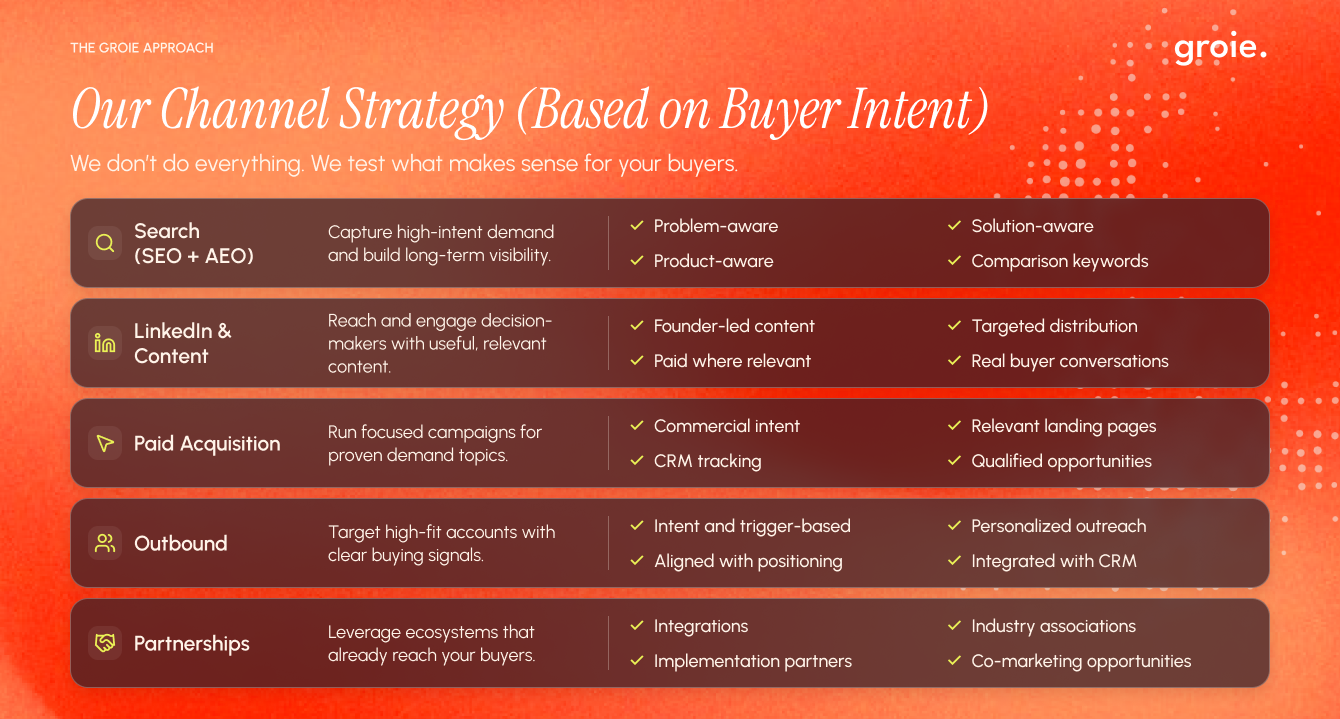
By this point, we should know more about your buyer, your positioning, your website, and the opportunities in your existing funnel.
Now we can start testing acquisition channels. Not all of them. Not at once. We'd select channels based on buyer behavior and evidence.
Paid search, if there's existing demand.
If buyers actively search for the category or problem your product solves, Google Search could be a sensible starting point.
- We'd build tightly focused campaigns around commercial intent, connect them to relevant landing pages, and track the journey through the CRM
- We wouldn't start by bidding on every broad keyword in your category
- And we wouldn't call a campaign successful simply because it generated cheap leads. We'd want to know whether those leads became qualified opportunities.
LinkedIn, if your buyers are identifiable.
For a niche B2B SaaS company, LinkedIn might be more useful for targeted distribution, founder-led content, and account engagement than broad lead generation. We'd build a content strategy around actual buyer questions, product insights, market observations, customer objections, and founder expertise.
Not daily motivational posts about entrepreneurship. We'd also test paid distribution selectively where the audience and economics justify it.
Outbound, if we can identify strong buying signals.
For some products, waiting for inbound demand isn't the smartest early move. If we know which companies are hiring relevant roles, implementing certain technologies, expanding operations, or experiencing specific triggers, we can build targeted outreach around those signals.
But we'd align the outreach with positioning, landing pages, sales collateral, and CRM tracking. Otherwise, you're simply generating more disconnected activity.
Partnerships, if the buyer ecosystem supports them.
Sometimes the most efficient acquisition channel isn't paid advertising. It could be an integration partner, industry association, implementation consultant, or technology ecosystem that already has access to your buyers.
We'd investigate that before committing the entire acquisition budget to ads. The goal of the first channel experiments isn't to prove that every channel works. It's to discover which ones deserve more investment.
Days 60–90: We'd Build the CRM and Nurture System Around the Sales Cycle
Imagine you've started generating demo requests, content downloads, and inquiries.
Now what? If every lead receives the same generic email sequence, you're probably missing important differences in buying intent. Someone comparing vendors needs different information from someone who just discovered the problem.
A CFO evaluating financial risk has different concerns from an operations manager who will use the product every day. We'd map the lifecycle stages and build nurture around those differences.
For example:
A high-intent demo request: Fast routing to sales, contextual follow-up, relevant product information, and clear ownership.
An early-stage content lead: Educational follow-up, relevant use cases, and opportunities to progress toward a product conversation.
A closed-lost opportunity: Re-engagement based on the original objection, product changes, or a relevant buying trigger.
An open opportunity: Case studies, objection-handling content, security documentation, and other assets that support the sales conversation.
We'd also establish reporting that connects marketing activity to commercial outcomes. We'd track qualified leads, lead-to-opportunity conversion, pipeline source, sales cycle, and opportunity progression where the data is reliable. For a company with a longer sales cycle, we'd use leading indicators while being clear that they aren't substitutes for revenue. And we'd make sure the attribution model reflects reality.
A buyer might discover your company through LinkedIn, research it on Google, read a comparison page, and eventually book a demo directly. Last-click attribution alone won't tell that whole story.
What Would We Actually Spend?
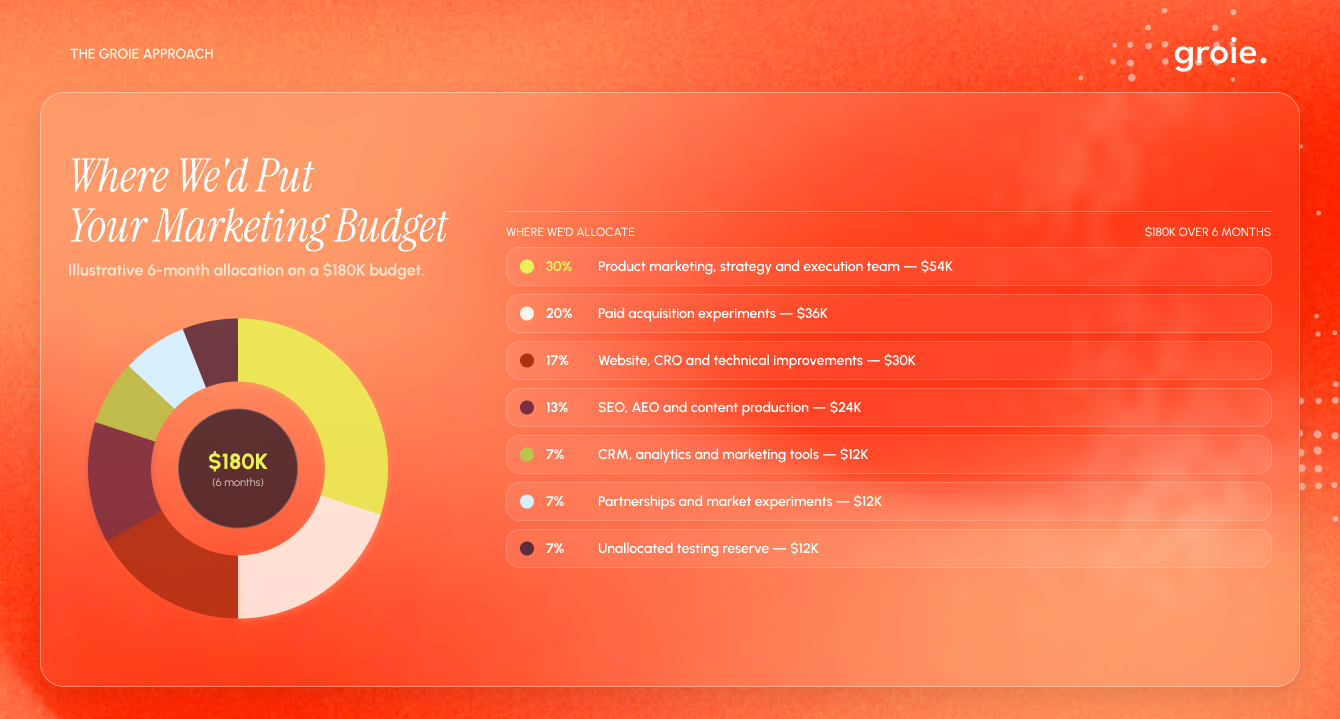
Let's talk about $3M.
We wouldn't recommend allocating a fixed percentage of the entire funding round to marketing without understanding your runway, growth targets, sales economics, and hiring plan. Your $3M needs to fund product development, engineering, operations, customer success, and whatever else the business requires. So instead of treating the funding round as permission to spend, we'd build a marketing investment model around the company's actual needs.
For illustration, suppose the business has approved a $180,000 marketing budget for the first six months.
That's $30,000 per month on average. Here's one way we'd initially plan that allocation.
This is a planning example, not a recommended spend for every seed-stage company. The categories may overlap depending on whether work is handled internally, by specialists, or through an embedded team. And we wouldn't necessarily spend it evenly.
- If paid search proves expensive and low-quality, we'd reduce that investment
- If a particular use-case page starts generating strong opportunities, we'd prioritize related pages and distribution
- If outbound uncovers a promising segment, we'd invest more in understanding and reaching that segment.
A budget is a hypothesis about where growth might come from. The data should determine how that budget evolves.
What Would We Deliberately Not Do?
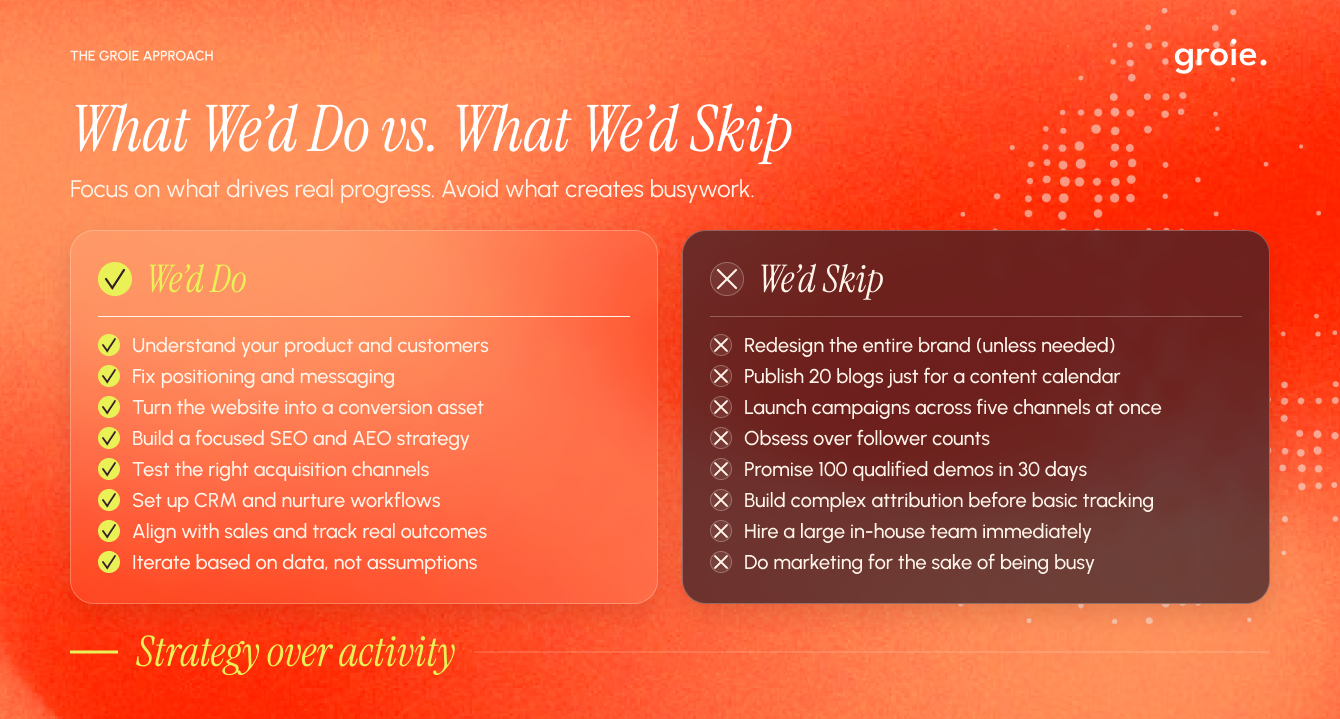
Here's what we'd probably push back on during the first 90 days.
We wouldn't immediately redesign the entire brand. Not unless brand clarity or credibility is genuinely restricting growth.
We wouldn't publish 20 blogs just to establish a content calendar. We'd rather build a smaller number of commercially relevant assets.
We wouldn't launch campaigns across five channels simultaneously. Early-stage teams need interpretable experiments, not a reporting dashboard full of disconnected metrics.
We wouldn't obsess over follower counts. We'd care more about whether the right people are engaging and progressing toward a buying conversation.
We wouldn't promise 100 qualified demos in 30 days. We'd first establish what qualified means and whether the available demand, budget, and sales capacity support that target.
We wouldn't build an elaborate attribution system before fixing basic tracking. Reliable CRM stages and source data come first.
And importantly, we wouldn't assume the company needs every marketing service Groie offers. The scope should follow the business problem, not the agency's service menu.
By Day 90, Here's What We'd Want in Place

We wouldn't expect every acquisition channel to be profitable or every positioning hypothesis to be proven in three months. Especially if the product has a six-month sales cycle.
But we'd expect the business to be considerably more organized about how it approaches growth.
Some initiatives, particularly website rebuilds, organic search, and longer sales-cycle experiments, would continue beyond Day 90. But the company should no longer be guessing what its marketing team is supposed to do.
Months 4–6: We'd Stop Treating Every Marketing Channel Equally
This is where we'd start separating promising signals from activities that simply look productive. By now, we should have some evidence about which audiences respond, which messages generate interest, which pages attract relevant visitors, and which acquisition channels create meaningful sales conversations.
We'd review that evidence against the initial hypotheses.
- Let's say one industry-specific landing page is generating fewer visitors than the homepage but substantially more qualified demo requests. That's worth investigating.
- Or perhaps a paid campaign is generating plenty of form submissions, but almost none of those leads fit the ICP. That campaign doesn't deserve more budget just because its cost per lead looks attractive.
- Maybe founder-led content is consistently reaching decision-makers but isn't producing directly attributable demos yet.
- We wouldn't automatically shut it down. We'd evaluate its role in the buying journey, distribution quality, and supporting sales activity.
Our decisions would fall into four categories:
Scale: Channels, segments, and messages showing credible commercial traction.
Improve: Activities with relevant demand but weak conversion or execution.
Pause: Experiments that haven't justified continued investment.
Build next: New opportunities identified through customer, sales, and campaign data.
By the end of six months, the company should have a clearer understanding of its marketing economics, stronger buyer messaging, more useful acquisition infrastructure, and a practical plan for the next stage. Not necessarily a fully predictable growth engine. But a much better foundation for building one.
And What Would Groie Actually Own?
If this were a Groie engagement, we wouldn't hand over the strategy and leave the founder to coordinate six different freelancers. We'd establish clear ownership across product marketing, website and conversion work, search, content, demand generation, and reporting, depending on the agreed scope.
The founders and internal team would remain involved in product decisions, customer insights, commercial priorities, and approvals. Groie would take responsibility for the marketing work we commit to delivering, including the thinking, coordination, and execution behind it. That's the difference between buying a collection of marketing deliverables and having an embedded marketing partner.
And it's why we evaluate business fit before accepting a new member.
You Raised $3M. Your Marketing Shouldn't Start With a Shopping List.
A funding round creates an opportunity to invest in growth. It doesn't automatically tell you which marketing activities will create that growth.
- You might need positioning before paid acquisition
- You might need a better website before more traffic
- You might need stronger sales enablement before generating additional leads
- Or you might already have those foundations and be ready to invest in distribution.
The right marketing strategy isn't determined by how much you've raised. It's determined by what your business needs to prove next. That's how we'd approach your first 90 days.
We'd understand the product, study the buyers, inspect the funnel, identify the constraints, build the foundations, and start testing where growth might come from. Then we'd let the evidence guide the next investment. Because the objective isn't to make your newly funded SaaS company look busy with marketing. It's to build a marketing function that can eventually justify its place on the balance sheet.
That's what Groie would do.
Raised your seed round? Meet Groie Residency.
Groie is a B2B SaaS product marketing studio working with a limited roster of 25 companies a year.
Our Groie Residency membership is designed for pre-seed to pre-Series A SaaS companies that need an embedded marketing team without immediately building one in-house. Memberships start at $4,500/month, with engagements structured around your company's priorities.

Author
Aabha Tiwari
Founder, Groie.