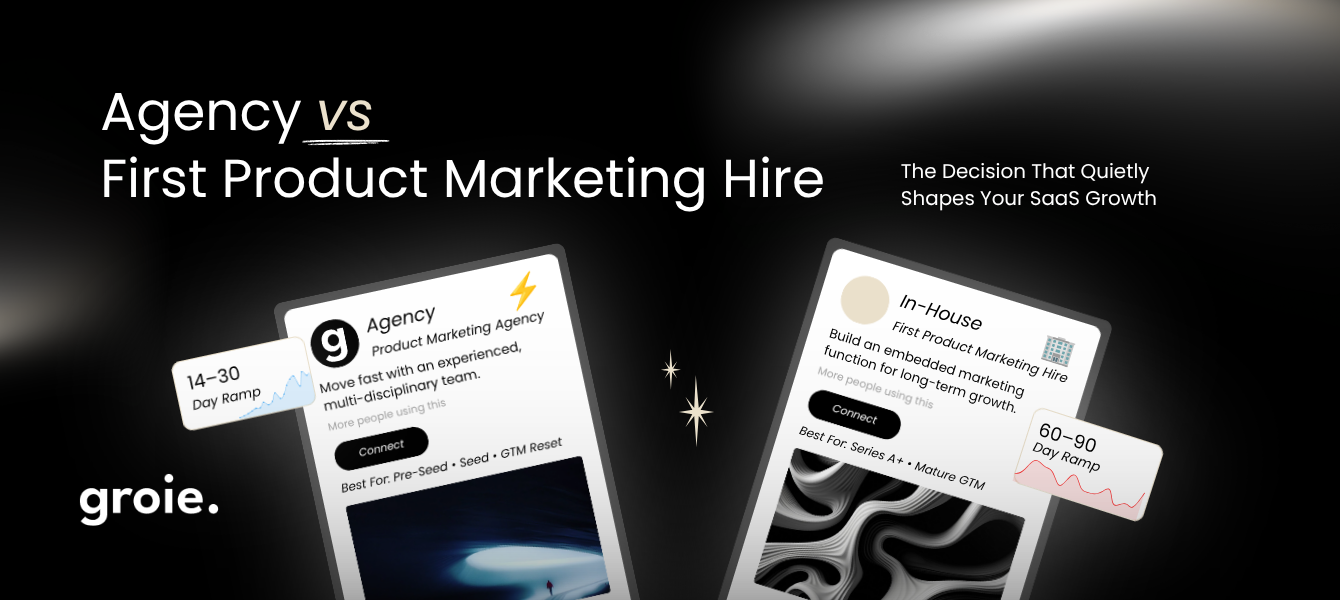
Agency vs First Product Marketing Hire: The Decision That Quietly Shapes Your SaaS Growth
You have product traction. You have a seed round in the bank. The natural next step, every founder is told, is to hire a head of marketing or a product marketing manager. The job description gets written, the LinkedIn post goes up, and the search begins. Three months later, the role is still open, two candidates have ghosted, and the one who accepted needs another two quarters to ramp up. Meanwhile, the pipeline is flat.
There is another path that founders consider seriously about half as often as they should: bringing in a saas product marketing agency or a product marketing consultant saas team that can move in 30 days, not 30 weeks. The decision between these two paths is one of the most consequential calls a post-seed founder makes, and most founders make it on instinct rather than on the underlying math. This article lays out what each option actually delivers, what each one costs at a relative level, and which signals point to which decision.
The hidden decision: most founders pick the wrong option without knowing it
The default mental model goes like this. Agencies are for big companies. Hires are for serious companies. So a Series A founder defaults to hiring, often before the GTM is defined, and often before there is anything for a PMM to execute against.
The result is predictable. The new hire spends their first 90 days trying to figure out positioning, segmentation, and which channels matter. By the time they have a plan, six months have passed, two quarters of payroll have been spent, and the company is roughly where it was when the hire started.
The reverse mistake is also common. A late-stage Series A company with a defined ICP, a working sales motion, and real marketing pipeline keeps stretching its agency relationship instead of bringing the function in house. The agency can execute, but cannot live inside daily product decisions, sales calls, and customer support tickets. Growth slows because the function is not embedded. Picking the right option at the right moment matters more than picking the more prestigious option.
What a first PMM hire actually delivers (and what they cannot)
A strong PMM brings things an agency rarely can. They sit in your standups. They hear sales calls in real time. They build relationships with product, engineering, and customer success that compound over years. They develop institutional memory about why decisions were made.
What they cannot do, especially as a first hire:
- Operate as a full team. One person cannot own positioning, content, paid ads, SEO, lifecycle, events, and sales enablement at once. They will pick two or three and the rest will stall.
- Ramp instantly. Even a senior PMM needs 60 to 90 days to absorb the company, the buyer, and the data.
- Replace a missing GTM. If the GTM strategy is undefined, a generalist marketing hire will fill the gap with tactics and produce uneven results.
A full-time senior PMM is also one of the higher-cost early SaaS hires. Once base salary, equity, benefits, and tooling are added together, the fully loaded first-year cost typically runs well into six figures, before output is measurable.
What a product marketing agency actually delivers (and what it cannot)
A focused outsourced product marketing service for growth stage saas brings the inverse of the hire. It compresses scope into 30 to 60 days because the team has already run the same playbook across many companies. The agency walks in with templates, working processes, a network of channel specialists, and pattern recognition from other SaaS clients.
What an agency delivers that a single hire usually cannot:
- Multi-disciplinary coverage. Positioning, messaging, web copy, SEO, paid, lifecycle, and sales enablement run in parallel from week one.
- Speed to first output. Working assets in 30 days instead of 90.
- Comparative benchmarks. The agency has seen what works for similar ICPs and price points.
What an agency cannot do:
- Sit inside daily product and sales conversations. Even an embedded agency lives one degree removed from internal context.
- Build long-term institutional memory. When the engagement ends, much of the tacit knowledge leaves.
- Replace a leader. An agency executes against direction. It cannot serve as the long-term head of marketing.
Comparison: Cost, ramp time, scope, accountability
When agency is the right call
If any of the following are true, the answer to when to hire an agency for saas marketing is probably "now":
- You are pre Series A and your GTM is still undefined.
- Founder-led marketing has hit its ceiling and pipeline is flat.
- You need positioning, messaging, and channel testing happening in parallel, not sequentially.
- You cannot afford a 6-month ramp before measurable output.
- Your current funnel is producing volume that does not convert, suggesting strategy gaps, not execution gaps.
This is the stage where outsourced product marketing typically pays back fastest. The agency compresses 9 months of solo PMM work into 60 days by running diagnosis, positioning, and execution in parallel.
It is also the stage where founders ask when is it too early to bring on a marketing partner for saas. The honest answer: it is rarely too early once you have a product in market and at least 10 paying customers. Before that, an agency cannot help you find product-market fit. After that, an agency can help you scale what is already working.
When a full-time PMM is the right call
By the time these signals show up, the answer to when should a series a saas startup hire outside marketing help has shifted toward "no, hire in house":
- Your ICP is defined and stable.
- You have a working sales motion with a documented playbook.
- Pipeline is producing predictable volume month over month.
- Product, sales, and customer success are coordinating tightly enough that a marketer needs to be in the room daily.
- The next 18 months of work is execution against a known strategy, not strategy itself.
This is the moment when the embedded value of a full-time hire compounds. The first marketing hire saas question at this stage is less "agency or hire" and more "PMM or generalist marketer." For B2B SaaS at this stage, a PMM is almost always the higher-leverage hire because positioning and sales enablement drive more revenue than broad channel execution.
The hybrid play: agency-led, in-house-owned within 12 months
The most effective pattern across post-seed SaaS companies is not "agency or hire." It is "agency first, hire later."
Here is how it typically runs.
Months 1 to 3: An agency runs the GTM reset. Positioning, ICP narrowing, messaging, channel mix, and the first wave of content and sales enablement output.
Months 4 to 9: The agency continues execution while the company runs a deliberate PMM search. The agency operates as the de facto marketing function so the founder is not under hiring pressure and can wait for the right candidate.
Months 10 to 12: The first PMM joins. They inherit a documented GTM, working channels, and a backlog of assets. Their ramp is 30 days instead of 90, because the strategy work is already done. The agency rolls off or shifts into a supporting role for specialized work like paid media or technical SEO.
This is the model Groie was built around. The Groie Launch Sprint is a 60-day engagement at $9,000 that produces the GTM foundation, positioning, and first wave of execution. Groie Core operates as the fractional product marketing team at $4,000 per month for the months between the sprint and the eventual in-house hire. By the time the SaaS company is ready for its first PMM, the work that PMM walks into is documented, tested, and producing. The hybrid model lowers risk on both sides. The company does not absorb the full payroll burden of an undefined role. The eventual PMM does not inherit a 90-day diagnostic problem.
FAQs
1. When should a Series A SaaS startup hire outside marketing help?
The moment pipeline stops responding to founder effort, or the moment marketing volume is not converting to revenue. Most Series A teams benefit from agency or consultant support before bringing in a full-time hire, because it surfaces the GTM gaps that a solo hire would need to diagnose alone over six months.
2. Is it too early to hire a product marketing agency at seed stage?
Only if you do not yet have a product in market or your first 10 paying customers. Before that, the work is product-market fit discovery, which sits with the founder. After that, an agency can compress positioning, messaging, and channel testing in ways a single hire cannot.
3. What is the difference between a PMM and a SaaS product marketing agency?
A PMM is one person embedded full time in your company who builds institutional knowledge over years. A product marketing agency is a multi-discipline team that brings comparative experience and faster execution, but lives one degree removed from your daily product and sales context. The PMM offers depth. The agency offers breadth and speed.
4. How much does a SaaS product marketing agency cost vs a full-time PMM?
A first-year PMM is a fully loaded six-figure commitment once base salary, equity, benefits, and tooling are factored in. A specialized SaaS product marketing agency typically costs a meaningful fraction of that on retainer, depending on scope. The agency also carries no hiring risk, no severance liability, and produces output in weeks instead of quarters.
5. Should the first marketing hire at a SaaS startup be a PMM or a generalist?
For B2B SaaS post-seed, a PMM is almost always the higher-leverage hire. Positioning, messaging, sales enablement, and competitive intelligence drive more revenue at that stage than broad channel execution. A generalist marketer fills a gap that an agency can fill at lower risk for less money.
6. Can a product marketing agency replace an in-house team long-term?
For most SaaS companies, no. Agencies are designed for compressed strategy and execution windows or for supplementing specialized capability. Past Series B, when product velocity is high and cross-functional coordination is constant, the in-house team becomes essential. The strongest model is agency-led to start, in-house-owned within 12 months.

Author
Aabha Tiwari
Founder, Groie.



.png)