.png)
.png)
.png)



.png)


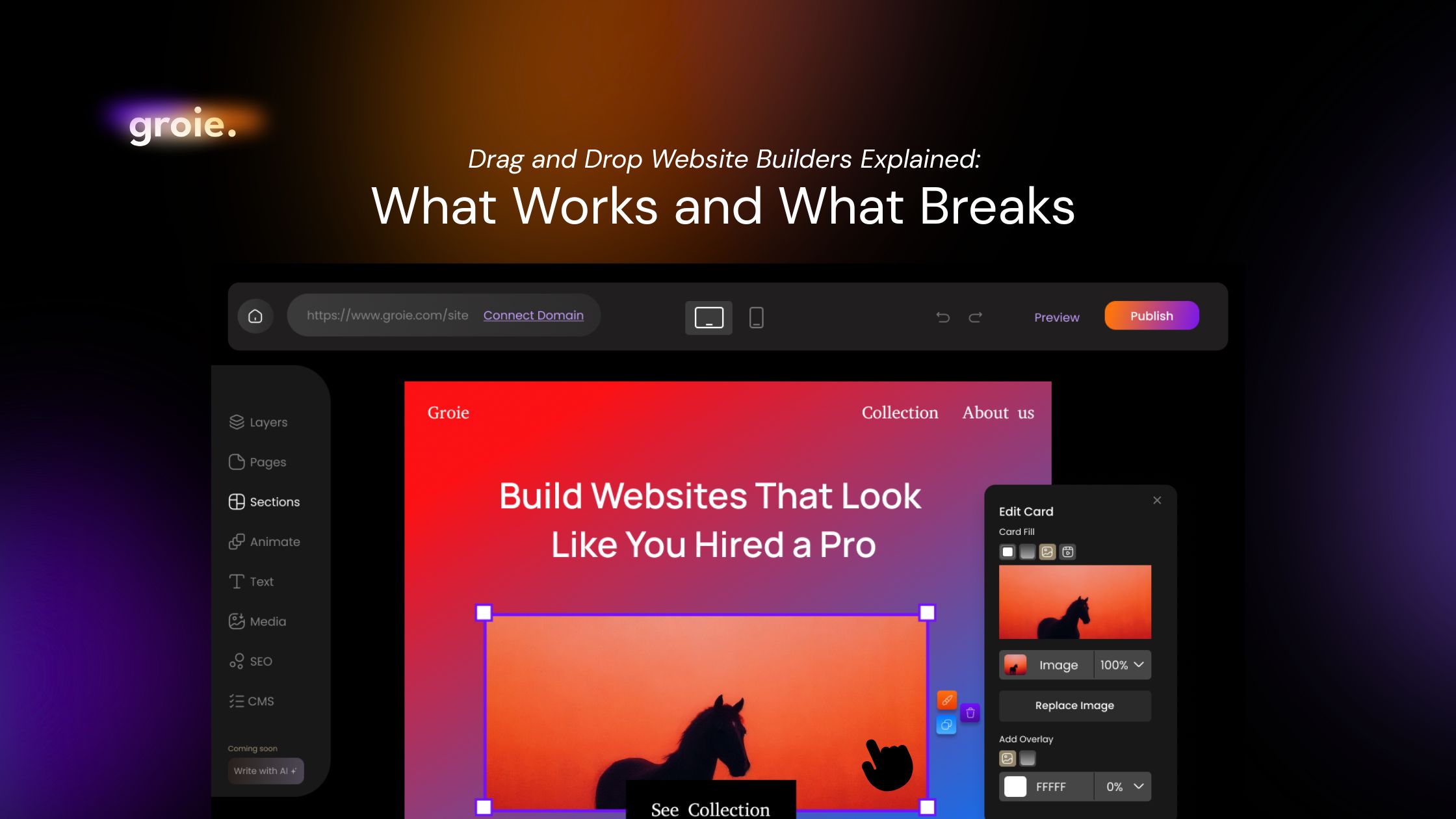
Drag and Drop Website Builders Explained: What Works and What Breaks
Most founders launching a new SaaS product face the same decision. How do we build our website quickly without hiring engineers?
Today there are two dominant approaches. Prompt based AI website builders that generate pages automatically. And the classic drag and drop website builder that allows teams to visually build pages themselves. At first glance both seem similar. Both promise speed. Both claim you can launch a website in minutes. But once you start scaling traffic, running SEO, or testing messaging, the differences become obvious.
Some builders help you publish pages. Very few help you build a website that actually drives growth. This guide explains how drag and drop builders work, where they outperform prompt based tools, and where both approaches often break for SaaS companies.
What Is a Drag and Drop Website Builder
A drag and drop website builder allows users to create web pages visually by placing elements on a page instead of writing code.
You can drag components such as:
text blocks
product sections
forms
images
pricing tables
testimonials
and arrange them exactly where you want them.
Instead of describing the website in prompts, you directly control the structure of the page. This visual control is the core difference between drag and drop builders and prompt based website tools. Prompt builders generate layouts automatically. Drag and drop builders let teams design the structure intentionally. For SaaS founders who care about messaging, positioning, and conversion flows, that difference matters more than most people realize.
Why Prompt Based Website Builders Became Popular
Prompt based website builders exploded because they promised something irresistible.
Type a prompt.
Get a website.
For founders trying to launch quickly, this feels magical.
Within minutes the tool can generate:
a homepage
product pages
copy blocks
images
basic layouts
But the problem becomes clear once you start editing the site. Prompt generated websites often create generic structures that are difficult to refine. Most SaaS teams eventually want to control things like:
product storytelling
feature hierarchy
pricing logic
SEO structure
content hubs
Prompt builders struggle with this level of control because the layout is generated rather than designed. This is why many teams eventually move back toward drag and drop builders / or traditional website development, once the product matures.
What Drag and Drop Website Builders Do Better
A good drag drop website builder solves several problems that prompt based builders cannot.
- Precise control over messaging
SaaS websites rely heavily on positioning. Founders need control over:
feature hierarchy
product explanation flows
comparison sections
integration blocks
Drag and drop builders allow teams to structure pages intentionally instead of relying on auto generated layouts.
- Better experimentation
Growth teams constantly test changes.
headlines
product explanations
pricing layouts
call to action placement
With an easy drag and drop website builder, marketers can iterate quickly without waiting for developers or rewriting prompts repeatedly.
Predictable page structure
Prompt based tools regenerate layouts each time. Drag and drop builders maintain consistent page structure.
This stability matters for:
SEO
analytics tracking
conversion testing
Where Most Drag and Drop Builders Still Break
Even though drag and drop builders are more flexible than prompt tools, many still fail SaaS teams in critical areas.
- SEO infrastructure
Many builders allow you to publish pages but do not provide a strong SEO framework.
Common issues include:
poor page hierarchy
weak internal linking systems
limited schema control
fragmented analytics visibility
For SaaS companies relying on inbound traffic, these limitations become serious obstacles.
- Fragmented growth stack
Most builders require external tools to understand website performance. Teams often end up combining:
Google Analytics
SEO monitoring tools
indexing tools
form tools
CRM systems
Instead of a unified growth workflow, founders manage multiple disconnected systems.
- Content scalability
As SaaS companies grow, their websites expand.
Documentation
feature libraries
comparison pages
SEO content hubs
Many drag and drop builders struggle with large content ecosystems. What started as a simple website becomes difficult to maintain as content grows.
Is Drag and Drop Good for Business Websites
For many businesses the answer is yes. An easy drag and drop website builder works well for:
service businesses
agencies
local companies
portfolio websites
But SaaS websites have very different requirements.
They must support:
product education
SEO driven traffic
conversion funnels
continuous content expansion
A builder that focuses only on visual design often falls short when the website becomes a core growth channel.
Are Drag and Drop Builders Scalable
They are scalable to a point.
Most SaaS startups successfully use drag and drop builders during early stages when the focus is speed.
But once the website becomes a growth engine, teams begin needing deeper infrastructure.
Things like:
SEO visibility
structured content systems
traffic analytics tied to pages
indexing monitoring
conversion tracking
This is where the difference between page builders and growth platforms becomes important.
The Real Problem With Website Builders Today
Most builders optimize for one thing. Publishing pages. But founders do not actually care about publishing pages. They care about getting traffic and leads. That requires much more than visual editing.
It requires:
SEO structure
Content discoverability
Analytics visibility
Growth workflows
Prompt based builders struggle with structure. Traditional drag and drop builders struggle with growth infrastructure. The next generation of builders will likely combine both visual flexibility and built in visibility systems.
Final Thoughts
A drag and drop website builder remains one of the fastest ways for SaaS founders to launch a website. It provides control, flexibility, and speed that prompt based builders often lack. But founders should recognize the difference between building pages and building growth infrastructure. A website that simply exists online is not enough. The real goal is a website that can be discovered, measured, and continuously improved. That is where the future of website builders is heading.
FAQs
What is a drag and drop website builder?
A drag and drop website builder is a visual platform that allows users to build websites by placing elements like text, images, and forms directly onto a page without writing code.
Are drag and drop builders scalable?
They are scalable for early stage websites, but many platforms struggle with SEO infrastructure, large content systems, and advanced growth analytics.
What are limitations of drag and drop builders?
Limitations often include weak SEO frameworks, limited control over indexing and schema, performance issues, and reliance on external growth tools.
Is drag and drop good for business websites?
Yes. Drag and drop builders work well for many business websites, especially when teams need to launch quickly without technical resources.
When should teams move away from drag and drop?
Teams usually reconsider their builder when website growth depends heavily on SEO traffic, structured content systems, and deeper analytics integration.

Author
Anwesha Roy
After spending nearly a decade in B2B space, as a founding partner in Groie, we help early stage SaaS startups with their GTM. Groie is built keeping in mind, what SaaS founders need, and we do exactly that.
