
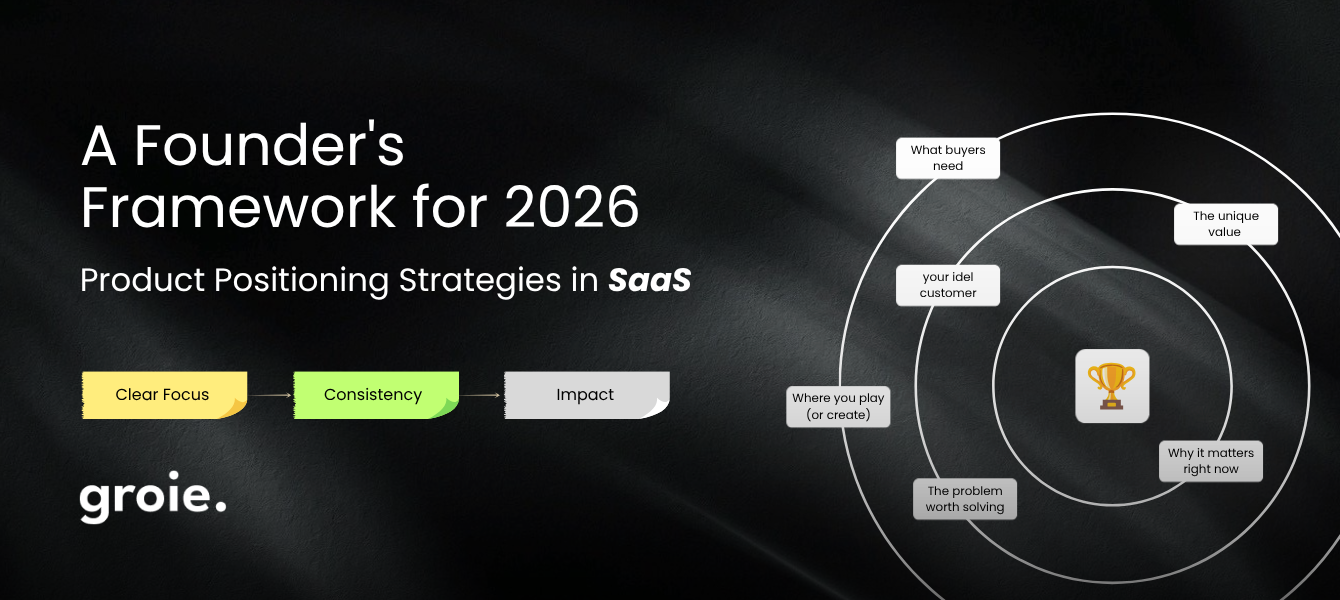
Product Positioning Strategies in SaaS: What You Should Be Doing in 2026
Your product works. Your team knows it works. Then a prospect lands on your homepage, skims the deck, or sits through a demo, and you watch the moment they fail to get it. In B2B SaaS that moment usually happens inside the first ten seconds, and once it passes, most buyers are gone.
That is a positioning problem wearing the costume of a product problem. The build is fine. What is missing is a clear answer to the question every buyer runs silently why this, for me, over everything else I could do instead.
Heading into 2026, the market is more crowded than ever. AI tools ship new products weekly, buyers pattern-match faster, and they trust vendors less. The strongest product positioning strategies in SaaS now treat positioning as the path to product-market fit rather than a polish job you tackle after it. This is a founder's framework for getting there.
What product positioning means in SaaS
Positioning is the strategic decision about where your product sits in a buyer's mind: who it is for, what it competes against, and why it wins for that buyer. It answers "why this product, for me, over the alternatives" and holds that answer steady across every place a buyer meets you.
Getting SaaS product positioning right starts with separating three things founders tend to collapse into one. Positioning is the strategy. Messaging is how you say it, the words and proof points that carry the position into every channel. Branding is how it feels, the name, look, and tone that make you recognizable. Positioning comes first and drives the other two. Polished b2b saas messaging sitting on top of muddy positioning still leaves the buyer confused, because clean words cannot rescue an unclear idea.
The practical test is consistency. When your homepage, deck, and outbound all answer the buyer's question the same way, positioning is doing its job. When those answers drift apart, you are paying to confuse people.
The 4 positioning archetypes SaaS founders pick from
Most SaaS positioning lands in one of four archetypes. Each makes a different bet about the mental model your buyer already has.
- Category creation: you name a new problem category and teach the market to want it. Drift did this with conversational marketing, Gainsight with customer success.
- Category challenger: you enter an established category and position as the sharper version of it. Linear took this route against legacy issue trackers.
- Niche dominance: you win a vertical or a specific use case completely before expanding. Toast built for restaurants, Veeva for life sciences.
- Bundle disruption: you replace two or three point tools with one surface. Rippling does this across HR, IT, and payroll.
Picking the wrong archetype is where a lot of early SaaS product positioning goes sideways. Each one gets its own section below.
Strategy 1: Category creation
Category creation means the existing labels do not describe what you do, so you define a new one and put real effort into teaching buyers why it matters. HubSpot naming inbound marketing is the textbook case. When it works, you own the category you built, and competitors arrive late and on your terms.
It works when the shift is real and the timing is right. You need a genuine change in how work gets done, a buyer who already feels the pain of the old way, and enough capital to fund years of education before the category pays back. Snowflake had all three when it framed the data cloud.
It fails more often than founders expect. If buyers already carry a mental model that fits you, inventing a new category asks them to do extra work, and most will not bother. Teaching a market is slow and expensive, and plenty of seed-stage teams run out of runway mid-lesson. When in doubt, enter an existing category first and grow into your own once you have proof.
Strategy 2: Category challenger, the sharper "better X"
Here you accept the category the buyer already knows and win by being clearly better along an axis they care about. The buyer understands what an issue tracker or an email client is, so you skip the education and compete on execution. Linear positioned against heavyweight issue trackers by owning speed and craft. Superhuman owned raw velocity in email. Figma made real-time collaboration native to the browser in design.
The trap is vague superiority. "Better" with no named axis reads as marketing noise, because every competitor claims it too. You have to pick the dimension you win on, prove it, and be honest about the ones you are conceding. The moment your "better X" tries to beat the incumbent at everything, it stops being a position and turns back into a feature list.
Strategy 3: Niche dominance
Niche dominance means you pick a vertical or a single sharp use case and win it so completely that buyers in that segment treat you as the default. Toast went deep on restaurants, Procore on construction, Veeva on life sciences. Each built product, language, and go-to-market around one world instead of chasing the general market early.
The advantage is leverage. When you speak to one segment, your homepage, your content, and your sales calls all sharpen, because you are naming a buyer in a situation you understand cold. Word of mouth compounds inside a tight community, and a focused b2b positioning agency or in-house team can point every asset at the same buyer.
The risk is picking a niche too small to grow into, or staying boxed in after you have won it. The strongest version treats the wedge as an entry point with a credible expansion path, so it becomes the base for the next segment rather than the ceiling.
Strategy 4: Bundle disruption
Bundle disruption positions you as the replacement for a stack of two or three tools a buyer already pays for and stitches together by hand. Notion pitched itself as the single surface for docs, wikis, and lightweight project work. Rippling brought HR, IT, and payroll under one system. framed itself as a work operating system that absorbs the spreadsheets and point tools teams outgrow.
The pull is obvious. Buyers are tired of tool sprawl, duplicate data, and app-switching tax, so "one thing instead of three" is an easy story to follow. The execution is hard, because you have to be credible across every job you claim to absorb. If your version of two of those tools feels thin, the buyer keeps the incumbents and files you as an add-on. Bundle disruption works when consolidation genuinely serves the buyer, and it backfires when it only serves your pricing page.
The positioning canvas: a 6-question framework
Once you know your archetype, this canvas turns it into a working position. Answer all six in your buyer's language.
- Who is this for, precisely, and what situation are they in the moment they start looking for a fix?
- What do they use or do today instead, including doing nothing? Those are your real competitive alternatives.
- What can you do that those alternatives cannot, and can you prove it?
- What value does that capability create that the buyer already cares about, framed as outcomes rather than features?
- What market category do you want the buyer to file you under, so they know how to weigh you?
- Why now? What has changed in the market, the technology, or the buyer's world that makes this the moment?
When the six answers line up, your homepage headline, your outbound opener, and your sales narrative all write from the same source. This is the layer Groie, the Austin product marketing studio founded by Aabha Tiwari and Anwesha Roy, works on with founders before any go-to-market spend turns on. A messaging clarity agency SaaS founders bring in early is really buying these six answers, aligned and wired into every channel.
How to test if your positioning is actually working
Positioning is a claim about how buyers react, so you validate it in the market rather than a strategy doc. Three signals tell you whether it lands. First, buyer echo. Listen to how prospects describe you back on sales calls, in review sites, and in inbound notes. When they repeat your framing in roughly your own words, the position has transferred. When everyone describes you differently, it never left your building.
Second, cheaper conversion on the right buyer. Clear positioning shortens sales cycles with your ICP, lifts cold-outreach reply rates, and cuts the "we need to think about it" stalls and confused-buyer churn. You feel it as more qualified pipeline from the same spend.
Third, pull from the channels that matter now. One of the clearer saas messaging trends heading into 2026 is that buyers vet vendors through AI answer engines like Perplexity and ChatGPT alongside Google. If your value proposition fits into one clean sentence, those tools can quote you and your content earns citations. If it cannot, you stay invisible in the channel your buyers increasingly start in.
Founders who win at product positioning strategies in SaaS treat it as ongoing work: pick your archetype, answer the canvas honestly, and let the market tell you whether it landed. Great products deserve clear positioning. Book a strategy call with Groie to refine your messaging, sharpen your differentiation, and build a positioning strategy that drives growth.
FAQs
What is product positioning in SaaS?
Product positioning in SaaS is the strategic decision about where your product sits in a buyer's mind: who it is for, what it competes against, and why it wins for that buyer. It answers the question every prospect asks silently, "why this product, for me, over the alternatives," and holds that answer steady across your homepage, outreach, and sales conversations. It matters because buyers judge fast, and if they cannot find their own problem in your words, they move on no matter how good the product is.
What's the difference between positioning, messaging, and branding in B2B SaaS?
Positioning is the strategy: where you sit in the market, who you serve, and why you exist. Messaging is the execution, the words that carry that position into every channel. Branding is the identity, the name, look, and tone that make you recognizable. Positioning sets the direction, and both messaging and branding express it. Polished b2b saas messaging built on unclear positioning still leaves buyers confused.
How do you create a positioning strategy for an early-stage SaaS product?
Start with buyer research in the customer's own language, drawn from interviews, sales calls, and churned-customer conversations. Map the real alternatives your buyer weighs, including doing nothing. Pick the archetype that fits your market: category creation, challenger, niche dominance, or bundle disruption. Then work the six-question canvas until the answers line up, and wire the result into your homepage, deck, and outbound. Expect four to eight weeks to reach a validated, usable position rather than a document that sits unused.
Who should own product positioning at a SaaS startup, founder, PMM, or agency?
Early on, the founder owns the position, because it comes straight out of the market insight the company is built on. As you scale, a product marketer takes over the day-to-day of keeping messaging sharp and consistent. Many teams bring in a saas positioning agency or b2b positioning agency at the inflection points, a raise, a new segment, a repositioning, when they need outside buyer research without adding headcount. The trap to avoid is outsourcing the thinking entirely. A good saas brand positioning agency pulls the answers out of the founder and the market and builds them into your systems, instead of handing back a deck no one uses.
How do you test if SaaS positioning is working?
Watch three signals. Buyer echo: prospects describe you back in roughly your own words on calls and in reviews. Cheaper conversion: shorter sales cycles with your ICP, higher cold-email reply rates, and fewer stalls or "not what we expected" churn. Channel pull: your one-sentence value proposition gets quoted by AI answer engines and your content earns citations. If prospects describe you five different ways and pipeline stays expensive, the positioning has not landed yet.
Can you change SaaS positioning after launch without losing momentum?
Yes, and most growing companies have to. What landed at seed sounds thin by Series A as your ICP sharpens and the market moves. To reposition without whiplash, anchor to your current best-fit customers, roll the change through internal teams and sales enablement before the homepage, and keep the throughline that earned buyers' trust while you sharpen the rest. Treat positioning as a living system you revisit, and a shift reads as focus rather than a reset.
.png)
Author
Himani Bhuradia
A SaaS B2B growth expert with 7+ years of experience in high-impact lead generation and data-driven go-to-market strategies. Helps brands scale faster by aligning demand, positioning, and revenue-focused execution.
